Posts tagged Persian Gulf
Obama Has No Answer To Iran’s Firing On US Drone Over Persian Gulf
Nov 9th
This “incident” was purposely and willfully kept from the America people for a full week before the election and was not made public for a full 24 hours after the election. Obama can do nothing except by deceit, lies and cover-ups. And in typical Obama fashion, he refused to take action against his fellow Muslims. Just like at Fort Hood…just like in Benghazi…just like in Tunisia….
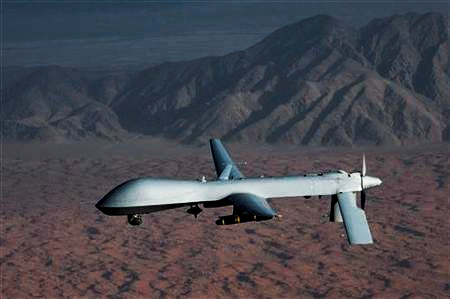
From Yahoo News: WASHINGTON (Reuters) – Iranian warplanes fired at an unarmed U.S. drone in international airspace last week but did not hit the aircraft, the Pentagon said on Thursday, disclosing details of an unprecedented incident that triggered a formal warning to Tehran through diplomatic channels.
The November 1 intercept was the first time Tehran had fired at an unmanned American aircraft, in a stark reminder of how tensions between the United States and Iran could escalate quickly into violence.
If Iran had hit the drone, as the Pentagon believes it was trying to do, it could have forced American retaliation – with the potential consequences that entails.
According to the timeline provided by the Pentagon, two Iranian SU-25 “Frogfoot” aircraft intercepted the American drone at about 4:50 a.m. EST (0850 GMT) as it conducted a routine, but classified, surveillance mission over Gulf waters about 16 nautical miles off the Iranian coast.
Pentagon spokesman George Little said the aircraft fired multiple rounds at the Predator drone and followed it for at least several miles as it moved farther away from Iranian airspace.
“We believe that they fired at least twice and made at least two passes,” he said.
International airspace begins after 12 nautical miles and Little said the drone at no point entered Iranian airspace. Last year, a crashed CIA drone was recovered inside Iran.
Defense Secretary Leon Panetta was quickly notified of the incident, as were members of Congress and the White House, Little added. The United States also sent Iran a warning through diplomatic channels, saying it would defend its military assets and would keep sending aircraft on such surveillance operations.
“There is absolutely no precedence for this,” Little said. “This is the first time that a (drone) has been fired upon to our knowledge by Iranian aircraft.”
Many questions about the incident remain, including why Iranian warplanes could not manage – if they wanted – to shoot down an unarmed drone, which lacks advanced capabilities to outmaneuver them.
Asked whether the Iranian aircraft were simply firing warning shots, Little said: “Our working assumption is that they fired to take it down. You’ll have to ask the Iranians why they engaged in this action.” There was no immediate comment by Iranian officials.
SANCTIONS TIGHTENED
President Barack Obama has resisted calls from inside the United States and Israel for military action against Iran, focusing instead on crushing rounds of sanctions, which were tightened again on Thursday.
The United States imposed sanctions on Iran’s communications minister and the Ministry of Culture and Islamic Guidance for jamming international satellite broadcasts to Iran and censoring and closing newspapers and detaining journalists.
The sanctions are part of broader efforts to isolate Tehran, which denies U.S. accusations that it seeks to develop nuclear weapons under the cover of its civilian atomic program. In an effort to drive Iran to compromise, the United States and the European Union have gone for the jugular – Iran’s oil exports – over the past year.
The United States and Israel, which regards a nuclear-armed Iran as a threat to its existence, have also hinted at the possibility of military strikes on Iran as a last resort.
Obama has said the United States will “do what we must” to prevent Iran from acquiring nuclear weapons and has repeatedly said that all options are on the table – code for the possibility of using force. source – Yahoo News
Eglin Air Force Base In Florida Moves Out All AC-130 Gunships
Sep 19th
Ready for war?
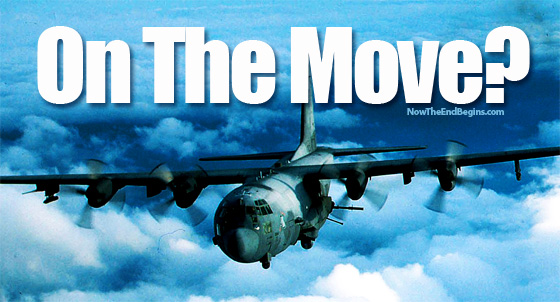
NTEB’s military sources have told us late this evening that at the Eglin Air Force Base, in the Florida panhandle, all Lockheed AC-130 aircraft have been moved out “somewhere”. We have not be able to confirm this yet and will keep you posted as the situation develops. Eglin AFB is home to the 33rd Fighter Wing, 919th Special Operations Wing, 7th Special Forces Group, and 53rd Wing to name a few.
But this would make perfect sense when you consider that a 30-nation team is, at this very moment, sweeping the entire Persian Gulf for mines in preparation of containing Iran after the strike on their nuclear facilities is carried out. NTEB believes we are only days away from that strike.
Operation IMCMEX-12 has begun
“British and US warships have joined a major naval exercise in the Persian Gulf as tensions between Israel and Iran over Tehran’s nuclear power programme increase. British forces are taking part in a joint operation conducted by the navies of more than 30 countries to sweep the area – a major transit point of maritime trade – clean of mines.” Read The Full Story…
30-Nation War Games Begin Minesweeping In Persian Gulf Ahead Of Iran Strike
Sep 18th
Operation IMCMEX-12 has begun
British and US warships have joined a major naval exercise in the Persian Gulf as tensions between Israel and Iran over Tehran’s nuclear power programme increase. British forces are taking part in a joint operation conducted by the navies of more than 30 countries to sweep the area – a major transit point of maritime trade – clean of mines.
“The UK is committed to a standing presence in the Gulf to ensure freedom of navigation in international waters such as the Straits of Hormuz,” said defence secretary Philip Hammond.
“Disruption to sailing in the strait would threaten regional and economic growth. Any attempt by Iran to do this would be illegal and unsuccessful.”
The show of strength in exercises that include naval deployment by Saudi Arabia, the US and France was designed to warn off Tehran from contemplating disrupting trade routes in the ongoing diplomatic poker game over its nuclear ambitions and Israel’s threat of a strike.
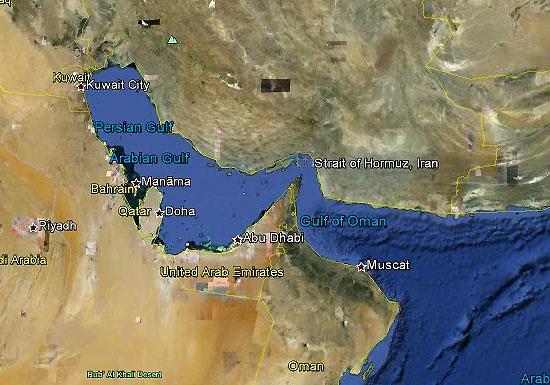
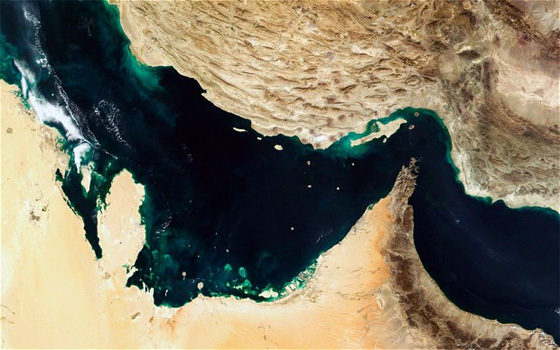
The Strait of Hormuz between Iran and Oman is one of the most heavily used trade waterways in the world. Some 35 percent of the world’s oil shipments – about 18 million barrels a day – pass through the 21-mile-wide channel.
Nuclear tension
Israel’s prime minister Benjamin Netanyahu has been putting pressure on President Obama to threaten Iran with military intervention if Tehran takes its nuclear programme further.
“It’s important to place a red line before Iran – that actually reduces the chance of a military conflict because if they know there’s a point, a stage in the enrichment or other nuclear activities that they cannot cross because they’ll face consequences, I think they’ll actually not cross it,” Netanyahu told CNN.
Iran’s atomic energy chief accused the International Atomic Energy Agency, the UN’s nuclear watchdog, of being infiltrated by “terrorists and saboteurs” after power lines to a nuclear enrichment plant were blown up.
Fereydoun Abbasi-Davani said that just after the explosion at the underground plant of Fordow, an inspector from the agency asked to visit the facility.
“Does this visit have any connection to that detonation? Who, other than the IAEA inspector, can have access to the complex in such a short time to record and report failures? Terrorists and saboteurs might have infiltrated the agency and might be making decisions covertly,” said Abbasi-Davani.
Naval Games
Military officials involved in the Gulf naval exercises played down the political significance of the operation.
“This exercise is about mines and the international effort to clear them,” said Vice-Admiral John Miller, commander of US Naval Forces Central Command.
“The work we will do here will strengthen relationships and enhance mine counter-measures interoperability among participating navies,” said exercise director Rear Admiral Kenneth Perry.
A US fleet spokesman also said that the navy manoeuvres will take place out of actual Strait of Hormuz itself.
Known as IMCMEX-12, the naval exercise will see the participation of two British mine counter measures vessels (MCMV) and one Royal fleet auxiliary vessel. The warships are part of the six-strong British fleet, which includes four MCMVs a frigate and a destroyer, currently present in the area. source – IBT
Armada Of US & British Naval Power Massing In Gulf As ISRAEL PREPARES TO STRIKE IRAN
Sep 16th
“My help cometh from the LORD, which made heaven and earth. He will not suffer thy foot to be moved: he that keepeth thee will not slumber. Behold, he that keepeth Israel shall neither slumber nor sleep.” Psalm 121
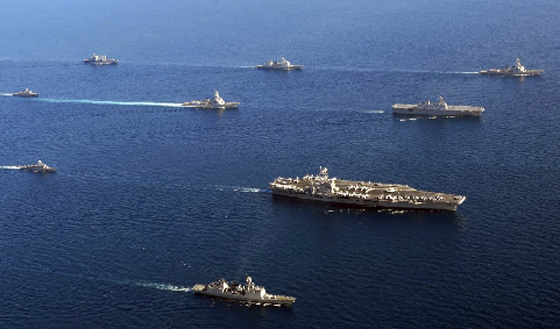
An armada of US and British naval power is massing in the Persian Gulf in the belief that Israel is considering a pre-emptive strike against Iran’s covert nuclear weapons programme. Battleships, aircraft carriers, minesweepers and submarines from 25 nations are converging on the strategically important Strait of Hormuz in an unprecedented show of force as Israel and Iran move towards the brink of war.
Western leaders are convinced that Iran will retaliate to any attack by attempting to mine or blockade the shipping lane through which passes around 18 million barrels of oil every day, approximately 35 per cent of the world’s petroleum traded by sea.
A blockade would have a catastrophic effect on the fragile economies of Britain, Europe the United States and Japan, all of which rely heavily on oil and gas supplies from the Gulf.
The Strait of Hormuz is one of the world’s most congested international waterways. It is only 21 miles wide at its narrowest point and is bordered by the Iranian coast to the north and the United Arab Emirates to the south.
In preparation for any pre-emptive or retaliatory action by Iran, warships from more than 25 countries, including the United States, Britain, France, Saudi Arabia and the UAE, will today begin an annual 12-day exercise.
The war games are the largest ever undertaken in the region. They will practise tactics in how to breach an Iranian blockade of the strait and the force will also undertake counter-mining drills.
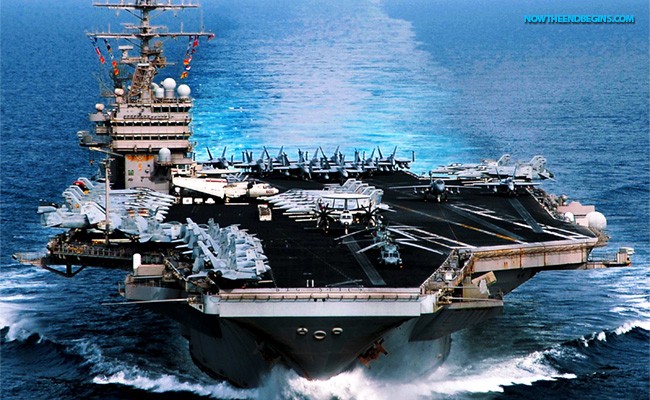
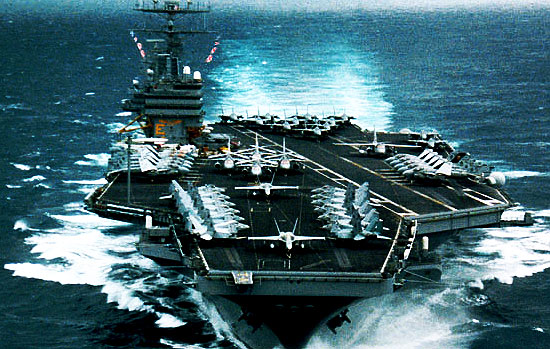
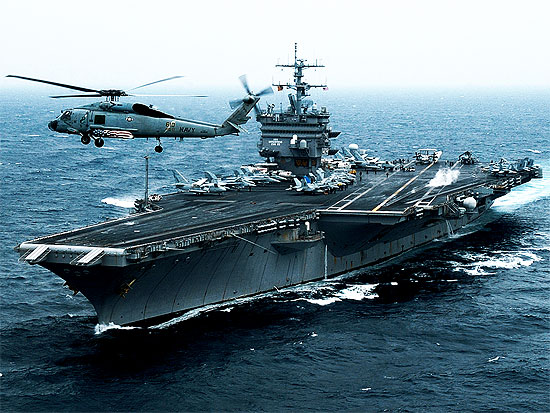
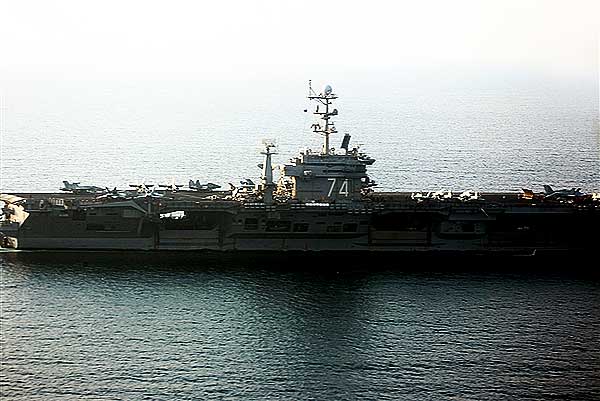
The multi-national naval force in the Gulf includes three US Nimitz class carrier groups, each of which has more aircraft than the entire complement of the Iranian air force.
The carriers are supported by at least 12 battleships, including ballistic missile cruisers, frigates, destroyers and assault ships carrying thousand of US Marines and special forces.
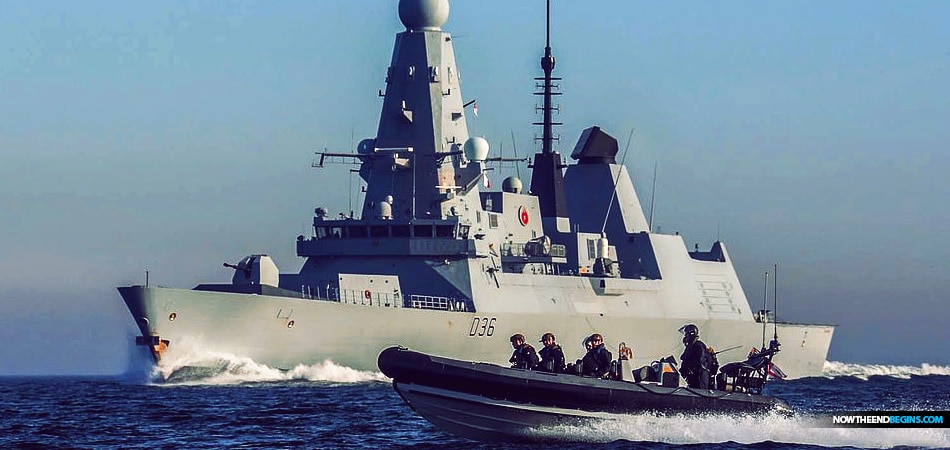
The British component consists of four British minesweepers and the Royal Fleet Auxiliary Cardigan Bay, a logistics vessel. HMS Diamond, a brand-new £1billion Type 45 destroyer, one of the most powerful ships in the British fleet, will also be operating in the region.
In addition, commanders will also simulate destroying Iranian combat jets, ships and coastal missile batteries.
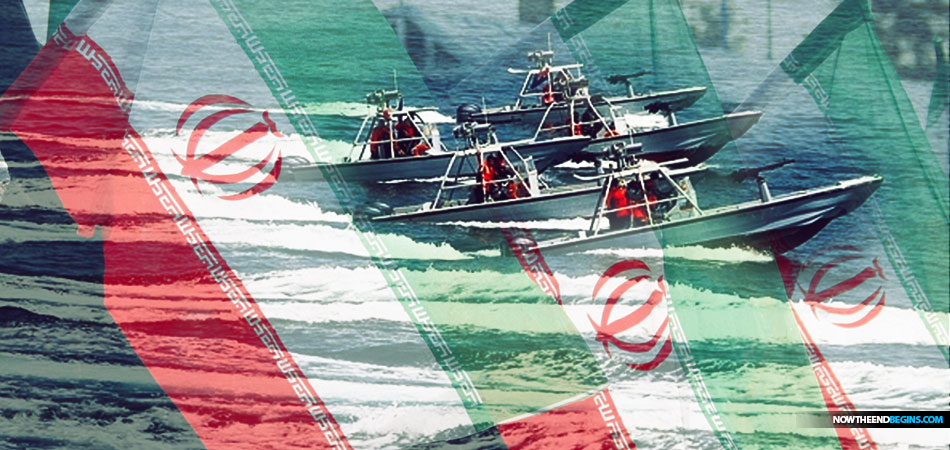
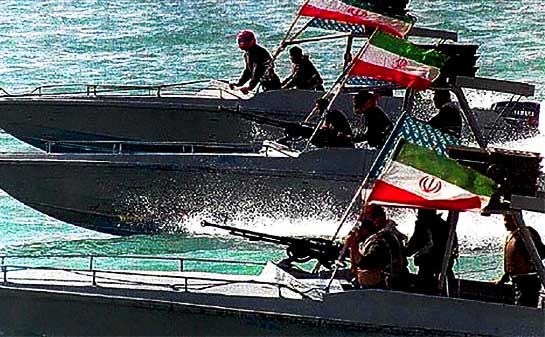
In the event of war, the main threat to the multi-national force will come from the Islamic Revolutionary Guards Corps navy, which is expected to adopt an “access-denial” strategy in the wake of an attack, by directly targeting US warships, attacking merchant shipping and mining vital maritime chokepoints in the Persian Gulf.
Defence sources say that although Iran’s capability may not be technologically sophisticated, it could deliver a series of lethal blows against British and US ships using mini-subs, fast attack boats, mines and shore-based anti-ship missile batteries.
Next month, Iran will stage massive military manoeuvres of its own, to show that it is prepared to defend its nuclear installations against the threat of aerial bombardment.
The exercise is being showcased as the biggest air defence war game in the Islamic Republic’s history, and will be its most visible response yet to the prospect of an Israeli military strike.
Using surface-to-air missiles, unmanned drones and state-of-the-art radar, Iran’s Revolutionary Guards and air force will combine to test the defences of 3,600 sensitive locations throughout the country, including oil refineries and uranium enrichment facilities.
Brigadier General Farzad Esmaili, commander of the Khatam al-Anbiya air defence base, told a conference this month that the manoeuvres would “identify vulnerabilities, try out new tactics and practise old ones”.
At the same time as the Western manoeuvres in the Gulf, the British Response Task Forces Group — which includes the carrier HMS Illustrious, equipped with Apache attack helicopters, along with the French aircraft carrier Charles de Gaulle – will be conducting a naval exercise in the eastern Mediterranean. The task force could easily be diverted to the Gulf region via the Suez Canal within a week of being ordered to do so.
The main naval exercise comes as President Barack Obama is scheduled to meet Benjamin Netanyahu, the Israeli prime minister, today to discuss the Iranian crisis.
Many within the Obama administration believe that Israel will launch a pre-emptive strike against Iran’s nuclear facilities before the US presidential elections, an act which would signal the failure of one of Washington’s key foreign policy objectives.
Both Downing Street and Washington hope that the show of force will demonstrate to Iran that Nato and the West will not allow President Mahmoud Ahmadinejad, the Iranian leader, to develop a nuclear armoury or close Hormuz.
Sir John Sawers, the head of MI6, the Secret Intelligence Service, reportedly met the Israeli prime minister and Ehud Barak, his defence secretary, two weeks ago in an attempt to avert military action against Iran.
But just last week Mr Netanyahu signalled that time for a negotiated settlement was running out when he said: “The world tells Israel ‘Wait, there’s still time.’ And I say, ‘Wait for what? Wait until when?’
“Those in the international community who refuse to put red lines before Iran don’t have a moral right to place a red light before Israel.”
The crisis hinges on Iran’s nuclear enrichment programme, which Israel believes is designed to build an atomic weapon. Tehran has long argued that the programme is for civil use only and says it has no plans to an build a nuclear bomb, but that claim has been disputed by the West, with even the head of MI6 stating that the Islamic Republic is on course to develop atomic weapons by 2014.
The Strait of Hormuz has long been disputed territory, with the Iranians claiming control of the region and the entire Persian Gulf.
Rear Admiral Ali Fadavi of the Iranian Revolutionary Guard Corps recently boasted that “any plots of enemies” would be foiled and a heavy price exacted, adding: “We determine the rules of military conflict in the Persian Gulf and the Strait of Hormuz.”
But Leon Panetta, the US defence secretary, warned that Iranian attempts to exercise control over the Strait of Hormuz could be met with force.
He said: “The Iranians need to understand that the United States and the international community are going to hold them directly responsible for any disruption of shipping in that region — by Iran or, for that matter, by its surrogates.”
Mr Panetta said that the United States was “fully prepared for all contingencies” and added: “We’ve invested in capabilities to ensure that the Iranian attempt to close down shipping in the Gulf is something that we are going to be able to defeat if they make that decision.”
That announcement was supported by Philip Hammond, the Defence Secretary, who added: “We are determined to work as part of the international community effort to ensure freedom of passage in the international waters of the Strait of Hormuz.”
One defence source told The Sunday Telegraph last night: “If it came to war, there would be carnage. The Iranian casualties would be huge but they would be able to inflict severe blows against the US and British.
“The Iranian Republican Guard are well versed in asymmetrical warfare and would use swarm attacks to sink or seriously damage ships. This is a conflict nobody wants, but the rhetoric from Israel is unrelenting.” source – Telegraph UK
Pentagon To Send 5,500 Troops And Aegis Guided-Missile Cruiser To Gulf Early
Jul 16th
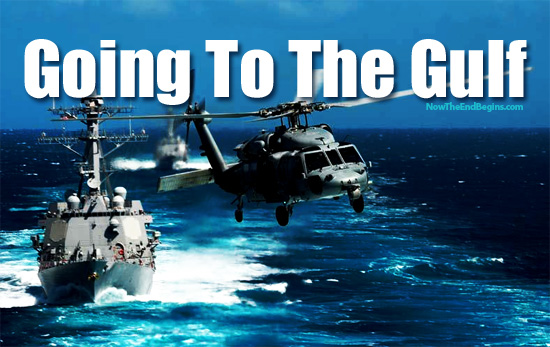
WASHINGTON (AP) – The Pentagon is sending an aircraft carrier to the Middle East several months early to make sure at least two carriers will constantly be present in the troubled region.

Questioned about whether the deployment is a response to problems with Iran or perhaps the violence in Syria, he declined to be specific.
There are two carriers in the area now, but one was scheduled to leave before its replacement arrived to fill that gap, Defense Secretary Leon Panetta has approved sending by late summer the USS John C. Stennis strike group, which also includes the Aegis guided-missile cruiser USS Mobile Bay and some 5,500 sailors.
The extra presence was approved late last week on a request by Gen. James Mattis, commander of U.S. Central Command, Pentagon press Secretary George Little said Monday.
Questioned about whether the deployment is a response to problems with Iran or perhaps the violence in Syria, he declined to be specific. Little said the need comes from a “wide range of security issues” in the region.
“This is not about any one particular country or any one particular threat,” he said.
The USS John C..Stennis will have to accelerate its training and re-equipping of the ship, because it just left the area in December.
After that last deployment, Iran’s army chief Gen. Ataollah Salehi in January warned the U.S. warship not to return to the Gulf, but its replacement, the carrier USS Abraham Lincoln, entered the Gulf without incident later in January.
Although U.S. warships have had a presence in the region for decades, the deployment schedule change comes during an escalating showdown between Iran and the West over the Islamic Republic’s nuclear program.
The Pentagon also recently doubled the number of minesweepers in the region, giving the U.S. greater flexibility to counter any Iranian effort to mine the Strait of Hormuz at the mouth of the Persian Gulf.
The strait is routinely patrolled by Iranian and U.S. warships. Iran has repeatedly threatened to close the strategic waterway, which is the transit route for about a fifth of the world’s oil supply, in retaliation for increased Western-led sanctions.
Another ship, the USS Ponce, has also been sent. The amphibious transport dock was recently retrofitted to become what is known as an afloat forward staging base. source - WTOP
BREAKING NEWS! US Navy Fires on Ship in Persian Gulf, One Dead
Jul 16th
Editor’s Note: We here at NTEB feel that this incident is a “trial balloon” by Iran and Russia to gauge American resolve in the Middle East. Time will tell, but that’s what it looks like to us.
Related Story: Pentagon To Send 5,500 Troops And Aegis Guided-Missile Cruiser To Gulf Early
From ABC News: An American Navy ship fired on a boat in the Persian Gulf today, killing one person and injuring three others aboard the craft, a U.S. naval official told ABC News.
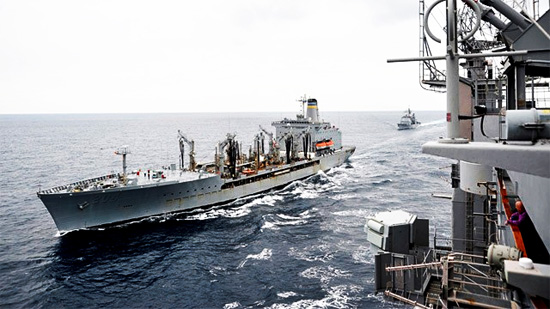
A spokesperson for the Navy’s 5th Fleet, which is based in nearby Bahrain, said that a security team aboard the oil supply ship U.S.N.S. Rappahannock fired a .50 caliber machine gun at a “small motor vessel after it disregarded warnings and rapidly approached the U.S. ship” off the coast of Jebel Ali, a city approximately 30 miles from Dubai in the United Arab Emirates.
The Navy is investigating the incident as details continue to emerge. A Navy official said the offending vessel was a white pleasure craft, but a UAE official told ABC News it was a fishing boat with four Indians and two Emirates on board. There doesn’t appear to be any indication the incident was terror-related, the UAE official said.
The Navy official said it’s not uncommon for Iranian speed craft to harass U.S. ships in the region, but in this case the boat wasn’t Iranian.
“I can’t emphasize enough that this has nothing to do with Iran,” the official said.
American sailors are trained to take special caution of any vessels that appear to be approaching their warships. In 2000 the destroyer U.S.S. Cole was attacked off the coast of Yemen by al Qaeda terrorists who used a small private craft armed with explosives to ram the ship, killing 17 American sailors.
Word of the shooting comes on the same day that the Pentagon confirmed that it had agreed to a recent request from U.S. Central Command to maintain a two carrier presence in the Middle East.
The carrier U.S.S. John C. Stennis has been ordered to head to the region four months ahead of schedule in September to replace the outgoing U.S.S. Enterprise. A Pentagon spokesman said the Stennis is being sent so that there is no gap in between two carrier assignments to the region.
On Sunday, the U.S.S. Eisenhower replaced the U.S.S. Abraham Lincoln in the region. By replacing the Enterprise, the U.S. will now be able to avoid having just one carrier in the region.
The U.S. Navy usually rotates one of its two carriers into the Persian Gulf while the other operates in the Arabian Sea providing air support for the war in Afghanistan. source – ABC News
US Quietly Moves Significant Military Reinforcements Into Persian Gulf
Jul 3rd
WASHINGTON — The United States has quietly moved significant military reinforcements into the Persian Gulf to deter the Iranian military from any possible attempt to shut the Strait of Hormuz and to increase the number of fighter jets capable of striking deep into Iran if the standoff over its nuclear program escalates.
The deployments are part of a long-planned effort to bolster the American military presence in the gulf region, in part to reassure Israel that in dealing with Iran, as one senior administration official put it last week, “When the president says there are other options on the table beyond negotiations, he means it.”
But at a moment that the United States and its allies are beginning to enforce a much broader embargo on Iran’s oil exports, meant to force the country to take seriously the negotiations over sharply limiting its nuclear program, the buildup carries significant risks, including that Iran’s powerful Islamic Revolutionary Guards Corps could decide to lash out against the increased presence.
The most visible elements of this buildup are Navy ships designed to vastly enhance the ability to patrol the Strait of Hormuz — and to reopen the narrow waterway should Iran attempt to mine it to prevent Saudi Arabia and other oil exporters from sending their tankers through the vital passage.
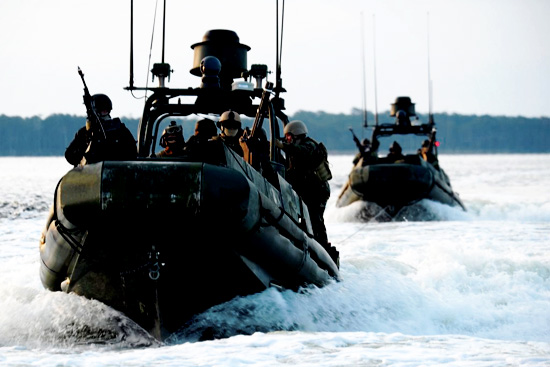
The Navy has doubled the number of minesweepers assigned to the region, to eight vessels, in what military officers describe as a purely defensive move.
“The message to Iran is, ‘Don’t even think about it,’ ” one senior Defense Department official said. “Don’t even think about closing the strait. We’ll clear the mines. Don’t even think about sending your fast boats out to harass our vessels or commercial shipping. We’ll put them on the bottom of the gulf.” Like others interviewed, the official spoke on the condition of anonymity because of the delicacy of the diplomatic and military situation.
Since late spring, stealthy F-22 and older F-15C warplanes have moved into two separate bases in the Persian Gulf to bolster the combat jets already in the region and the carrier strike groups that are on constant tours of the area. Those additional attack aircraft give the United States military greater capability against coastal missile batteries that could threaten shipping, as well as the reach to strike other targets deeper inside Iran.
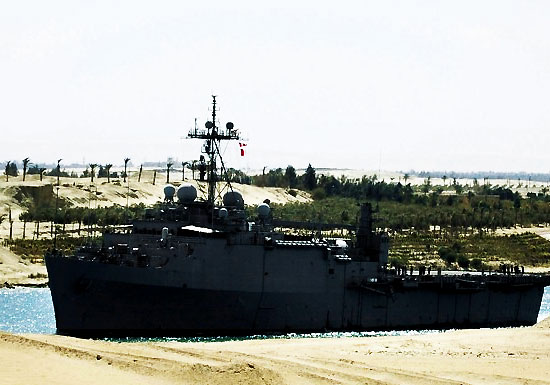
And the Navy, after a crash development program, has moved a converted amphibious transport and docking ship, the Ponce, into the Persian Gulf to serve as the Pentagon’s first floating staging base for military operations or humanitarian assistance.
The initial assignment for the Ponce, Pentagon officials say, is to serve as a logistics and operations hub for mine-clearing. But with a medical suite and helicopter deck, and bunks for combat troops, the Ponce eventually could be used as a base for Special Operations forces to conduct a range of missions, including reconnaissance and counterterrorism, all from international waters.
For President Obama, the combination of negotiations, new sanctions aimed at Iran’s oil revenues and increased military pressure is the latest — and perhaps the most vital — test of what the White House calls a “two track” policy against Iran. In the midst of a presidential election campaign in which his opponent, Mitt Romney, has accused him of being “weak” in dealing with the Iranian nuclear issue, Mr. Obama seeks to project toughness without tipping into a crisis in the region.
At the same time he must signal support for Israel, but not so much support that the Israelis see the buildup as an opportunity to strike the Iranian nuclear facilities, which Mr. Obama’s team believes could set off a war without significantly setting back the Iranian program.
A key motivation for “Olympic Games,” the covert effort to undermine Iran’s enrichment capability with cyberattacks, has been to demonstrate to the Israelis that there are more effective ways to slow the program than to strike from the air.
But this delicate signaling to both Iran and Israel is a complex dance. Senator John Kerry, the Massachusetts Democrat who is chairman of the Foreign Relations Committee, said that the administration must strike a fine balance between positioning enough forces to deter Iran, but not inadvertently indicate to Iran or Israel that an attack on Iran’s nuclear sites is imminent or inevitable.
“There are a lot of expectations to manage,” Mr. Kerry said in an interview. “People need to know you’re serious, but you must also leave room for peaceful resolution. It’s very important not to take steps that send the wrong messages here.” source – NY Times