Posts tagged Islamists
Islamists Dominate Egypt’s Upper House After Vote
Feb 25th
Islamists seized most seats in the two-stage vote for Egypt’s upper house of parliament, the Shura Council, the electoral commission said on Saturday.

Egypt’s Muslim Brotherhood today claimed an outright majority in the election for the upper house of parliament. The Freedom and Justice Party won 59 percent of the Shura’s 180 seats, the Brotherhood’s newspaper said. - DemDigest.net
The results cap landmark legislative elections that saw Islamists propelled to the centre stage of Egyptian politics.
A commission official said the Muslim Brotherhood’s Freedom and Justice Party (FJP) secured 105 seats, the Salafist Al-Nur party took 45, the liberal Wafd won 14, and the Egyptian Bloc eight. Another eight seats went to smaller factions.
The vote, which began on January 29, was for 180 seats in the 270-seat chamber in which the remaining third of seats are allocated by the head of the ruling Supreme Council of the Armed Forces (SCAF), Field Marshal Hussein Tantawi. But electoral commission chief Abdel Moez Ibrahim told reporters on Saturday the turnout in voting for the Shura was not more than 10 percent.
Many polling stations were empty on Wednesday, the final day of voting for the Shura, in sharp contrast to the long queues and active campaigning that marked the People’s Assembly vote. Members of both houses of parliament will now choose a panel to draft a new constitution.
The elections are part of a roadmap for a transition to democratic rule laid out by the ruling military council that took power after the popular uprising that overthrew president Hosni Mubarak last year.
Under the complex system adopted after Mubarak’s ouster, two thirds of the Shura’s 180 elected members are elected via a party-list system, while one third are elected directly.
One third of the members of the Shura Council are nominated by the head of state. The powerful Brotherhood’s FJP won a crushing victory in the lower house elections, contested over three months, to clinch 47 percent of seats.
Al-Nur, representing the ultra-conservative Salafist current of political Islam, came second, with liberal parties trailing far behind.
The election comes amid nationwide protests calling for the ouster of the SCAF led by Tantawi, who was also Mubarak’s long-time defence minister.
Protesters accuse the military council of mismanagement and of human rights abuses. The SCAF has vowed to cede power to civilian rule by June when a new president is elected, but there is a widespread belief it seeks to maintain some degree of control even afterwards. source – Yahoo News
Here Comes Sharia! Egypt’s Islamists Win 75 Percent of Parliament
Jan 21st
CAIRO (AP) – Final results on Saturday showed that Islamist parties won nearly three-quarters of the seats in parliament in Egypt’s first elections since the ouster of authoritarian president Hosni Mubarak, according to election officials and political groups.
The Islamist domination of Egypt’s parliament has worried liberals and even some conservatives about the religious tone of the new legislature, which will be tasked with forming a committee to write a new constitution. It remains unclear whether the constitution will be written while the generals who took power after Mubarak’s fall are still in charge, or rather after presidential elections this summer.
In the vote for the lower house of parliament, a coalition led by the fundamentalist Muslim Brotherhood won 47 percent, or 235 seats in the 498-seat parliament. The ultraconservative Al-Nour Party was second with 25 percent, or 125 seats.
The Salafi Al-Nour, which was initially the biggest surprise of the vote, wants to impose strict Islamic law in Egypt, while the more moderate Brotherhood, the country’s best-known and organized party, has said publicly that it does not seek to force its views about an appropriate Islamic lifestyle on Egyptians.
The two parties are unlikely to join forces because of ideological differences, but both have a long history of charity work in Egypt’s vast poverty-stricken neighborhoods and villages, giving them a degree of legitimacy and popularity across the country in areas where newer liberal parties have yet to get a foothold.
Muslim Brotherhood lawmaker Mohammed el-Beltagi said the new parliament represents “the wish of the Egyptian people.”
Egypt’s elections commission acknowledged that there were voting irregularities, but the vote has been hailed as the country’s freest and fairest in living memory.
The liberals who spearheaded the revolt that toppled Mubarak struggled to organize and connect with a broader public in the vote, and did not fair as well as the Islamists.
The Egyptian bloc, which is headed by a party founded by Christian telecom tycoon Naguib Sawiris, said it won 9 percent of the seats in parliament. Egypt’s oldest secular party, the Wafd, also won around 9 percent. source- My Way News
Jimmy Carter Says He’s ‘Pleased’ With Islamist Takeover Of Egypt
Jan 10th
Former US president Jimmy Carter gave the thumbs up on Tuesday to Egypt’s parliamentary elections, saying the people’s will was “expressed accurately.”

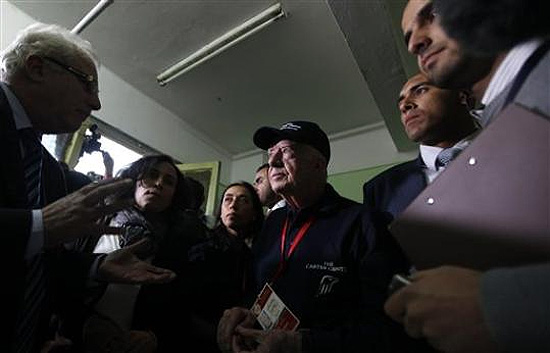
Former US President Jimmy Carter, center, visits a polling site during run-off voting in the parliamentary election in Cairo, Egypt, Tuesday, Jan. 10, 2012. Former President Jimmy Carter on Tuesday dismissed concerns about the success of Islamist parties in Egypt's first elections since the fall of President Hosni Mubarak, because it represents the will of the Egyptian people. (AP Photo/Khalil Hamra)
“We have been very pleased,” Carter told reporters during a tour of a polling station at the Rod al-Farag girls’ secondary school in a working class district of the Egyptian capital
He said the election — a three-staged process launched in November to choose the first parliament since mass protests forced former president Hosni Mubarak to quit — had been peaceful despite “some problems.”
Carter arrived in Egypt on Monday to join a Carter Center delegation of 40 witnesses representing 21 countries deployed in Egypt since mid-November, the statement added. Egypt’s two main Islamist parties have scored a crushing victory in the seats declared so far, reflecting a regional trend since Arab Spring uprisings overthrew authoritarian secular regimes.
Asked about Islamists coming to power, Carter said: “I have no problem with that. The US government has no problem with that either.”
The powerful Muslim Brotherhood, the country’s best organised political movement, has claimed the lead through its political arm, the Freedom and Justice Party (FJP).
It has been closely followed by Al-Nur, which represents the ultra-conservative Salafi brand of Islam, raising fears among increasingly marginalised liberals about the prospects for civil liberties and religious freedom.
Under the complex electoral system, voters have been asked to cast three ballots — two for individual candidates and one for a party list — for the 498 elected seats in the lower house.
On Tuesday, Egyptians were voting in second-round run-offs for the third and final phase of the election. The run-off, which takes place over two days in the last nine of the country’s 27 provinces to vote, is for individual candidates.
The election is to be re-run in several constituencies between January 14 and January 19, after complaints over the conduct of the first-round voting were upheld. The electoral commission has yet to announce when it will publish the final results. source – Breitbart
‘Religion of Peace’ Islamist Muslims Slaughtering Christians in Nigeria
Jan 7th
MAIDUGURI, Nigeria — Hundreds of Christians have begun fleeing northern Nigeria after dozens were killed in a series of attacks by Islamist militants who issued an ultimatum to Christians to leave the mainly Muslim region or be killed, witnesses said on Saturday.

Local residents in the Adamawa state capital Yola said gunmen had fired on Christians leaving church on Friday, killing eight people. The police confirmed the incident but were not able to give further comment or a death toll.
A Nigerian newspaper on Tuesday published a warning from Boko Haram, a movement styled on the Taliban, that Christians had three days to get out of northern Nigeria.
Since the expiry of that ultimatum, attacks in towns in four states in northeastern Nigeria have left at least 37 people dead and hundreds of Christians are fleeing to the south, according to residents and a Red Cross official.
Gunmen armed with Kalashnikovs have targeted church congregations and a group of mourners in a church hall.
Witnesses said some shops run by Christians from the Igbo ethnic group in towns hit by the violence, including Yola and Mubi, were closed on Saturday and residents started to pack their belongings onto buses heading to southern regions.
There are fears of reprisal attacks on Muslims. Christian groups have asked their followers to remain peaceful but they concede that there is a risk of further violence.
“We are very worried by the persistent killings. We have asked youths to remain calm. We stand for a united Nigeria but there is a limit to human tolerance,” a spokesman for the Christian Association of Nigeria told Reuters.
But the leader of Nigeria’s main umbrella group for Christians says its members will defend themselves, The Associated Press reported.
Pastor Ayo Oritsejafor of the Christian Association of Nigeria gave the warning Saturday to journalists in Abuja, Nigeria’s capital.
Oritsejafor said: “We have decided to work out ways of protecting ourselves.” source – MSNBC
Arab Spring Is Now Targeting Algeria
Dec 8th
(Reuters) – Algeria’s Islamists, in the political wilderness since their last attempt to win power dissolved into civil war, are now trying again, galvanized by the success of their brethren elsewhere in north Africa in the wake of the “Arab Spring”.

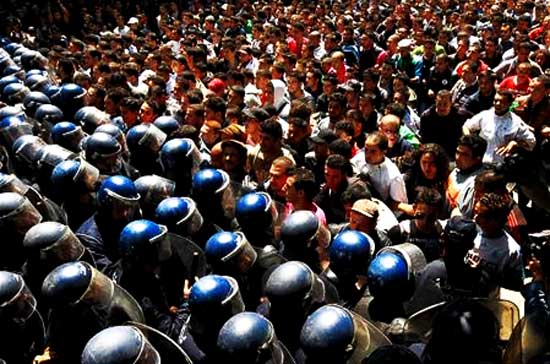
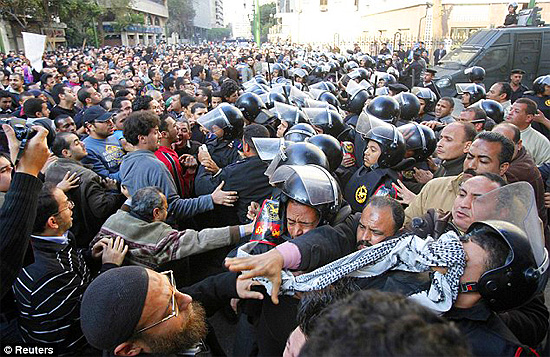
Riot policemen clash with university students from marching during a demonstration in which they demand political change in Algiers May 2, 2011. Credit: Reuters/Zohra Bensemra
Most Islamists in Algeria have been excluded from political life since the conflict, but in the past few months they have shown renewed signs of activity, much of it conducted from exile to dodge the attentions of the Algerian state.
They have set up a satellite television station based in Europe, sent delegations to Arab countries that saw revolutions this year, and made tentative forays into anti-government protests.
Their chances of success are slim: they are divided into rival ideological camps, hemmed in by the powerful Algerian security apparatus, and, most importantly, discredited in the eyes of many people by a conflict in which they took part and which killed an estimated 200,000 people.
But they see an opportunity in the upheavals of the “Arab Spring,” which have this year unseated entrenched secularist leaders. In neighboring Tunisia, a previously outlawed Islamist movement has come to power, while in Egypt Islamists have taken a strong early lead in multi-stage parliamentary elections.
“Tunisia was an example and launcher of this (Arab Spring) revolution,” said Abdullah Anas, a London-based member of the leadership council of the Islamic Salvation Front (FIS), which is banned in Algeria.
“It could be a very good example for Algeria.”
LEGACY OF VIOLENCE
Any Islamist revival in Algeria, an OPEC member and supplier of about a fifth of Europe’s imported gas, would have first to shed the burden of the country’s bloody history.
Twenty years ago, FIS was poised to win a legislative election, called after street protests forced the authorities to loosen their grip on power. FIS said it would impose an Islamic state.
The military-backed government stepped in to annul the election. The Islamists took up arms and Algeria slipped into a conflict of horrific violence. Civilians had their throats slit in the street; in the mornings, people woke up to find their towns littered with bodies.
A rump of Islamists, now operating under the banner of al Qaeda in the Islamic Maghreb, is still fighting. They periodically ambush security forces in the countryside, kidnap Westerners and stage suicide bombings.
But the violence has subsided considerably. A huge security crackdown has rounded up thousands of insurgents. Others have laid down their arms and been granted an amnesty, in exchange for an undertaking to stay out of politics.
This legacy is the biggest obstacle to any comeback by Algeria’s Islamists.
“Since then (the conflict), the Islamist was no longer seen as a hero who stands up against tyranny,” said Soheib Bencheikh, a theologian who used to be the chief cleric at the mosque in Marseilles, France, where there is a large Algerian community.
“On the contrary, he became, in the eyes of public opinion, accountable for the pain and suffering of the people,” Bencheikh told Reuters.
A fear of a return to violence helps explain why Algeria has this year remained relatively calm while neighboring countries have been convulsed by unrest.
TV STATION
But the Islamists still believe that Algeria is ripe for change, and are beginning to take practical steps.
Starting in November, a group of exiled Islamists with links to FIS set up a Europe-based television station, called Rachad TV. Carried by the Atlantic Bird 7 and Nilesat satellites , the station can be picked up in Algeria, where most homes have a dish.
It broadcasts political and social programs where opposition leaders and activists — most of them harshly critical of the government — are invited to comment on Algeria.
At the top of the station’s homepage on the Internet, there is a link to show viewers “how to free your country”, and a second link to help them “organize and participate in unrest.”
The exiles say they are also building contacts with other countries where “Arab Spring” revolts have propelled Islamists into a position of power.
Rachad says on its website that it sent a delegation to Libya in late September to meet officials in the new government, in which Islamists have a prominent role.
Abdullah Anas, the exiled Islamist in London, said there had also been contacts with Rachid Ghannouchi, the head of the moderate Islamist Ennahda party. Since an election in October his party leads Tunisia’s coalition government.
Tunisia’s experience had proved that it is possible to open up the political space in north Africa, said Anas.
“Everyone in Algeria must understand that Algeria has room for all … no matter what opinions you have,” he said, calling for a lifting of political curbs and the possibility of power-sharing between previously antagonistic groups.
SALAFISTS STIRRING
Inside Algeria, the most influential Islamist force are the Salafists, followers of an ultra-purist interpretation of Islam. Unlike the FIS, they are tolerated by the Algerian state because their creed forbids participation in politics.
When Algeria was shaken at the beginning of this year by protests sparked by a spike in food prices, the spiritual leader of the Algerian Salafists, Abdelmalek Ramdani, who lives in Saudi Arabia, issued a religious decree.
It said: “As long as the commander of the nation is a Muslim, you must obey and listen to him. Those who are against him are just seeking to replace him, and this is not licit.”
Nevertheless, there are stirrings of political activity by some Salafist preachers.
Sheikh Abdelfateh Zeraoui, a former FIS member and now a well-known Salafist preacher in the Algerian capital, issued a declaration in October saying the government had to enact urgent reforms.
“Political reforms allowing us to have free political activity are key to the stability of the country. Without reforms the country may explode,” the declaration stated.
The preacher has also tried to organize protest marches in the capital, but these have been blocked by the security forces. “We have been barred from politics,” he told Reuters.
The fact that Algerian Islamists are divided dilutes their ability to stage a comeback, said Mohamed Mouloudi, an editor and specialist on Islam.
“They are no longer speaking with one voice,” Mouloudi told Reuters.
“You have the Salafists, the Muslim brotherhood, and the Djaz’airists,(who give priority to Algerian religious traditions) among others,” he said. “You have those who are for a political action, and those who consider political action as illicit.”
SUCCESSION DEBATE
Even so, a debate is now under way in earnest within the Algerian ruling elite, for the first time since the conflict began 20 years ago, about giving Islamists a role in politics.
The focus for that debate — which, like much of Algerian politics, is conducted behind closed doors — is the question of who will succeed President Abdelaziz Bouteflika when his final term ends in 2014.
One camp within the elite is backing Abdelaziz Belkhadem, a former prime minister and secretary general of the ruling FLN party. He is a secularist but is trusted by the Islamists. Opposing him is a camp of hardline secularists who have backing from the powerful security forces.
Friction spilled out into the open when a group of Belkhadem opponents inside the FLN launched a campaign to have him removed from the party leadership.
“It will be wise to promote a man like Abdelaziz Belkhadem who has good ties with Islamists as well as with decision makers inside the regime,” said Mohamed Lagab, a secularist academic at Algiers university.
“Decision makers should take into account that North Africa will be ruled by Islamists ,” said Lagab. source – Reuters
Muslim Brotherhood Poised To Take Over Egypt’s Gov’t
Nov 16th
Egypt Islamists plan mass rally against charter
Egyptian Islamists will hold a mass rally on Friday to protest a government draft of a basic constitution they say should be left to an elected parliament, a leading Islamist group announced on Wednesday.

If present trends continue, the Muslim Brotherhood will score a resounding electoral victory and put themselves firmly in charge of Egyptian governance.
The Muslim Brotherhood, the country’s best organised movement, said on its website it would hold the rally after the government went ahead with its plan to draft overarching constitutional principles.
The principles, which would bind a panel appointed by parliament that Islamists hope to dominate, were demanded by liberal and secular groups. A three-stage parliamentary election will start on November 28.
The government’s draft drew fire from most quarters for including clauses that removed the ruling military’s budget from parliamentary oversight and allowed the military final say on military-related laws.
The government revised the draft, but the Islamists, who organised a mass protest in July against such a charter, have rejected the very idea of a document that would limit parliament’s authority to draft the constitution.
“The cabinet is clinging on to undemocratic articles, so we have no choice but to stage a million person march to defend democracy on Friday,” the Brotherhood said.
The Brotherhood, through its Freedom and Justice Party, may emerge as the largest bloc in the election, the first since an uprising ousted president Hosni Mubarak in February. The military, which took charge after Mubarak’s ouster and suspended the constitution and parliament, says it will hand over power once a president is elected. source – Yahoo News
Islamists Demand Sharia Law In Egypt
Jul 30th
Tension Rises as Islamists Dominate Tahrir Square
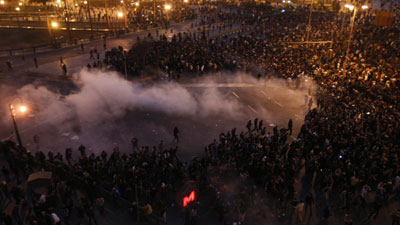
Tens of thousands of Egyptians poured into Tahrir Square on Friday for a day that had been billed as one of unified protest against the interim military government. But the turnout was lopsided, dominated by members of religious movements, ranging from the most conservative, the Salafists, to the relatively moderate Muslim Brotherhood.
According to The Associated Press, instead of chanting “The people want to topple the regime,” a slogan heard at protests across the Arab world this year, from Tahrir Square to Tunisia, demonstrators called out, “The people want to implement Sharia,” a strict code of Islamic law.
This video, which was posted on YouTube on Friday, is said to show the Salafists, many of them wearing skullcaps and conservative attire, walking toward Tahrir Square. Men in T-shirts and baseball caps look on as they pass by.
Egypt has been showing increased signs of polarization, Mr. Shadid reports, and the rift between religious and secular factions was clearly in evidence on Friday as many secular Egyptians responded to the scene in Tahrir Square on social media sites. The Egyptian blogger and activist Nora Shalaby wrote on Twitter that the Salafists were “diverting us from the real demands of the revolution bc of their selfishness.” source – NYTimes