Posts tagged microchip
The World Begins To Embrace The Implantable RFID Microchip
Aug 15th
Normalizing the unthinkable
“And that no man might buy or sell, save he that had the mark, or the name of the beast, or the number of his name.” Revelation 13:17
RELATED STORY: The Mark of the Beast
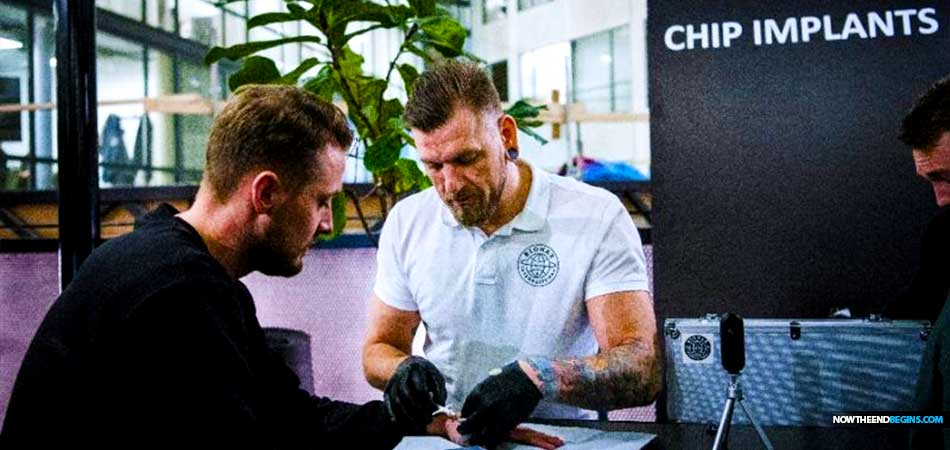
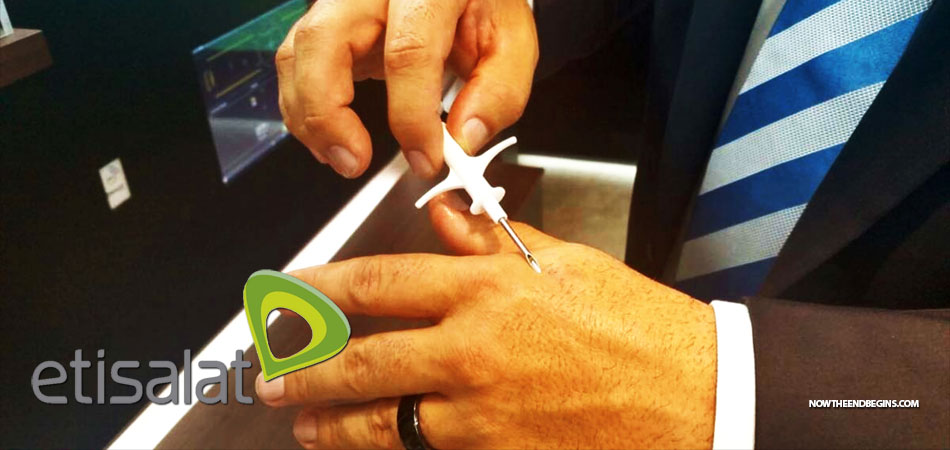
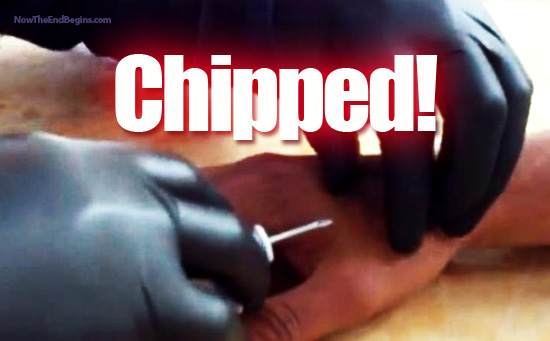
Amal Graafstra snaps on a pair of black rubber gloves. “Do you want to talk about pain management techniques?” he asks. The bearded systems administrator across the table, who requested I call him “Andrew,” has paid Grafstra $30 to have a radio-frequency identification (RFID) chip injected into the space between his thumb and pointer finger, and as Graafstra describes Lamaze-type breathing methods, Andrew looks remarkably untroubled, in spite of the intimidatingly high-gauge syringe sitting on the table between them.
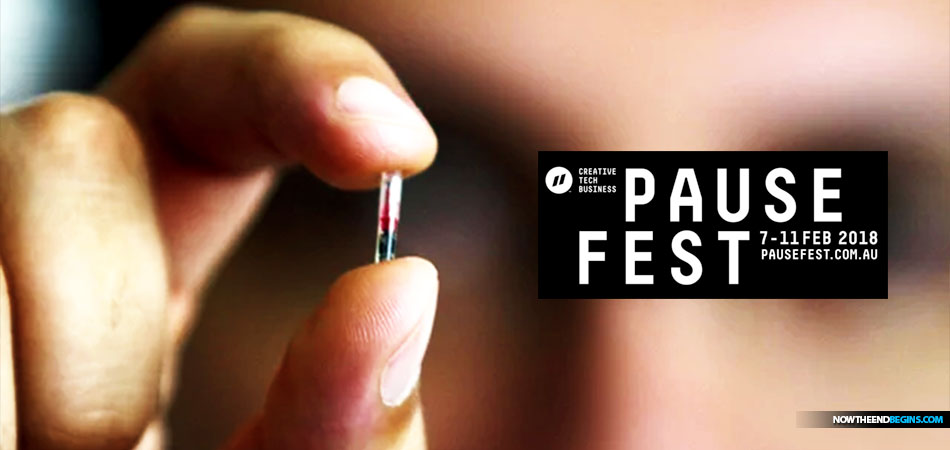
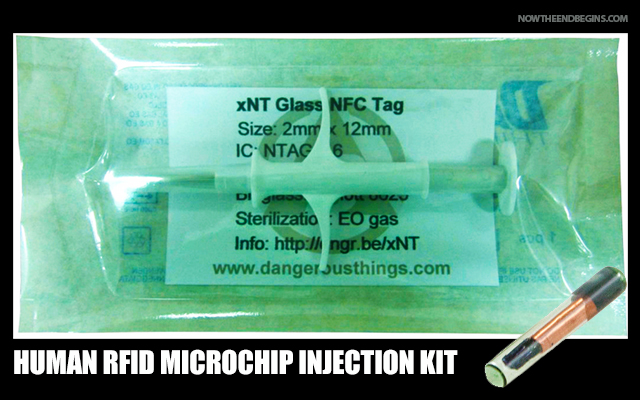
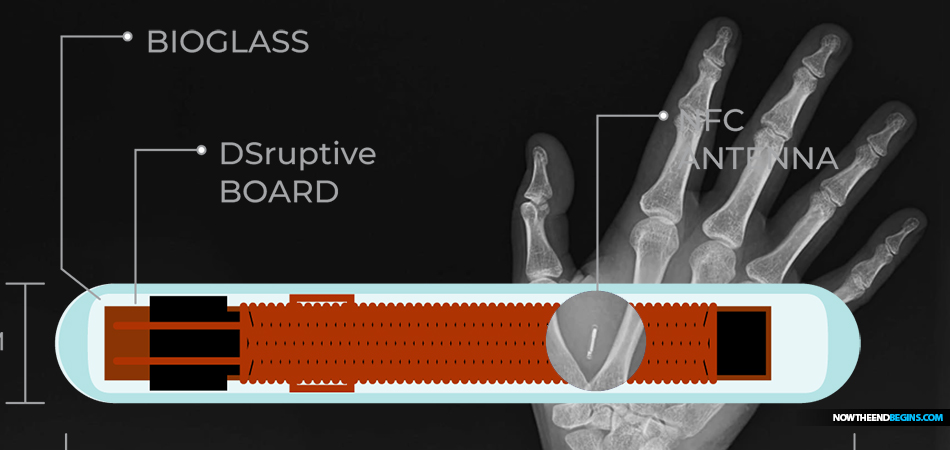
Graafstra finishes his pain talk, fishes a tiny cylindrical two-millimeter diameter EM4012 RFID chip out of a tin of isopropyl alcohol, and drops it into the syringe’s end, replacing the RFID tag intended for pets that came with the injection kit. He swabs Andrew’s hand with iodine, carefully pinches and pulls up a fold of skin on the top of his hand to create a tent of flesh, and with the other hand slides the syringe into the subcutaneous layer known as the fascia, just below the surface.
Then he plunges the plastic handle and withdraws the needle. A small crowd of onlookers applauds. The first subject of the day has been successfully chipped.
Here’s a video of the RFID Microchip Implant procedure:
Over the course of the weekend, Andrew would be one of eight people to undergo the RFID implantation among the 500 or so attendees of Toorcamp, a hacker conference and retreat near the northwest corner of Washington State. Graafstra’s “implantation station” was set up in the open air: Any camper willing to spend $30 and sign a liability waiver could have the implantation performed, and after the excitement of Andrew’s injection, a small line formed to be next.
And why volunteer to be injected with a chip that responds to radio signals with a unique identifier, a procedure typically reserved for tracking pets and livestock? “I thought it would be cool,” says Andrew, when we speak at a picnic table a few minutes after his injection. (The pain, he tells me, was only a short pinch, followed by a “weird feeling of a foreign body sliding into my hand.”)
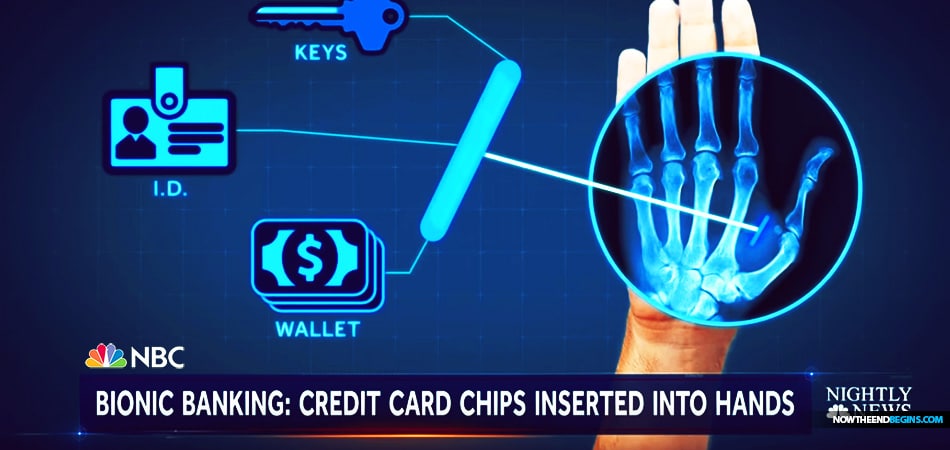
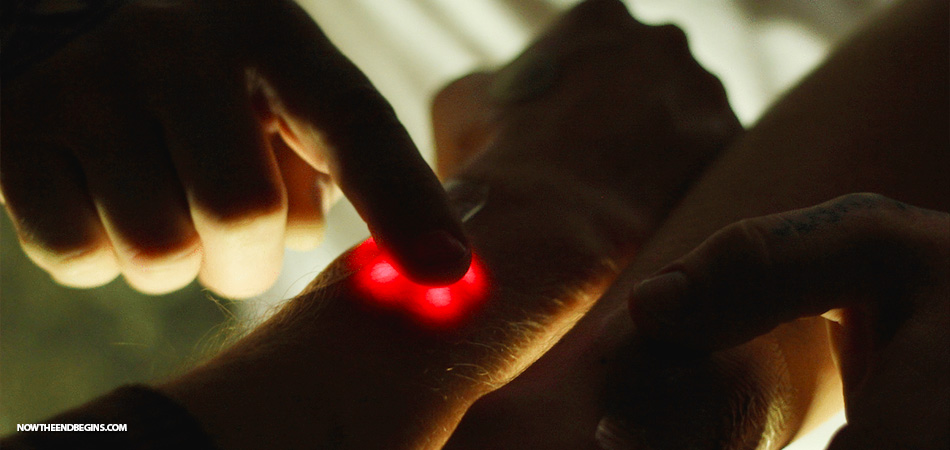
The practical appeal of an RFID implant, in theory, is quick authentication that’s faster, cheaper and more reliable than other biometrics like thumbprints or facial scans. When the chip is hit with a radio frequency signal, it emits a unique identifier number that functions like a long, unguessable password. Implantees like Andrew imagine the ability to unclutter their pockets of keys and keycards and instead access their cars, computers, and homes with with a mere wave of the hand.
Andrew says he initially hoped to use his RFID implant instead of the HID identity card his office uses for entry, but wasn’t deterred from the injection when Graafstra told him that HID uses a proprietary system whose chips Graafstra couldn’t implant. “I don’t have anything specific in mind, now, but I didn’t know when I’d have another opportunity to do it,” says Andrew. “And it’s a good excuse to start learning more about RFID.”
Another young hacker who underwent the procedure at Toorcamp said he hopes to install an RFID access system at the door of his local hackerspace. A young woman with a small collection of rings and studs in her ears compared her new implant to aesthetic body modifications like piercings and tattoos, or even the fringier culture of erotic “needleplay.” “I guess I have an interest in my body’s response to pain and modification,” she says. “There’s a certain thrill of the new.”
For Graafstra himself, the chips are more than a novelty or a hacker hobby. Graafstra uses them to access his home near Seattle, to turn on his motorcycle, to open a safe in his house, even to authenticate into his phone, a Samsung Galaxy Nexus that’s capable of near-field communications. He had his first chip installed in 2005 by a doctor client of his IT services firm, and has since become one of a few vocal RFID body implant evangelists, chronicling his experiences with the chip on his website and in a book, RFID Toys.
The enthusiasm of hackers like those at Toorcamp for RFID implants may seem a bit surprising–privacy advocates have long warned that the chips could allow individuals to be tracked by governments and corporations, even when they’re merely housed in passports or clothing, not to mention injected subcutaneously. But Graafstra says that the chips he’s implanting are difficult to read from more than a few inches away. And he argues the idea of some trying to read his chip in order to spoof its signal and access his house or other property is far less of a threat than other potential privacy invasions.
“If someone manages to read this, it’s just as if they found a piece of paper with a number on the ground,” he says. “For any kind of attack, they would have to also know me and where I live and wants to gain access to the things I’ve enabled. There are easier ways to do that, like breaking into my window.”
That hasn’t stopped privacy advocates and religious types from attacking Graafstra as a harbinger of evil–Some link his hand chip with the Bible’s “mark of the beast,” a number stamped by the Devil on hands and heads in the Book of Revelations. Graafstra ignores their emails or responds politely. “Some people view the body as a sacred temple,” he says. “Some view it as a sports utility vehicle they can upgrade. I’m definitely in the second category.”
Even so, he says his Toorcamp implantation station was a one-off. Outside of the camp’s community of hacking and experimentation, he worries that the risk of unhappy customers would be too high. “I trust that the people here have put a little thought into it and know what they’re getting into,” he says. “For everyone else, I recommend you contact your local piercing artist.” source – Forbes
Singularity! Blind Man Can See As World’s First Bionic Eye Microchip Implant Successful
May 3rd
SINGULARITY
“And he had power to give life unto the image of the beast, that the image of the beast should both speak, and cause that as many as would not worship the image of the beast should be killed.” Revelation 13:15
RELATED STORY: Singularity
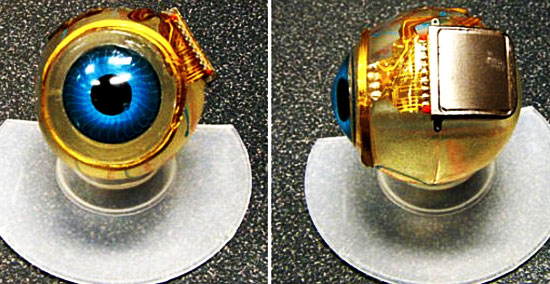
Two blind men can see again for the first time in more than two decades after an implant of a 3mm ‘bionic eye’ microchip. Doctors believe in time Chris James will be able to recognise faces, once his brain learns to see again.
Chris, from Wiltshire, said: ‘I’ve always had that thought that one day I would be able to see again.’
Surgeons in Oxford, led by Professor Robert MacLaren, fitted the chip at the back of Chris’ eye in a complex eight-hour operation last month. Chris was one of two British patients to receive the electronic microchips – and both were regaining ‘useful vision’ just weeks after undergoing surgery.
Robin Millar, 60, from London, is one of the patients who has been fitted with the chip along with 1,500 electrodes, which are implanted below the retina. The music producer said: ‘Since switching on the device I am able to detect light and distinguish the outlines of certain objects which is an encouraging sign.
‘I have even dreamt in very vivid colour for the first time in 25 years so a part of my brain which had gone to sleep has woken up! ‘I feel this is incredibly promising for future research and I’m happy to be contributing to this legacy.’
Eye experts developing the pioneering new technology said the first group of British patients to receive the electronic microchips were regaining ‘useful vision’ just weeks after undergoing surgery. The news will offer fresh hope for people suffering from retinitis pigmentosa (RP) – a genetic eye condition that leads to incurable blindness.
Retina Implant AG, a leading developer of subretinal implants, fitted two RP sufferers with the wireless device in mid-April as part of its UK trial.
The patients were able to detect light immediately after the microchip was activated, while further testing revealed there were also able to locate white objects on a dark background, Retina Implant said. source – Daily Mail UK
Terahertz Microchip X-Ray Scanner Allows Mobile Phones To See Through Walls
Apr 20th
Privacy no more
RELATED STORY: Mark Of The Beast
Comic-book superpowers could become reality as scientists have designed a phone that works as ‘X-Ray spex’.
A hi-tech chip allows a phone to ‘see through’ walls, wood and plastics – and (although the researchers are coy about this) through fabrics such as clothing.
Doctors could also use the imagers to look inside the body for cancer tumours without damaging X-Rays or large, expensive MRI scanners. The researchers claim it could allow DIYers to detect studs within walls, or allow businesses to detect counterfeit money.
At present, it’s designed to work over a short range – and works with a normal-sized microchip that could fit into phones or other handheld electronics.
The team’s research involves tapping into an unused range in the electromagnetic spectrum. But the terahertz band of the electromagnetic spectrum, one of the wavelength ranges that falls between microwave and infrared, has not been accessible for most consumer devices.
‘We’ve created approaches that open a previously untapped portion of the electromagnetic spectrum for consumer use and life-saving medical applications,’ said Dr. Kenneth O, professor of electrical engineering at UT Dallas.
‘The terahertz range is full of unlimited potential that could benefit us all.’
Using the new approach, images can be created with signals operating in the terahertz (THz) range without having to use several lenses inside a device. This could reduce overall size and cost.
The second advance that makes the findings applicable for consumer devices is the technology used to create the microchip.
Chips manufactured using CMOS (Complementary Metal-Oxide Semiconductor) technology form the basis of many consumer electronic devices used in daily life such as personal computers, smart phones, high definition TV and game consoles.
‘CMOS is affordable and can be used to make lots of chips,’ Dr. O said. ‘The combination of CMOS and terahertz means you could put this chip and receiver on the back of a cellphone, turning it into a device carried in your pocket that can see through objects.’
Due to privacy concerns, Dr. O and his team are focused on uses in the distance range of less than four inches.
Consumer applications of such technology could range from finding studs in walls to authentication of important documents. Businesses could use it to detect counterfeit money. Manufacturing companies could apply it to process control.
There are also more communication channels available in terahertz than the range currently used for wireless communication, so information could be more rapidly shared at this frequency. Terahertz can also be used for imaging to detect cancer tumors, diagnosing disease through breath analysis, and monitoring air toxicity.
‘There are all kinds of things you could be able to do that we just haven’t yet thought about,’ said Dr. O, holder of the Texas Instruments Distinguished Chair. The research was presented at the most recent International Solid-State Circuits Conference (ISSCC). The team will work next to build an entire working imaging system based on the CMOS terahertz system. source – Daily Mail
Broadcom Unveils A New Microchip That Knows EXACTLY Where You Are
Apr 10th
Fulfilling the prophetic word
“And he causeth all, both small and great, rich and poor, free and bond, to receive a mark in their right hand, or in their foreheads: And that no man might buy or sell, save he that had the mark, or the name of the beast, or the number of his name.” Revelation 13:16,17
RELATED STORY: The Mark of the Beast
The day is here where technology exists that will help fulfill the prophecies of the book of Revelation from the holy bible. This is something that no generation in world history has ever been able to say. YOU are living in the time of the end…are you ready for what comes next?
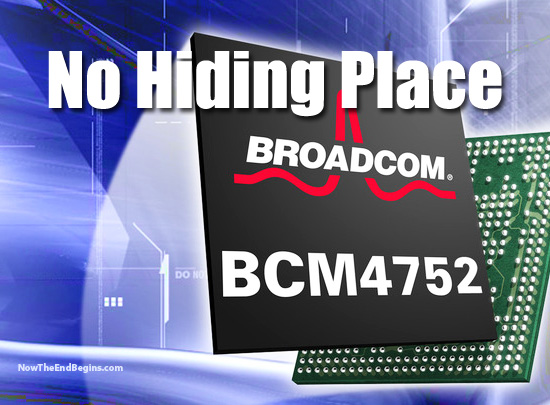
From Technology Review: Broadcom has just rolled out a chip for smart phones that promises to indicate location ultra-precisely, possibly within a few centimeters, vertically and horizontally, indoors and out.
The unprecedented accuracy of the Broadcom 4752 chip results from the sheer breadth of sensors from which it can process information. It can receive signals from global navigation satellites, cell-phone towers, and Wi-Fi hot spots, and also input from gyroscopes, accelerometers, step counters, and altimeters. (NOTE: The Broadcom 4752 chip. When you add 4+7+5+2 you get 18. 18 divided is 6+6+6. Just saying…)
The variety of location data available to mobile-device makers means that in our increasingly radio-frequency-dense world, location services will continue to become more refined.
In theory, the new chip can even determine what floor of a building you’re on, thanks to its ability to integrate information from the atmospheric pressure sensor on many models of Android phones. The company calls abilities like this “ubiquitous navigation,” and the idea is that it will enable a new kind of e-commerce predicated on the fact that shopkeepers will know the moment you walk by their front door, or when you are looking at a particular product, and can offer you coupons at that instant.
The integration of new kinds of location data opens up the possibility of navigating indoors, where GPS signals are weak or nonexistent.
Broadcom is already the largest provider of GPS chips to smart-phone makers. Its new integrated circuit relies on sensors that aren’t present in every new smart phone, so it won’t perform the same in all devices. The new chip, like a number of existing ones, has the ability to triangulate using Wi-Fi hot spots. Broadcom maintains a database of these hot spots for client use, but it says most of its clients maintain their own.
A company that pioneered the construction and maintenance of these kinds of Wi-Fi hot spot databases is SkyHook Wireless. Skyhook CEO Ted Morgan is skeptical that Broadcom can catch up to his company’s software-based system allowing for precise indoor location. “Broadcom is just now talking about something we have been doing for seven to eight years, uncovering all the challenges,” says Morgan. These include battery management and cataloging a new wave of mobile Wi-Fi hot spots. “Broadcom has never done major deployment,” adds Morgan.
Scott Pomerantz, vice president of the GPS division at Broadcom, counters that “the big [mobile] operating systems all have a strategy in place” to create their own Wi-Fi databases. Pomerantz isn’t allowed to name names, but one of Broadcom’s biggest customers is Apple, which previously used Skyhook for location services in its iPhone but now employs its own, Apple-built location system.
At least one feature of Broadcom’s new GPS chip is entirely forward-looking, and integrates data from a source that is not yet commercially deployed: Bluetooth beacons. (Bluetooth is the wireless standard used for short-range communications in devices like wireless keyboards and phone headsets.)
“The use case [for Bluetooth beacons] might be malls,” says Pomerantz. “It would be a good investment for a mall to put up a deployment—perhaps put them up every 100 yards, and then unlock the ability for people walking around mall to get very precise couponing information.”
“The density of these sensors will give you even finer location,” says Charlie Abraham, vice president of engineering at Broadcom. “It could show you where the bananas are within a store—even on which shelf there’s a specific brand.” source – Technology Review
Pharmacy On A Microchip Fast Becoming A Reality
Feb 16th
The Mark of the Beast
“And he causeth all, both small and great, rich and poor, free and bond, to receive a mark in their right hand, or in their foreheads:” Revelation 13:16
Click here to read more on how the coming Mark of the Beast World System is in almost everything you do…
From BBC News: The futuristic idea that microchips could be implanted under a patient’s skin to control the release of drugs has taken another step forward. US scientists have been testing just such a device on women with the bone-wasting disease osteoporosis.
The chip was inserted in their waist and activated by remote control. A clinical trial, reported in Science Translational Medicine, showed the chip could administer the correct doses and that there were no side effects.
The innovation has also been discussed here at the annual meeting of the American Association for the Advancement of Science (AAAS). One of the designers, Professor Robert Langer from the Massachusetts Institute of Technology (MIT), claimed the programmable nature of the device opened up fascinating new avenues for medicine.
“You could literally have a pharmacy on a chip,” he said. “This study used the device for the treatment of osteoporosis. However, there are many other applications where this type of microchip approach could improve treatment outcomes for patients, such as multiple sclerosis, vaccine delivery, for cancer treatment and for pain management.”
The work is described as the first in-human testing of a wirelessly controlled drug delivery microchip. The technology at its core has been in development for more than 15 years.
Programmed to dose
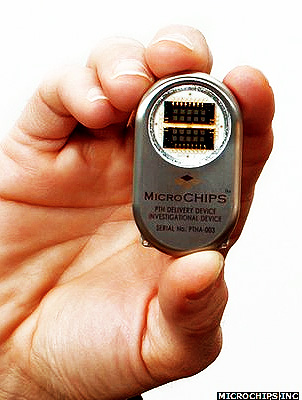
It sees the fingernail-sized chip connected to an array of tiny, individually sealed wells of a drug product – in this case, a parathyroid hormone, teriparatide, which is used to counter bone density loss. Fully packaged, the device is about the size of a heart pacemaker.
The drug wells are capped by a thin membrane of platinum and titanium. A dose can only get out when a well membrane is broken, which is achieved through the application of a small electrical current.
The chip controls the timing, and because it is programmable, the dosages can be scheduled in advance or – as in the newly reported study – triggered remotely by a radio signal. ”When the microprocessor decides to pass current through a particular membrane, that membrane decomposes in about 25 microseconds,” explained co-author Prof Michael Cima. ”The drug is then available for pick up in the capillaries that surround the device to go into the bloodstream.”
The device was tested on seven women between ages of 65 and 70 from Denmark. In their paper, the scientists report that the implant delivered the drug teriparatide just as effectively as the injections pens that often used to administer such treatment, and that there were indications of improved bone formation (although drug efficacy was not formally assessed in the trial). Critically, no side effects were noticed.
The innovation started out as a research project in MIT but is now being developed by a spin-off company, Microchips Inc. The firm is trying to scale up the system so that more doses can be included. In the trial, only 20 wells were present. Microchips Inc believes drug delivery devices containing hundreds of wells are possible.
However, the team acknowledges that a marketable product is still at least five years away.
Clinical promise
Commenting on the research, John Watson, a professor of bioengineering at the University of California, San Diego, listed areas where improvements would be needed. ”In the study, the device failed in one patient (an 8th patient, not included in their analysis), and the manufacturing process yielded only one device with all 20 reservoirs of drug,” he said.
“Nevertheless, all doses present were released from the seven devices. Several years are still needed to bring this technology to approval by the US Food and Drug Administration (FDA) and to the clinical promise reflected in this small study.”
Automated drug delivery systems are likely to prove popular with patients who currently have a daily regimen of self-administered injections. Julia Thomson, a nurse with the UK’s National Osteoporosis Society, said such innovations could improve compliance among patients, some of whom will stop injecting because of the hassle.
“These implants form a new and novel approach to the way in which parathyroid hormone is administered, and although it was a very small study, the findings are certainly exciting,” she said. ”The downside with parathyroid hormone has always been that women have to inject themselves on a daily basis so a new implant, like this, would certainly address compliance issues.”
Ultimately, say the Massachusetts researchers, one could envisage sensors being combined with chips that hold reservoirs of different kinds of drugs, creating a system which could adapt treatments in response to changing conditions in a patient’s body. source – BBC
Mark of the Beast – Hotels To Start Microchipping Bath Towels and Robes
Jul 29th
The mark of the beast edges closer
Click here to read more on the Mark of the Beast…
The days of hotel guests helping themselves to towels and robes when they check out could be a thing of the past as high tech gets in to the linen. One company has come up with a way of adding miniature tags in the expensive materials which were costing hotel managements a fortune to constantly replace.
It has long been assumed, wrongly in most cases, that the smart towelling robes and plush fluffy towels were fair game for guests looking to save some cash at home. But now beware – they may come with an electronic leash as more and more hotels are turning to new radio frequency chips to keep track of their inventory.
The RFID technology – which stands for radio frequency identification and requires an installed chip that can be read by an electronic reader – has been used by various industries for several years to organise product storage and tally shipments.
Now hotels are using the tech to monitor the whereabouts of bathrobes, bed sheets, duvet covers, bathmats, pool towels and banquet linens. Up to 20 per cent of hotels’ stock typically go missing, estimates William Serbin of Linen Tracking Technology.
The company, which sells trackable linens, has teamed with Fluensee, an inventory tracking technology firm, to market the RFID tags to hotels. A towel with a chip is about a dollar more than other towels, he says. Bendable and washable, the tags can be read by sensors up to six feet away. When towels are removed from a closet, for example, a reader station can register how many, so that the closet can be restocked. source – Daily Mail UK
Click here to read more on the Mark of the Beast…