Barack Hussein Obama
Rising Muslim-Democrat Furor Over Obama’s Jerusalem Flip-Flop Platform Vote
“I’m concerned that Arab-Americans will feel they got punched in the solar plexus,” said James Zogby, the president of the Arab-American Institute who serves on the Democratic Party’s platform committee. “This was ham-fisted and a blunder … They stepped all over the convention the way this was done.”

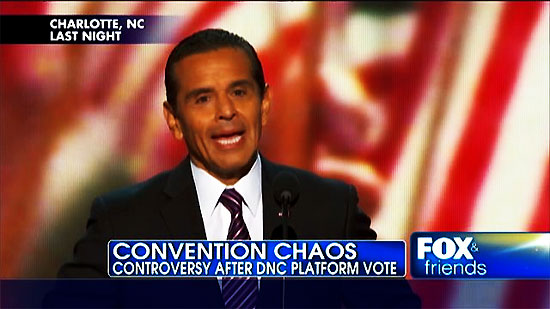
CHARLOTTE, N.C. — The Democratic party’s abrupt platform reversal on Jerusalem — reinstating language describing it as the capital of Israel despite loud objections from the Democratic National Convention floor — stirred fresh and unexpected controversy Thursday in Charlotte as Arab-American and Muslim party officials expressed anger over how the issue was handled and predicted that it may suppress Democratic votes this fall among constituents in key swing states.
Los Angeles Mayor Antonio Villaraigosa found himself at the center of the controversy on Wednesday over whether to include in the Democratic Party platform the statement that Jerusalem is the capital of Israel, when he rammed the proposal through on a voice vote in which the “yeas” did not come close to drowning out the “nays.”
“I’m concerned that Arab-Americans will feel they got punched in the solar plexus,” said James Zogby, the president of the Arab-American Institute who serves on the Democratic Party’s platform committee. “This was ham-fisted and a blunder … They stepped all over the convention the way this was done.”
Zogby, who has long served as a key party liaison to the Arab-American community, made his comments Thursday outside a luncheon meeting of the Muslim Democratic caucus, a group that consists of 112 delegates. Many of those present shared his outrage, especially at Los Angeles Mayor Antonio Villaraigosa, the convention chairman.
During the proceedings Wednesday, Villaraigosa asked convention delegates three times to approve by voice-vote a motion reinstating language that had been dropped from the official party platform, declaring that “Jerusalem is and will remain the capital of Israel.”
Despite a loud chorus of “No!” and some boos that appeared to be at least as loud as those shouting “Yes,” Villaraigosa declared the motion to have passed by the required two-thirds vote.
Most political analysts have portrayed the Jerusalem issue as a potent one because of its potential impact on Jewish voters. But Zogby and others at the luncheon noted that Arab-Americans and Muslim-American voters are a growing and important voting block: The number of Muslim Americans — now about 2.6 million — is expected to double to 6.2 million by 2030. Moreover, their numbers are especially concentrated in key swing states such as Ohio and Florida: There are, for example, currently 124,000 Muslim voters in Florida alone. source – NBC Politics








Barack Hussein Obama
THE PROPHECY NEWS PODCAST: The Obama Library Opens In Chicago As A Dystopian Granite Monolith Like The Headquarters Of A Post-American ‘1984’ Future
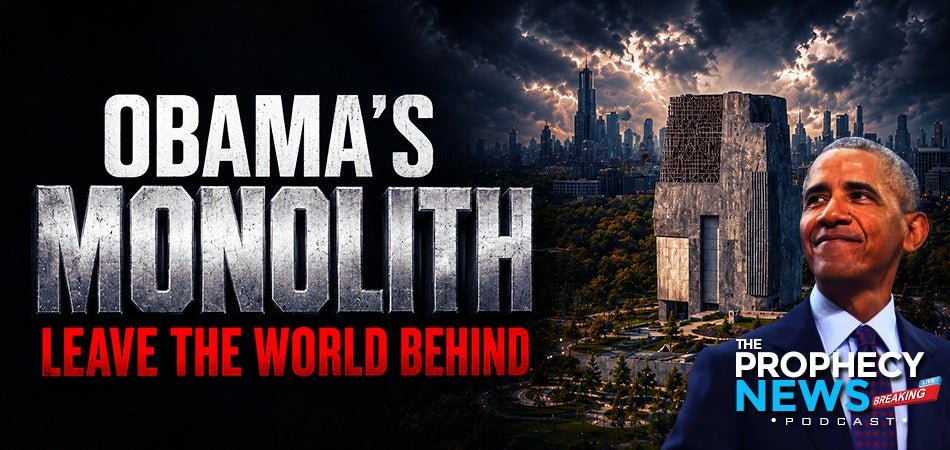
Barack Hussein Obama’s Dark Presidential Library Rises Over Chicago Like A ‘1984’ Dystopian Fortress From The World Of ‘Leave The World Behind’
Barack Obama’s entire political career was built on image. The logo, the posters, the “citizen of the world” speeches. The “hope and change.” The global adoration, the fainting crowds and the messianic language from the media. The Nobel Peace Prize before he had done anything to earn it. The carefully produced cultural aura surrounding him was always bigger than the man himself. Now that image has been literally poured into concrete and granite, with the result looking exactly like what it always was: cold, controlled, menancing, towering, and spiritually empty.
“Cease ye from man, whose breath is in his nostrils: for wherein is he to be accounted of?” Isaiah 2:22 (KJB)
On this episode of the Prophecy News Podcast, in 2023, Barack and Michelle Obama’s Higher Ground Productions was attached to Netflix’s ‘Leave The World Behind’, the dystopian thriller directed by Sam Esmail in which America begins collapsing through cyberattack, communications failure, infrastructure breakdown, mass confusion, and psychological terror. Netflix identified Higher Ground as part of the project, and the film itself was sold as a story about a mysterious blackout and a nation coming apart under invisible forces. Now take that imagery and place it side by side with Obama’s new Presidential Library in Chicago. On one side, you have Obama’s Netflix-backed dystopian nightmare: America cut off, Americans confused, phones dead, media gone, planes falling, tankers crashing, trust evaporating, and citizens left to wonder who is really behind the collapse. The end of the movie reveals it to be the American government. On the other side, you have Obama’s real-world presidential tower that is massive, dark, nearly windowless, and standing over Chicago like the headquarters of the people who would remain after the collapse was complete. The official story is “democracy,” “hope,” “community,” and “civic engagement.” But the visual story is something very different. The visual story is granite, height, surveillance-age design, digital archives, curated memory, political legacy, and a near-religious treatment of a man whose presidency accelerated America’s transformation into the globalized, technocratic, identity-driven, post-Christian system we are watching harden all around us. It is literally a depiction of George Orwell’s ‘1984’. The UK Guardian said “Towering over a low-income area of Chicago, and wrapped in a speech that’s hard to decipher, this controversial monolith feels like a menacing sci-fi HQ. Is it a monument – or a mausoleum?” That’s a great question, and today we bring you all the news you need to know here on Day 2,270 of 15 Days To Flatten The Curve!
Study Helps And Links For Today’s Podcast
- Today Was Another Bible Distribution Day At The Glory Fellowship Church In Kenya Where Operation Africa! Delivered Hundreds Of Bibles In Ekegusii And English
- Why Are So Many Things From The Barack Obama Netflix Civil War Movie ‘Leave The World Behind’ Suddenly Starting To Take Place? You Know Why.
- 2018 IRONY: Community Organizers In Chicago Now Fighting Against Barack Obama And His Proposed Presidential Library
- 6 Places Where Chilling Dystopian Events Forewarned About In George Orwell’s ‘1984’ Have Already Come True Both Here In America And Around The World
We Are Broadcasting Live Four Days A Week
-
The BIBLE BELIEVERS Sunday Service
Every Sunday morning, from 11:00 AM – 12:30 PM EST, we invite you to join us live and in-person at the Bible Believers Church here inside the NTEB Bookstore in Palatka where we lift up the Lord Jesus Christ in psalms, hymns and spiritual songs, and preach a message from the pages of the King James Authorized Version Holy Bible.
OUR MOST RECENT SUNDAY SERVICE VIDEO: Chief Of Sinners
• The RIGHTLY DIVIDING Radio Bible Study
Every Sunday evening from 7:00 – 9:00 PM EST, we offer an in-depth rightly dividing and dispensationally correct rocket ride through the preserved word of God as found within the pages of the King James Holy Bible.
- SUNDAY NIGHT: Our original Sunday Night Radio Bible Study, it’s from 7:00 – 9:00 PM EST, and we have praise, singing, testimony and of 90-minute King James Bible study. All our King James bible study programs are archived here.
• The NTEB PROPHECY NEWS PODCAST Hour
Every Monday and Friday afternoons from Noon to 1:30 PM EST, we examine breaking news and current events in light of bible prophecy.
- MONDAY AT NOON: Every Monday at Noon we review all the latest news and events related to bible prophecy, and examine what is happening in light of what is written. If you miss the live show, all of our Prophecy News Podcast programs are archived here.
- FRIDAY AT NOON: Friday at Noon we review all the latest news and events related to bible prophecy, and examine what is happening in light of what is written. If you miss the live show, all of our Prophecy News Podcast programs are archived here.
Your Generous Donations Make These Live King James Radio Bible Studies & Prophecy News Podcasts Possible!
HOW TO DONATE: Click here to view our WayGiver Funding page
Listen to What Our Donation Angels Have to Say About the Ministry of Now The End Begins
- “You are truly an end time ministry and I appreciate how our Precious Lord is using you to educate his very own flock. There is a lot of confusion , but your ministry is putting scripture in the right prospective. Thank-you so so much Geoffrey S Grider for standing firm and putting in a lot of hours of your time. God Bless You , also your Ministry and your family. IN JESUS MIGHT NAME.” T. Muto
- “Jesus. I am now 64 years old and never in all the years I’ve been a Christian was I able to grow in the Lord as much as I have in the last past year. All because of our blessed brother’s work Geoffrey Grider who as the bravery of standing fast forward without fear of claiming the truth of God by the power of his love in Jesus Christ. May God bless you abundantly to the end my dear brother… ROMANS: 8: 36,37,38” Mireille Anderson
- “I met you at the car dealership earlier this year. We spoke briefly, then you handed me a card and told me to check out the website. You left. A few minutes later, you returned to tell me not to forget to look up the website. I told you…” I already did. I already subscribed.” In that short time we spoke, I experienced from you…a total stranger…peace, joy, kindness, gentleness, compassion, and love. I am convinced that God sent you to share the Good News that Jesus Christ is our Lord and Savior. For that, and for the work you are doing for the Kingdom of God, I say…Thank you and God Bless You.” Sonia Merced
- “I really enjoy the emails and Bible studies! I haven’t found a church and enjoy your services very much! Be blessed brother!” Marcia Mann
- “You and your organization are on the front lines in the Battle For Truth…. current events, end times, and trying to awaken a sleeping Laodicean Church. Thank you brother for fighting for us and all your teaching and insight God bless…” Daniel Cartrette
- I just want to thank you for the teachings you give every Sunday night on radio. You are such a blessing to me. I absolutely love your way of teaching the scriptures. I don’t have a church where I can have fellowship and teaching, so you have been my teacher for many months now. Thanks God you are there for all of us who have no church to go to. I pray that the Lord will bless you abundantly in your ministry, and your loved ones too. You are such a blessing to me, and many others, in these last days before the rapture. Thank you so much Geoffrey, from the bottom of my heart. May the Lord keep you, until He comes back for us. You are in my prayers.” Donald Godin
- “Thank you for the work you are doing brother. Your page and your testimony were a blessing to me this morning as I came across it for the first time. Thank you for the reality of your testimony and what God has done for you in introducing you to Jesus our Lord. God has brought me, in salvation, to Himself as well, through His love and mercy and grace in salvation. How can we praise Him enough? How can we not share this good news!? I pray this day for God’s blessing on your ministry that He may save many souls through the work He has called you to. Isaiah 40:31 (KJV)” Mark and Melissa
- “Love the Sunday night bible study. I want to support someone who has the passion for the lost like Geoffrey does and rightly divides the word of God. God bless you.” Teresa Carey
- “I give because not many news outlets are brave enough or Godly enough to tell these stories from a Christian’s point of view. I see stories here that will not be seen anywhere else.” William Grayshaw
- “It’s hard to find solid biblical teaching in America these days. It’s a blessing to be able to take part in a ministry financially without being concerned about false teaching. All glory to God! God bless!” Maximilian Swan
- “I donate because you are reporting the truth about the increasing wickedness of our time, as God’s word foretold. In so doing we are reminded to “Keep looking up” as we wait in joyful hope for the Lord’s coming, Maranatha! ” Anthony Sloane
- “Geoffrey has the best End Times News out there. I have been receiving his emails for years now and always enjoy his Sunday night messages although I don’t always think exactly as he thinks. We are all in this “boat of life” together and as I come to the end of my life’s journey here, I am more aware of Jesus’s call for us to be one as He and the Father are One.” Deborah Cleaveland
STREET-TESTED NTEB GOSPEL TRACTS:
This is the official gospel tract of NTEB, used here on the streets of Saint Augustine and sent around the world as they are purchased through our website. We ask you to prayerfully consider supporting the work of Now The End Begins by purchasing a box of these full-color, high-quality gospel tracts. Thank you in advance!
But whatever you do, don’t do nothing. Time is short and we need your help right now. The Lord has given us an open door with a tremendous ‘course’ for us to fulfill that will create an excellent experience at the Judgement Seat of Christ. Please pray for our efforts, and if the Lord leads you to donate, be as generous as possible. The war is REAL, the battle HOT and the time is SHORT…TO THE FIGHT!!!
“Looking for that blessed hope, and the glorious appearing of the great God and our Saviour Jesus Christ;” Titus 2:13 (KJB)
“Thank you very much!” – Geoffrey, editor-in-chief, NTEB
Barack Hussein Obama
President Trump Says Barack Obama Is Guilty Of ‘Sedition And Treason’ Against The United States And That ‘Papers Are Signed’ To Have Him Arrested
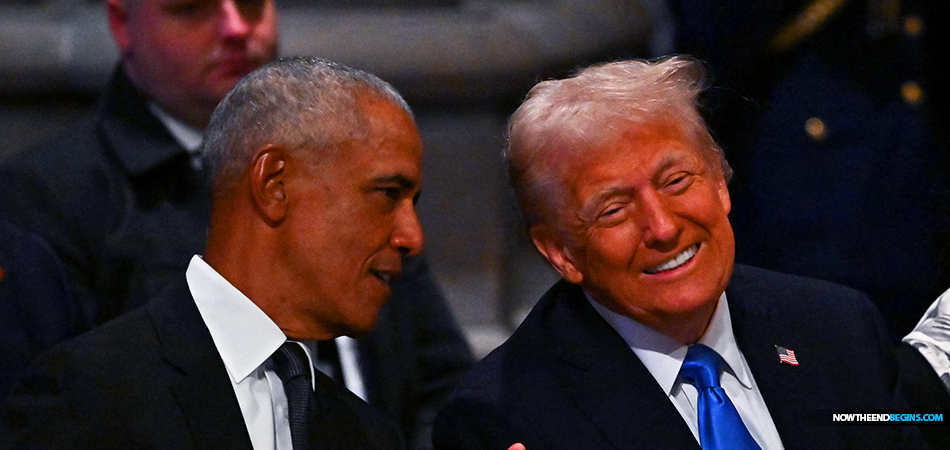
Former President Barack Obama’s office claims that the Office of the Director of National Intelligence (ODNI) report indicating senior officials in the Obama administration orchestrated the “Russia Collusion” hoax after President Donald Trump was elected, is “outrageous.”
President Trump in his efforts to make the Epstein files scandal go away has put himself in a very precarious position. He has accused former president Barack Obama of ‘sedition and treason’ against the government of the United States, has pronounced him to be guilty, saying “it’s time to go after people”.
“Let me be weighed in an even balance, that God may know mine integrity.” Job 31:6 (KJB)
Here’s the problem with all that. If Trump, having pronounced Obama to be guilty of the highest crime possible against the nation, does not have him arrested nearly immediately, it will show that Trump is lying. Trump would then be guilty of libel for publishing false statements and slander for speaking false statements. If Trump does have Obama led away in handcuffs, it will ignite a firestorm not seen since the last civil war. On our Podcast yesterday, I called Trump’s bluff, and said he would never do that while at the same time allowing for the slightest possibility that he just might. Crazy is as crazy does. Obama today called Trump’s accusations “outrageous”, and said his claims are “without merit”. Having now successfully painted himself into the proverbial corner, Trump has to ‘put up or shut up’, and arrest Obama and try him, or be branded a liar. What do you think he’ll do?
Obama’s Office Responds to Trump’s Accusation of Treason: ‘Outrageous’
FROM BREITBART NEWS: Obama spokesman Patrick Rodenbush issued a statement challenging the report released by Director of National Intelligence Tulsi Gabbard on Friday, according to a screenshot from the Hill White House columnist Niall Stanage.
The ODNI report found “overwhelming evidence that demonstrates how, after President Trump won the 2016 election against Hillary Clinton, President Obama and his national security cabinet members manufactured and politicized intelligence to lay the groundwork for what was essentially a years-long coup against President Trump,” per a release from Gabbard’s office.
BREAKING NEWS: President Trump from the Oval Office has just declared that former president Barack Obama is guilty of treason. How long until he issues the order to arrest Obama? Because if he doesn’t, then he’s lying. What happens next should be interesting. pic.twitter.com/0pk5MfPkQO
— Now The End Begins (@NowTheEndBegins) July 22, 2025
Rodenbush heavily denied the allegations in the report:
- Out of respect for the office of the presidency, our office does not normally dignify the constant nonsense and misinformation flowing out of this White House with a response. But these claims are outrageous and merit one. These bizarre allegations are ridiculous and a weak attempt at distraction.
- Nothing in the document issued last week undercuts the widely accepted conclusion that Russia worked to influence the 2016 presidential election but did not successfully manipulate any votes. These findings were affirmed by the bipartisan Senate Intelligence Committee, led by then-Chairman Marco Rubio.
The statement comes hours after Trump declared Obama is “guilty.”
“He’s guilty. It’s not a question, you know, I like to say, ‘Let’s give it time.’ It’s there. He’s guilty… This was treason. This was every word you can think of. They tried to steal the election. They tried to obfuscate the election,” Trump told reporters in the Oval Office.
Trump also emphasized that he did not pursue charges against twice-failed presidential candidate Hillary Clinton in 2017 over her email scandal, but said after what has happened to him over the past decade, “it’s time to go after people.”
“You know, when we caught Hillary Clinton, I said, ‘You know what, let’s not… go too far here; It’s the ex-wife of a president.’ And I thought it was sort of terrible, and I let her off the hook. And I’m very happy I did,” Trump said. “…After what they did to me, and whether it’s right or wrong, it’s time to go after people. Obama’s been caught directly. So people say, ‘Oh, you know a group.’ It’s not a group, it’s Obama. His orders are on the paper. The papers are signed,” Trump added. READ MORE
Donald Trump says Barack Obama is ‘guilty of treason’ against the United States
Now The End Begins is your front line defense against the rising tide of darkness in the last Days before the Rapture of the Church
- HOW TO DONATE: Click here to view our WayGiver Funding page
When you contribute to this fundraising effort, you are helping us to do what the Lord called us to do. The money you send in goes primarily to the overall daily operations of this site. When people ask for Bibles, we send them out at no charge. When people write in and say how much they would like gospel tracts but cannot afford them, we send them a box at no cost to them for either the tracts or the shipping, no matter where they are in the world. We have a Gospel Billboard program. We are now broadcasting Bible studies, Podcasts and a Sunday Service 5 times a week, thanks to your generous donations. All this is possible because YOU pray for us, YOU support us, and YOU give so we can continue growing.

But whatever you do, don’t do nothing. Time is short and we need your help right now. The Lord has given us an open door with a tremendous ‘course’ for us to fulfill that will create an excellent experience at the Judgement Seat of Christ. Please pray for our efforts, and if the Lord leads you to donate, be as generous as possible. The war is REAL, the battle HOT and the time is SHORT…TO THE FIGHT!!!
“Looking for that blessed hope, and the glorious appearing of the great God and our Saviour Jesus Christ;” Titus 2:13 (KJB)
“Thank you very much!” – Geoffrey, editor-in-chief, NTEB
Barack Hussein Obama
THE PRESIDENT THAT WASN’T THERE: Joe Biden Comes To An Ignominious End As The Third Term Proxy Presidency Of Barack Obama Comes To A Close
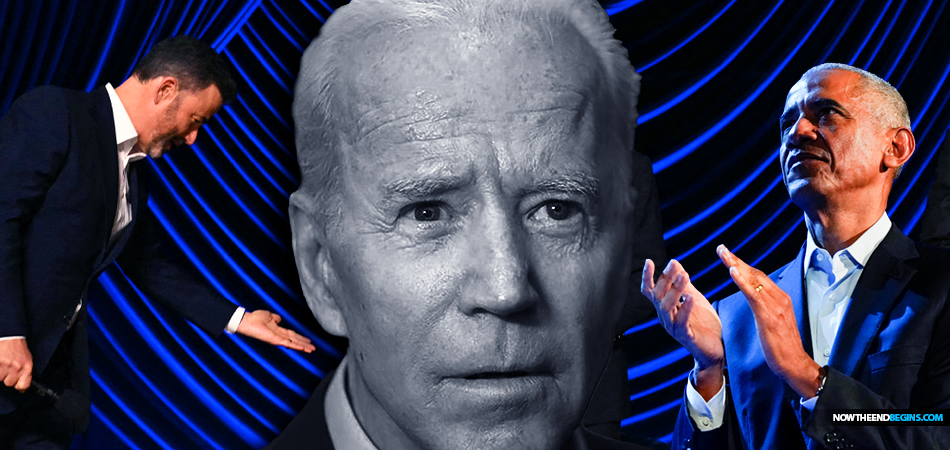
For 4 years, the White House has run a con game that Joe Biden was a functioning leader, in reality it was the presidency by proxy of Barack Obama in his third term pulling the strings
Earlier today, the usually conservative Wall Street Journal ran a blistering story on how the entire Biden administration spent 4 years conning America that Joe Biden was actually in charge and calling the shots. It’s a stunning article, a segment captured below, and we encourage you to read the whole thing on wsj.com. What they left out, however, was that it was way more than just a con game, it was the literal third term of Barack Obama, made possible by the president who wasn’t there, Joe Biden.
“When the righteous are in authority, the people rejoice: but when the wicked beareth rule, the people mourn.” Proverbs 29:2 (KJB)
We have told you before Joe Biden was ever sworn in that the whole reason he was chosen was because of his highly diminished mental faculties, that way he could be propped up before the cameras while Barack Obama called all the shots like the Wizard of Oz from behind the curtain. Biden went bad, to worse, to “replace him with Kamala” in sickeningly realistic fashion. The main stream media did their part by refusing to report on Biden’s obvious ‘absent while present’ speech patterns, weird gesture and motions, and everyone’s favorite thing to pretend is not happening, his walking away from the podium as if he had no idea where he was. He had no idea. What does all this have to do with drones over New Jersey? The same government that told you Joe Biden was fine is the same government telling you there is nothing to worry about with the drones. That’s the memo.
How the White House Functioned With a Diminished Biden in Charge
FROM THE WALL STREET JOURNAL: The president’s slide has been hard to overlook. While preparing last year for his interview with Robert K. Hur, the special counsel who investigated Biden’s handling of classified documents, the president couldn’t recall lines that his team discussed with him. At events, aides often repeated instructions to him, such as where to enter or exit a stage, that would be obvious to the average person. Biden’s team tapped campaign co-chairman Jeffrey Katzenberg, a Hollywood mogul, to find a voice coach to improve the president’s fading warble.
Biden, now 82, has long operated with a tightknit inner circle of advisers. The protective culture inside the White House was intensified because Biden started his presidency at the height of the Covid pandemic. His staff took great care to prevent him from catching the virus by limiting in-person interactions with him. But the shell constructed for the pandemic was never fully taken down, and his advanced age hardened it.
The structure was also designed to prevent Biden, an undisciplined public speaker throughout his half-century political career, from making gaffes or missteps that could damage his image, create political headaches or upset the world order.
The system put Biden at an unusual remove from cabinet secretaries, the chairs of congressional committees and other high-ranking officials. It also insulated him from the scrutiny of the American public.
For the past 3.5 years, Barack Obama has been operating his Third Term through the rented body of Joe Biden. Listen to what he said to Stephen Colbert about how that term would function. Now you know why Democrats nominated a mentally-impaired person. pic.twitter.com/qGgviU6Kek
— Now The End Begins (@NowTheEndBegins) July 20, 2024
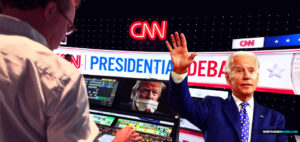
The strategies to protect Biden largely worked—until June 27, when Biden stood on an Atlanta debate stage with Trump, searching for words and unable to complete his thoughts on live television. Much of the Democratic establishment had accepted the White House line that Biden was able to take the fight to Trump, even in the face of direct evidence to the contrary.
On July 13, Biden held an uncomfortable call with a group of Democratic lawmakers called the New Democrat Coalition, aimed at reassuring them about his ability to stay in the race.
The president told participants that polling showed he was doing fine. He became angry when challenged, according to lawmakers on the call. At one point, Biden looked up and abruptly told the group he had to go to church. Some lawmakers on the call believed someone behind the camera was shutting it down. Biden dropped out of the race eight days later. READ MORE
The sad and strange decline of Joe Biden
Joe Biden dropped out of the race to become the next president, after a series of gaffes in 2024 raised concerns about his age, and a disastrous presidential debate performance caused alarm within the Democratic party.
Now The End Begins is your front line defense against the rising tide of darkness in the last Days before the Rapture of the Church
- HOW TO DONATE: Click here to view our WayGiver Funding page
When you contribute to this fundraising effort, you are helping us to do what the Lord called us to do. The money you send in goes primarily to the overall daily operations of this site. When people ask for Bibles, we send them out at no charge. When people write in and say how much they would like gospel tracts but cannot afford them, we send them a box at no cost to them for either the tracts or the shipping, no matter where they are in the world. We have a Gospel Billboard program. We are now broadcasting Bible studies, Podcasts and a Sunday Service 5 times a week, thanks to your generous donations. All this is possible because YOU pray for us, YOU support us, and YOU give so we can continue growing.
But whatever you do, don’t do nothing. Time is short and we need your help right now. The Lord has given us an open door with a tremendous ‘course’ for us to fulfill that will create an excellent experience at the Judgement Seat of Christ. Please pray for our efforts, and if the Lord leads you to donate, be as generous as possible. The war is REAL, the battle HOT and the time is SHORT…TO THE FIGHT!!!
“Looking for that blessed hope, and the glorious appearing of the great God and our Saviour Jesus Christ;” Titus 2:13 (KJB)
“Thank you very much!” – Geoffrey, editor-in-chief, NTEB


























-

 George Soros10 years ago
Proof Of George Soros Nazi Past Finally Comes To Light With Discovery Of Forgotten Interview
-
Election 201610 years ago
DEAD POOL DIVA: Huma Abedin Kept Those Hillary Emails That The FBI Found In A Folder Marked ‘Life Insurance’
-
Election 201610 years ago
Crooked Hillary Campaign Used A Green Screen At Today’s Low Turnout Rally In Coconut Creek FL
-
George Soros10 years ago
SORE LOSER: George Soros Declares War On America As Violent MoveOn.Org Protests Fill The Streets
-
Donald Trump10 years ago
Donald Trump Will Be 70 Years, 7 Months And 7 Days Old On First Full Day In Office As President
-
Headline News10 years ago
If Hillary Is Not Guilty, Then Why Are Her Supporters Asking Obama To Pardon Her? Hmm…
-
Election 201610 years ago
WikiLeaks Shows George Soros Controlling Vote With 16 States Using SmartMatic Voting Machines
-
End Times10 years ago
False Teacher Beth Moore Endorses The Late Term Partial-Birth Abortion Candidate Crooked Hillary