Middle East
Saleh Forced Out As Yemen Is Latest Country To Fall In Arab Spring Riots
From January 2011 he struggled to quell big popular protests against his rule as a spate of gunbattles pushed Yemen closer to civil war. The violence culminated in deadly clashes between forces of the Hashed tribal group and government troops. Under mounting pressure, Saleh agreed to sign a Gulf accord in November that was meant to see him gradually relinquish power.

SANAA (Reuters) – Ali Abdullah Saleh, who once compared his 33-year rule of Yemen to “dancing on the heads of snakes,” formally steps down this week after Yemenis anoint a new president in an election many hope will give Yemen a chance for democracy.
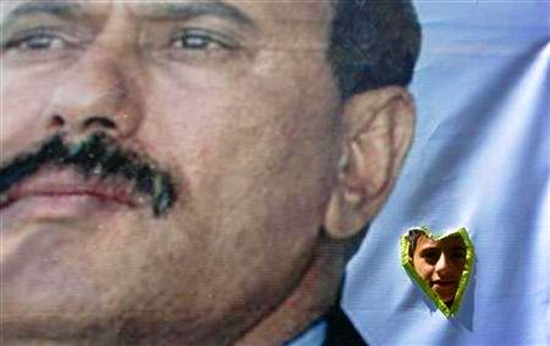
A boy looks through a hole in a banner, with an image of Yemen's outgoing President Ali Abdullah Saleh, as he performs the weekly Friday prayers during a rally to show support for him in Sanaa January 27, 2012. REUTERS/Mohamed al-Sayaghi
No ceremonies are expected to mark the end for Saleh, who is out of the country being treated in the United States for injuries he sustained in an assassination attempt last June.
But the election, in which Saleh’s deputy Abd-Rabbu Mansour Hadi is the only candidate, is expected to pave the way for Yemen to introduce political and economic reforms and give it a chance to restructure security forces currently run by the outgoing president’s relatives.
Before he flew to the United States last month, Saleh apologized for “any shortcoming” in his rule and said he planned to come back. “I will return to Sanaa as head of the General People’s Congress party,” he told senior party and government officials in a televised speech before his departure on January 22.
From January 2011 he struggled to quell big popular protests against his rule as a spate of gunbattles pushed Yemen closer to civil war. The violence culminated in deadly clashes between forces of the Hashed tribal group and government troops. Under mounting pressure, Saleh agreed to sign a Gulf accord in November that was meant to see him gradually relinquish power.
But fears remain that the accord, inked in Saudi Arabia, the world’s No. 1 oil exporter which shares a long porous border with Yemen, may not provide the impoverished Arabian Peninsula state with a roadmap out of misery and chaos.
The bombing of Saleh’s compound in June, an apparent assassination attempt, left Saleh with severe burns, forcing him to seek treatment in Saudi Arabia, one of Yemen’s resource-rich neighbors which had tried in vain to ease him from power.
Ever nimble, Saleh reneged on three deals to transfer power before the attempt on his life and shrugged off U.S. and Saudi pressure to stay in exile, making good on a promise to return home in September.
But international pressure redoubled in October, when the U.N. Security Council adopted a resolution demanding he sign a handover plan brokered by Gulf neighbors. France and Britain hinted at European Union sanctions against him.
The United States has talked openly of its concern about who might succeed Saleh, an ally in the fight against al Qaeda in the Arabian Peninsula, a Yemen-based wing of the militant group.
Until last year, Saleh’s grip on power seemed unshakeable. In 2010, supporters pushed for constitutional changes to allow him unlimited five-year terms as president. Speculation was high that he was grooming one of his sons as a possible successor.
But popular uprisings that toppled Tunisian President Zine al-Abidine Ben Ali and Egypt’s Hosni Mubarak resonated in Yemen, drawing tens of thousands to daily protests in Sanaa and in Taiz to the south, threatening his apparent dynastic ambitions.
Saleh began to offer concessions.
First, he said he would not stand for re-election in 2013 and dismissed the idea of his son succeeding him. Then he offered a referendum on a new constitution by the end of the year and a shift to a truly democratic “parliamentary system.”
But after the death of 52 protesters in March, mostly by sniper fire, a string of generals, tribal leaders, diplomats and ministers either resigned or switched their allegiance to the protesters.
They included key figures in the al-Ahmar and Sanhan tribes, kinsmen who Saleh had placed in key military and other positions.
When confronted with a power transfer deal brokered by the six-member Gulf Cooperation Council, Saleh was forced to accept that he has lost the ability to win back his former allies, and sign up to the deal.
OVERSAW UNIFICATION
Saleh became the ruler of North Yemen in 1978 at a time when the south was a separate communist country, and has led the unified country since the two states merged in 1990.
Opponents often complained that he failed to address the basic needs of Yemen’s people, two-thirds of whom live on less than $2 per day. Oil wealth is dwindling and water is running out, though liquefied natural gas exports began in 2009.
Yet Saleh managed to keep Western and Arab powers on side.
After the September 11, 2001 attacks on U.S. cities, Washington became more aware of Yemen as a source of foot soldiers for Osama bin Laden’s al Qaeda network. Bin Laden himself, though born in Saudi Arabia, could trace his roots back to Yemen’s Hadramaut region.
Saleh cooperated with U.S. authorities, and the CIA started taking action against wanted figures. But by 2007, militants had regrouped in Yemen, and in 2008 they announced that their Saudi and Yemeni wings had united under the banner of al Qaeda in the Arabian Peninsula.
From 2009, the resurgent group made ever bolder attempts to stage attacks on Saudi and U.S. targets beyond Yemen, as well as targeting foreign tourists at home. At the same time, Shi’ite Muslims in the north rebelled against Saleh’s rule and southerners, feeling marginalized, began a new separatist drive.
Saudi Arabia, the United States and other allies responded by stepping up financial support to bolster Saleh’s rule.
If Saleh has been a determined survivor, he has also been a charismatic and often popular ruler with a canny understanding of the workings of Yemeni society.
Born in 1942 near Sanaa, Saleh had only limited education before joining the military as a non-commissioned officer.
His first break came when President Ahmed al-Ghashmi, who came from the same Hashed tribe as Saleh, appointed him military governor of Taiz, North Yemen’s second city. When Ghashmi was killed by a bomb in 1978, Saleh replaced him.
In 1990, an array of domestic and regional circumstances propelled North Yemen under Saleh and the socialist South Yemen state into a unification that Saudi Arabia at first opposed.
He angered Riyadh by staying close to Saddam Hussein during the 1990-91 Iraqi occupation of Kuwait, leading to the expulsion of up to one million Yemenis from Saudi Arabia. Before the crisis, Kuwait had given Yemen financial aid.
But Saleh then won plaudits from Western powers for carrying out economic reforms drawn up by the International Monetary Fund and World Bank, and made efforts to attract foreign investors.
His General People’s Congress party swept to victory in a 1993 parliamentary election, the first held after unification. South Yemen tried but failed to secede in a brief civil war in 1994 and Saleh then proceeded to move closer to Saudi Arabia, allowing an influx of its radical Wahhabi form of Sunni Islam. source – Yahoo News







Headline News
The Three Musketeers Of Islam: Saudi Arabia, Turkey And Pakistan Are Building A Military Alliance That Will Soon Find Itself Standing Against Israel And Jerusalem
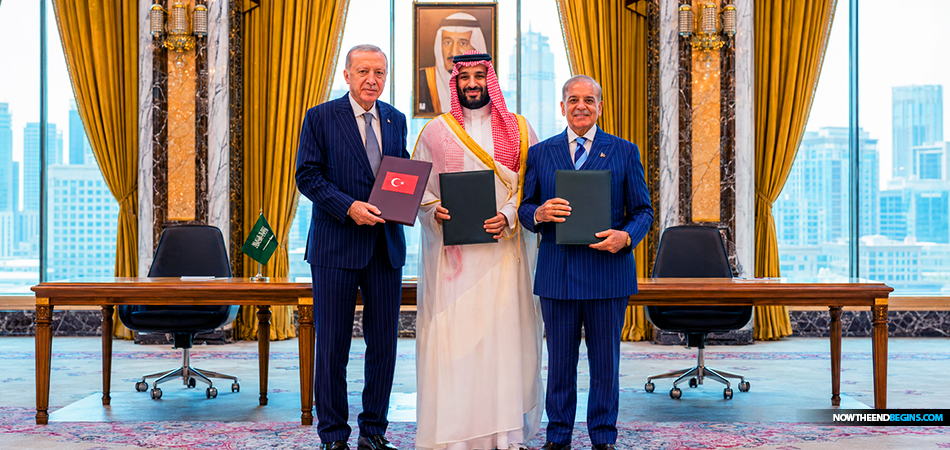
The Three Musketeers Of Islam: Saudi Arabia, Turkey And Pakistan Are Building A Military Alliance That Will Soon Find Itself Standing Against Israel And Jerusalem
The Telegraph has dubbed the emerging partnership between Saudi Arabia, Turkey and Pakistan “The Three Musketeers”, invoking the famous slogan “all for one, one for all,” and there is something almost darkly humorous about the comparison. On the surface, this is being presented as another strategic defense arrangement designed to strengthen regional security in an increasingly unstable world. But when you look at the three nations involved, the military power they represent, their relationship to the Islamic world, and their individual attitudes toward the Jewish state, it becomes increasingly difficult to imagine that Israel will not eventually become one of the primary objects of this alliance.
“For, lo, thine enemies make a tumult: and they that hate thee have lifted up the head.” Psalm 83:2 (KJB)
Saudi Arabia brings staggering financial power, enormous influence over the global energy markets and, perhaps most significantly, its position as guardian of Mecca and Medina, the two holiest cities in Islam. Turkey brings one of the largest and most capable military forces in the Muslim world, a rapidly expanding defense industry, advanced drones and missile technology, and a government under Recep Tayyip Erdoğan that has become increasingly hostile toward Israel. Pakistan brings a massive standing army and something that neither Saudi Arabia nor Turkey presently possesses: nuclear weapons. When you combine Saudi money, Turkish military capability and Pakistani nuclear power inside a developing Islamic security structure, you are no longer talking about a meaningless diplomatic photo opportunity. You are looking at the beginnings of a military bloc that has the potential to become enormously consequential, and prophetically deadly.
The leaders involved may insist today that their partnership is defensive, that it is not directed against any particular country and that its purpose is merely to protect their mutual interests. That is precisely the sort of language governments use when military alliances are being assembled. Alliances are rarely formed by announcing on the first day who the eventual enemy will be. Instead, nations construct the framework, establish military cooperation, conduct joint exercises, coordinate intelligence, share weapons technology and build the political relationships necessary for collective action. Then a crisis comes along and reveals what the structure was really capable of becoming. In the Middle East, the crisis that eventually forces everyone to choose a side has a remarkable way of coming back to the same place over and over again: Israel and Jerusalem.
Turkey has already traveled a considerable distance down that road. Erdoğan has spent years positioning himself as one of the loudest defenders of the Palestinian cause while his government’s relationship with Israel has deteriorated dramatically. Pakistan has never recognized the State of Israel at all, and opposition to Israel remains deeply embedded in its political and religious establishment. Saudi Arabia is the most fascinating member of this emerging trio because the kingdom has spent years appearing to move closer to possible normalization with Israel while simultaneously attempting to preserve its leadership position in the Islamic world. The Abraham Accords opened the possibility of an entirely new Middle Eastern security architecture centered around normalization with the Jewish state, and for years Saudi Arabia has been viewed as the ultimate prize of that process. Now Riyadh is simultaneously drawing closer militarily to Turkey and nuclear-armed Pakistan.
That tension cannot continue indefinitely, and Saudi Arabia cannot permanently occupy two geopolitical worlds if those worlds eventually collide. It can pursue commercial cooperation and diplomatic engagement with Israel while regional conditions remain relatively stable, but when the next major confrontation erupts over Gaza, Jerusalem, the Temple Mount, Iran, Lebanon, Syria or some crisis that has not yet appeared on the horizon, Riyadh may find itself forced to decide where its deepest loyalties actually reside. Saudi Arabia is not simply another Arab nation. It occupies a unique position within Islam itself, and the pressure upon the kingdom to stand with the Muslim world against Israel during a sufficiently explosive regional crisis would be tremendous.
That is why I believe the eventual direction of these “Three Musketeers” isn’t overly difficult to see. Turkey is already openly antagonistic toward Israel, Pakistan refuses even to recognize Israel’s existence, and Saudi Arabia is binding itself more closely to both countries militarily. Whatever cordial diplomatic language accompanies the arrangement today, this is a coalition being constructed from nations whose long-term interests and religious identity place them on a collision course with the Jewish state.
This is also where we have to rightly divide the prophetic scriptures and avoid one of the most common errors in modern prophecy teaching. This is not Ezekiel 38. Ezekiel 38 does not describe some Russian, Turkish, Iranian or Muslim coalition attacking modern-day Israel before the Tribulation or during the Church Age. The battle in Ezekiel 38 takes place after the thousand-year reign of Jesus Christ, when Satan is loosed from his prison and goes out to deceive the nations once again, exactly as Revelation 20:7–9 describes. Israel at that time is completely regathered and dwelling safely in unwalled villages without bars or gates because the Prince of Peace Himself has been ruling the earth from Jerusalem for a thousand years. Trying to squeeze today’s Middle Eastern alliances into Ezekiel 38 completely destroys the biblical timeline.
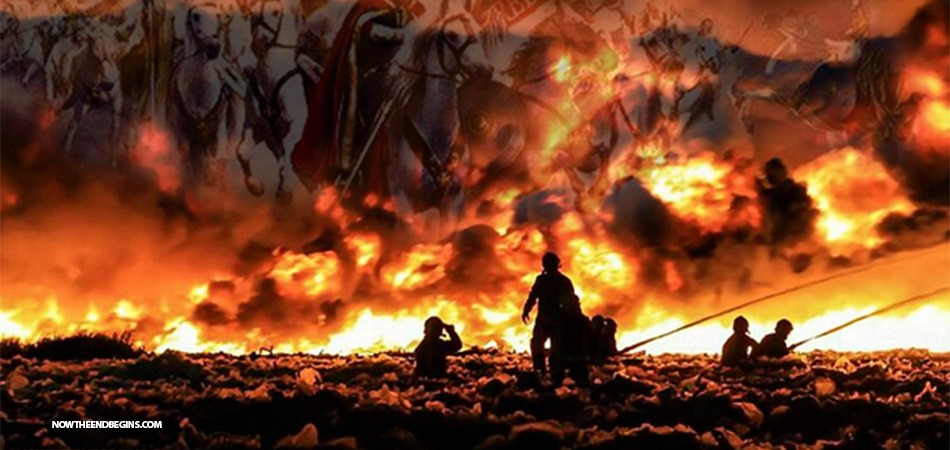
Ezekiel 39 is another matter entirely. Ezekiel 39 describes the great slaughter connected with the Battle of Armageddon at the Second Coming of Jesus Christ, corresponding with the scene presented in Revelation 19. The fowls and beasts being summoned to feast upon the slain, the enormous burial operation lasting seven months, the cleansing of the land and the seven years of burning the weapons all belong on the front side of the Millennium, not at the end of it. Ezekiel 39 and Revelation 19 belong together; Ezekiel 38 and Revelation 20 belong together. Those are two entirely different wars separated by at least one thousand years, and confusing them creates an enormous amount of unnecessary prophetic confusion. Understanding that distinction actually makes the present Saudi-Turkish-Pakistani alliance more interesting, not less. The Bible clearly shows that before Jesus Christ returns at the Second Advent, the nations of this world will be increasingly consumed with the controversy surrounding Israel and Jerusalem. The present-day rearrangement of military alliances throughout the Middle East is part of the world being prepared for the events that will ultimately culminate in the Time of Jacob’s Trouble and the Battle of Armageddon described in Revelation 19 and Ezekiel 39.
“And in that day will I make Jerusalem a burdensome stone for all people: all that burden themselves with it shall be cut in pieces, though all the people of the earth be gathered together against it.” Zechariah 12:3 (KJB)
There is the destination toward which the nations are moving. Jerusalem becomes the burdensome stone, and the nations eventually gather themselves against it. Bible prophecy has already shown us the ultimate disposition of the Gentile nations toward Jerusalem, and therefore we should pay very close attention when powerful Islamic countries begin organizing themselves into new military structures capable of acting collectively.
Saudi Arabia, Turkey and Pakistan are three very different nations with different political systems, strategic interests and regional priorities, yet Islam provides them with a powerful common identity and Israel provides them with an increasingly obvious common point of tension. Saudi Arabia possesses the money and religious prestige, Turkey possesses tremendous conventional military capability, and Pakistan possesses the Islamic world’s nuclear arsenal. Put those things together and you have the makings of a bloc that could exert tremendous pressure upon Israel when circumstances demand it.
For Saudi Arabia, that moment may ultimately involve choosing between continued rapprochement with Israel through the Abraham Accords and solidarity with an Islamic military bloc built around Ankara and Islamabad. I do not believe Saudi Arabia will ultimately choose Israel when that decision becomes unavoidable. Whatever temporary normalization arrangements may emerge along the way, the prophetic trajectory of the Middle East is not toward the nations embracing Jerusalem and the Jewish people. It is toward increasing pressure, increasing isolation and eventually the gathering of the nations against the land God gave to Abraham, Isaac and Jacob.
The Telegraph can call them the Three Musketeers and make the story sound almost whimsical, but there is nothing whimsical about an alliance connecting Saudi Arabia, Turkey and nuclear-armed Pakistan. These are three heavyweight Islamic powers creating a framework for collective military action at a moment when the Middle East is being rapidly rearranged and Israel is becoming increasingly isolated. I believe that sooner rather than later, the same leaders who today insist that this new arrangement is aimed at no particular country will find themselves confronted with the Israel question, and when that happens, there should be very little doubt which direction this alliance will move. The military architecture is being constructed now, the crisis that activates it will come later. When it does, Saudi Arabia, Turkey and Pakistan will not be standing shoulder to shoulder in defense of the Jewish state. They will be standing on the other side as the Bible so clearly declares.
Now The End Begins is your front line defense against the rising tide of darkness in the last Days before the Rapture of the Church
- HOW TO DONATE: Click here to view our WayGiver Funding page
When you contribute to this fundraising effort, you are helping us to do what the Lord called us to do. The money you send in goes primarily to the overall daily operations of this site. When people ask for Bibles, we send them out at no charge. When people write in and say how much they would like gospel tracts but cannot afford them, we send them a box at no cost to them for either the tracts or the shipping, no matter where they are in the world. We have a Gospel Billboard program. We are now broadcasting Bible studies, Podcasts and a Sunday Service 5 times a week, thanks to your generous donations. All this is possible because YOU pray for us, YOU support us, and YOU give so we can continue growing.

But whatever you do, don’t do nothing. Time is short and we need your help right now. The Lord has given us an open door with a tremendous ‘course’ for us to fulfill that will create an excellent experience at the Judgement Seat of Christ. Please pray for our efforts, and if the Lord leads you to donate, be as generous as possible. The war is REAL, the battle HOT and the time is SHORT…TO THE FIGHT!!!
“Looking for that blessed hope, and the glorious appearing of the great God and our Saviour Jesus Christ;” Titus 2:13 (KJB)
“Thank you very much!” – Geoffrey, editor-in-chief, NTEB
Donald Trump
Donald Trump Didn’t Finish The Job As Iran’s IRGC Boasts That Surviving America’s Attacks Has Opened The Door For Islam To Rise Up And Rule The World
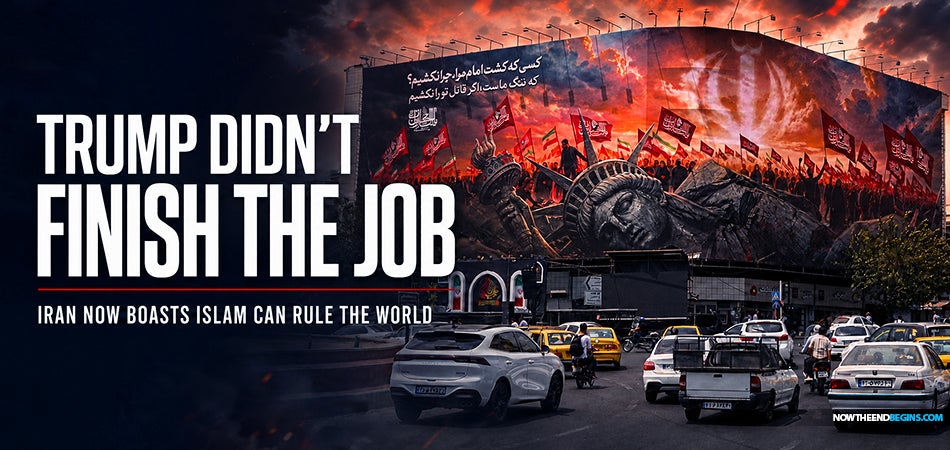
President Trump started a war with Iran that remains wholly unfinished, and that is allowing Tehran to turn defeat into a resounding victory that is energizing them
The fact that Iran’s top military commander Ahmad Vahidi can stand before the Islamic world and boast that Tehran has brought the United States “to its knees” tells you everything you need to know about President Trump’s claim that America had “finished the job.” The job was not finished. Iran was hit, Iran was damaged and Iran was bloodied, but the Islamic regime was left standing—and now it is transforming survival into victory. President Trump has put America in a very dangerous position by not eliminating the Iranian regime, and it is already coming back to haunt him.
“And the LORD shall be king over all the earth: in that day shall there be one LORD, and his name one.” Zechariah 14:9 (KJB)
Ahmad Vahidi is not speaking like the commander of a defeated nation, he is speaking like the leader of an emboldened Islamic revolution. He is openly declaring that Iran’s battlefield performance proves “Islam can be made to rule the world.” Those are not the words of a government that has been neutralized. Those are the words of a regime that believes it endured America’s best shot and lived to continue the war. Trump attacked Iran’s military machinery but left the revolutionary engine running. The IRGC still commands, the missiles are still flying, and the Strait of Hormuz remains a battlefield. American forces and Gulf infrastructure remain under attack. Tehran’s Islamic leadership remains in power, issuing threats, preaching conquest and promising the arrival of worldwide Islamic government. That is not mission accomplished, that’s an unfinished war.

Iran does not need to defeat the United States conventionally to claim victory. It only needs to survive. Every additional day the regime remains standing allows Tehran to tell the Muslim world that the Great Satan attacked with everything it had and failed to destroy the Islamic Republic. Vahidi is already turning that survival into a recruiting message for jihadists, militias and Islamic revolutionaries around the world. This is the price of fighting a war halfway. Infrastructure can be rebuilt. Missile launchers can be replaced. Nuclear facilities can be reconstructed underground. Commanders can be promoted to replace those who were killed. As long as the Islamic regime and the IRGC remain intact, the threat remains intact. From a military persepctive, that spells potential disaster for America.
READ THIS: Understanding The Muslims Plan For World Dominance Through Islam And Sharia Law
Iran’s leaders are not hiding their objective, they are proclaiming it before the entire world. Islamic rule, Islamic conquest and the overthrow of the existing world order. Tehran believes this war has opened the gates for a global Islamic uprising. America’s political leaders should listen carefully, because Iran is telling us exactly what it intends to do. Trump did not finish the job, he postponed the next phase of it. Iran will rebuild, rearm and return unless the Islamic Republic is permanently dismantled. Anything less merely gives Tehran time to prepare for the next round while presenting its survival as proof that Allah has delivered America into its hands. President Trump, do your job and finish this war with military victory. Anything less is unacceptable, and unAmerican.
Now The End Begins is your front line defense against the rising tide of darkness in the last Days before the Rapture of the Church
- HOW TO DONATE: Click here to view our WayGiver Funding page
When you contribute to this fundraising effort, you are helping us to do what the Lord called us to do. The money you send in goes primarily to the overall daily operations of this site. When people ask for Bibles, we send them out at no charge. When people write in and say how much they would like gospel tracts but cannot afford them, we send them a box at no cost to them for either the tracts or the shipping, no matter where they are in the world. We have a Gospel Billboard program. We are now broadcasting Bible studies, Podcasts and a Sunday Service 5 times a week, thanks to your generous donations. All this is possible because YOU pray for us, YOU support us, and YOU give so we can continue growing.
But whatever you do, don’t do nothing. Time is short and we need your help right now. The Lord has given us an open door with a tremendous ‘course’ for us to fulfill that will create an excellent experience at the Judgement Seat of Christ. Please pray for our efforts, and if the Lord leads you to donate, be as generous as possible. The war is REAL, the battle HOT and the time is SHORT…TO THE FIGHT!!!
“Looking for that blessed hope, and the glorious appearing of the great God and our Saviour Jesus Christ;” Titus 2:13 (KJB)
“Thank you very much!” – Geoffrey, editor-in-chief, NTEB
Donald Trump
After Trump Was Smuggled Off Air Force One In A Catering Truck, Gulf States Now Accept That An ‘Obliterated’ Iran Controls The Strait Of Hormuz
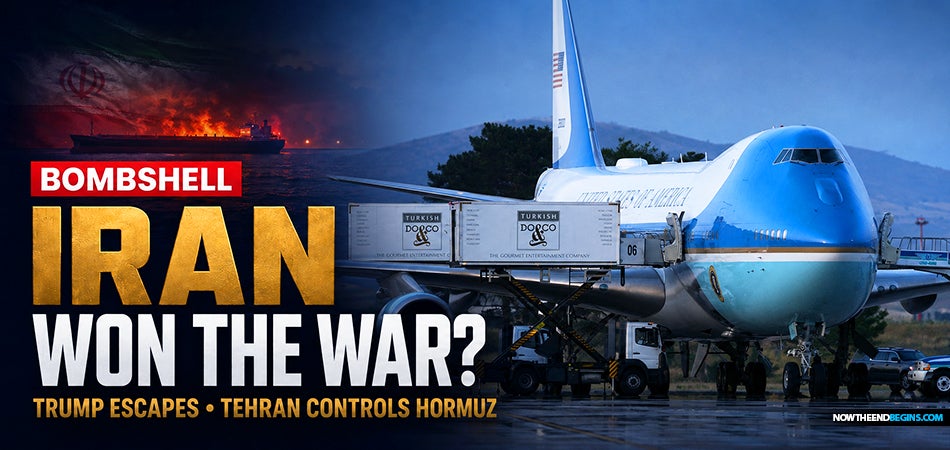
The Catering Truck Escape Of President Trump Exposes How An Iran Declared ‘Decimated And Obliterated’ Remains Dangerous And In Control Of Hormuz Despite Months Of American Bombing
America was told that Iran had been “decimated” and “obliterated,” but the truth of the matter is that when President Trump visited Turkey last month, credible threats from Iran forced the Secret Service to extract the president and smuggle him out hidden inside a catering truck, and flown to safety on an alternate Air Force One. As you let that sink in, ask yourself, what does that tell you? It tells me that we have been lied to about the Iran War from start to finish. How do you reconcile the endless boasting and bragging from the Department of War on how America “decimated” Iran with the mental picture of Trump and Hegseth hiding in a catering truck because Iran made some threats? The photo at the top of this article shows you the actual container that Trump and Hegseth were hidden in. This is beyond shameful and unacceptable, and as American patriots, we cannot, and must not, abide this deception any longer.
“The horse is prepared against the day of battle: but safety is of the LORD.” Proverbs 21:31 (KJB)
Faced with what American officials reportedly considered a credible Iranian assassination threat, Trump did exactly what the president of the United States should have done: he followed the security plan designed to keep him alive. The scandal is not that Trump got into the catering truck. The scandal is that America was repeatedly told Iran had been “decimated” and “obliterated,” while the people protecting the president privately believed Tehran still possessed the reach, intelligence and operational capability to threaten his life in a NATO country. That’s the bombshell hiding underneath the sensational headline. According to a report published by the New York Post, President Trump publicly boarded the familiar blue-and-white Air Force One following the NATO summit in Ankara on July 8. Television cameras recorded the presidential departure, reporters boarded the plane, White House personnel took their seats, and everything appeared normal. But it was all a decoy.
A DARK DAY FOR AMERICA: President Trump was forced to sneak away, hidden in a catering truck, after threats from Iran caused panic. Let that sink in. Trump is hiding from the very same people he started the war with. Iran is very much in control. @POTUS https://t.co/tCBfo9SiOW
— Now The End Begins (@NowTheEndBegins) August 11, 2026
On the opposite side of the aircraft, Trump and several aides reportedly entered an elevated airport catering container. The container was lowered onto a truck, driven across the tarmac and raised to the door of a smaller Air Force C-32A military aircraft. Trump secretly boarded that plane while reporters and even some White House staff departed Turkey believing the president was flying with them aboard Air Force One. Secretary of War Pete Hegseth was also aboard the secret flight, reportedly boarding separately to preserve the illusion of a routine military departure.
The operation was triggered by what a United States official described as a credible Iranian threat against Trump’s life. Israel had reportedly warned Washington of a possible Iranian assassination plot. The White House did not subsequently deny that the clandestine transfer occurred, instead saying that every available security measure was being employed to protect the president. Now, no responsible person should criticize him for following the security instructions of the Secret Service and the military. Presidents do not prove courage by unnecessarily exposing themselves to assassination. But Americans have every right to ask why, to demand why the private threat assessment differed so dramatically from the public victory narrative. This is absolutely a scandal that needs to be addressed.
Iran Was Bombed Into Rubble, But It Was Not Neutralized
The United States and Israel unquestionably inflicted catastrophic physical damage upon Iran. An April 1 Department of War fact sheet claimed that American forces had struck more than 12,300 targets, flown more than 13,000 combat missions and damaged or destroyed more than 155 Iranian vessels. Command centers, IRGC headquarters, intelligence facilities, air defenses, ballistic-missile sites, weapons-production facilities, communications networks and Iranian naval assets were hammered by the most technologically advanced military force on the planet.
Iran could not match the United States in the air. It could not match the United States at sea. It could not prevent American bombers and missiles from destroying enormous portions of its conventional military infrastructure. But destroying thousands of targets is not the same thing as winning a war.
A war is won when the enemy can no longer impose his will, threaten your interests or compel you to alter your behavior. Judged by that standard, Iran was in some respects devastated, but it was not defeated. It was damaged, but it was not disarmed. It was battered, but it was never neutralized. Iran absorbed the punishment, kept its regime alive and retained the weapons that mattered most: geography, asymmetrical warfare, assassination capabilities, mines, missiles, drones, regional proxies and control over the narrow passage through which a major portion of the world’s energy supply must travel. Washington won the bombing campaign. Tehran may be winning everything that came after it.

The Strait Of Hormuz Tells The Real Story
On July 28, the White House published remarks in which President Trump flatly declared, “Iran doesn’t control the Strait. We control the Strait.” Less than two weeks later, the Wall Street Journal published a report beneath this astonishing headline:
“Gulf States Accept a New Normal in Hormuz: Iran Is in Control.”
That isn’t a minor discrepancy, t is the difference between the victory Americans were promised and the strategic reality now confronting the Middle East. Persian Gulf energy producers are reportedly concluding that Iranian control over the Strait of Hormuz could become permanent. They do not like it, and they do not necessarily recognize Tehran’s claims as legitimate. But they increasingly view accommodation with Iran as preferable to returning to a war that would bring additional Iranian missiles and drones crashing into their ports, pipelines, refineries and desalination plants.
An emerging agreement under discussion would reportedly place inbound shipping through Hormuz under Iranian oversight while Oman supervised outbound traffic. The agreement has not been finalized, and Washington remains opposed to allowing Iran to restrict international navigation. Nevertheless, Gulf governments are reportedly willing to contemplate formal Iranian oversight because the alternative may be another destructive regional war.
Think about what that means. The United States possesses aircraft carriers, submarines, stealth bombers, cruise missiles, surveillance satellites and enough firepower to demolish Iranian military installations repeatedly. Yet the Gulf states are concluding that all that American military power still cannot guarantee the uninterrupted movement of their oil and natural gas. Iran does not need to defeat the United States Navy ship for ship. It only needs to make commercial navigation dangerous enough, insurance expensive enough and Gulf infrastructure vulnerable enough that terrified governments begin negotiating for Tehran’s permission to conduct business. That is how an apparently weaker nation converts geography into strategic power.
America can control which ships reach Iran through its naval blockade. Iran can control whether ships belonging to the Gulf states move safely through the waterway. Washington possesses overwhelming firepower, but Tehran possesses the ability to create chaos at the precise point where the global economy can least afford it. We told you back in July of 2024, after Trump got his warning shot to his right ear, that God has put him in power as judgment on America. And so it is.
The Catering Truck Exposed The Truth
The catering truck operation now takes on tremendous symbolic importance. Trump and Hegseth spent months speaking as though Iran had been reduced to strategic irrelevance. But when intelligence officials warned that Iran might be targeting the president, the victory speeches stopped and the professionals went to work. Air Force One became a decoy. Reporters and White House personnel unknowingly became part of the deception. The president and his War Secretary disappeared onto another aircraft.
American intelligence and presidential security officials believed the threat was sufficiently credible to justify one of the most extraordinary presidential extraction operations in modern history. The government did not behave as though Iran had been obliterated, it behaved as though Iran remained organized, dangerous and capable of striking the president of the United States beyond its own borders. That is the reality Americans were not shown while administration officials were celebrating overwhelming victory. The public was given the number of targets destroyed. It was not given an honest assessment of the enemy’s remaining ability to retaliate. Tactical achievements were packaged and sold as strategic victory, while Iran’s most dangerous capabilities survived beneath the rubble.
Iran Lost The Battles But May Have Won The War
Iran never needed to defeat the United States conventionally, as such a victory was always impossible. But as the old saying goes, “there’s more than one way to skin a cat”. Iran’s realistic objectives were to survive, preserve the regime, impose unbearable economic costs, frighten the Gulf monarchies, keep the Strait of Hormuz under threat and force Washington toward negotiations without surrendering Tehran’s regional power. Measured against those objectives, Iran has performed far better than the American public was led to believe.
Pete Hegseth and Donald Trump promised us that America had won the war with Iran with “overwhelming victory”. Then they hid in a catering truck to escape when Iran threatened them in Turkey on July 8 at the NATO Summit. Nothing these people say is true. None of it. pic.twitter.com/EsyUIpUDGM
— Now The End Begins (@NowTheEndBegins) August 11, 2026
If the final settlement allows the Iranian regime to survive, gives Tehran formal authority over inbound shipping, produces sanctions relief and ends American military operations without eliminating Iran’s power to threaten its neighbors, then Iran will have achieved a genuine strategic victory despite suffering catastrophic battlefield losses. It will have lost its ships, missile batteries, command centers and military installations while gaining international recognition of the leverage it always wanted over Hormuz. That’s not Iran winning because it was militarily stronger. It is Iran winning because it endured longer, accepted greater pain and convinced its enemies that continuing the war would cost more than tolerating the new Iranian order.
In conclusion, we strongly urge you to disbelieve anything and everything told to us by the Trump administration going forward. They have proven to be patholoigical liars, incapable of truth, and only a complete defeat in the midterms will come close to stopping them. The Iran War is all but over now, America has been roundly humiliated, but worse than that, our enemies like Russia, China and North Korea now see how we can be defeated under Trump. And make no mistake, they’re coming.
Now The End Begins is your front line defense against the rising tide of darkness in the last Days before the Rapture of the Church
- HOW TO DONATE: Click here to view our WayGiver Funding page
When you contribute to this fundraising effort, you are helping us to do what the Lord called us to do. The money you send in goes primarily to the overall daily operations of this site. When people ask for Bibles, we send them out at no charge. When people write in and say how much they would like gospel tracts but cannot afford them, we send them a box at no cost to them for either the tracts or the shipping, no matter where they are in the world. We have a Gospel Billboard program. We are now broadcasting Bible studies, Podcasts and a Sunday Service 5 times a week, thanks to your generous donations. All this is possible because YOU pray for us, YOU support us, and YOU give so we can continue growing.
But whatever you do, don’t do nothing. Time is short and we need your help right now. The Lord has given us an open door with a tremendous ‘course’ for us to fulfill that will create an excellent experience at the Judgement Seat of Christ. Please pray for our efforts, and if the Lord leads you to donate, be as generous as possible. The war is REAL, the battle HOT and the time is SHORT…TO THE FIGHT!!!
“Looking for that blessed hope, and the glorious appearing of the great God and our Saviour Jesus Christ;” Titus 2:13 (KJB)
“Thank you very much!” – Geoffrey, editor-in-chief, NTEB













































-

 George Soros10 years ago
Proof Of George Soros Nazi Past Finally Comes To Light With Discovery Of Forgotten Interview
-
Election 201610 years ago
DEAD POOL DIVA: Huma Abedin Kept Those Hillary Emails That The FBI Found In A Folder Marked ‘Life Insurance’
-
Election 201610 years ago
Crooked Hillary Campaign Used A Green Screen At Today’s Low Turnout Rally In Coconut Creek FL
-
George Soros10 years ago
SORE LOSER: George Soros Declares War On America As Violent MoveOn.Org Protests Fill The Streets
-
Donald Trump10 years ago
Donald Trump Will Be 70 Years, 7 Months And 7 Days Old On First Full Day In Office As President
-
Headline News10 years ago
If Hillary Is Not Guilty, Then Why Are Her Supporters Asking Obama To Pardon Her? Hmm…
-
Election 201610 years ago
WikiLeaks Shows George Soros Controlling Vote With 16 States Using SmartMatic Voting Machines
-
End Times10 years ago
False Teacher Beth Moore Endorses The Late Term Partial-Birth Abortion Candidate Crooked Hillary