Posts tagged food stamps
Hispanics Handed Obama The Election Now They Demand Amnesty For Illegals
Nov 9th
You scratch my back, I’ll scratch yours
Obama is about to flood the system with an instant and massive influx of millions of illegal aliens who will take from it much more than they will contribute. Overnight, welfare, food stamps and other entitlement programs will swell to obscene proportions which will result in a collapsing of our entire economy, government and way of life. But this has been the strategy from the beginning, as Obama and the Liberals finish the job of dismantling America.
From NBC News: Hispanic voters, who were instrumental in putting Barack Obama back in the White House, now hope the president will work diligently in his second term to cross some big to-dos off their legislative wish list: jobs, affordable education, health care access and immigration reform.
Hispanics voted for Obama over Mitt Romney by a resounding 71 percent to 27 percent and may have put him over the top in several key swing states. The total number of potential Hispanic voters this year reached a record 23.7 million – up about 80 percent since 2000 – and Hispanics now compose about 10 percent of the total electorate, according to the Pew Hispanic Center.
“The Latino electorate arrived Tuesday, there’s no question about it,” said Rafael Collazo, director of political campaigns for the National Council of La Raza. The organization, which bills itself as the largest national Hispanic civil rights and advocacy organization in the United States, says it helped register more than 90,000 new Hispanic voters this year.
“States like Florida, Colorado, Nevada, Pennsylvania, even Ohio — the Latino vote was a net gain for the preferred candidate and was the deciding factor or at least very, very close to being the decisive factor,” Collazo told NBC News.
“The Latino giant is wide awake, cranky and is taking names,” labor leader Eliseo Medina, of the Service Employees International Union, told NBC Latino.
With the election behind them, Hispanics now want Obama and Congress to work on issues identified in surveys as their priorities – more jobs, affordable health care, access to higher education and immigration reform.
GOP faces immigration fight after election
The latter issue has been more important for Hispanics than for other U.S. voters, said Mark Hugo Lopez, associate director of the Pew Hispanic Center, a nonpartisan research organization.
Hispanic support for Obama was high even before he announced in June that the government will stop deporting, and begin granting work permits to, some undocumented immigrants who entered the U.S. as children.
“However, when it comes to asking Hispanics which party is more concerned for the Hispanic community, after the deferred action program was announced the (Democratic) share went from 45 to 61 percent – the highest we’ve measured in Pew Hispanic surveys in 10 years,” Lopez said.
“In his acceptance speech, Obama mentioned that comprehensive immigration reform was something that needed to be addressed, and we’re going to hold him to that,” Collazo told NBC News.
The day after the election, Senate Majority Leader Harry Reid promised to introduce an immigration reform package next year. He said if Republicans block the legislation, they would do so “at their peril.”
Al Cardenas, chairman of the American Conservative Union and former chairman of the Republican Party in Florida, agreed that the immigration debate has been detrimental for the GOP.
“Across the board generationally and demographically, the immigration issue has become a wedge issue … because it’s become a litmus test of respect and caring in that community,” Cardenas said. “My advice for conservatives and the party as a whole is to get bipartisan immigration reform done in next 100 to 200 days.”
A survey of Hispanic voters by the firm Latino Decisions found that Hispanics pushed Obama over the top in Colorado, Florida and Nevada, swing states where they turned out in unusually high numbers.
Cardenas said the GOP can’t pay short shift to minority groups if it wants to put a Republican in the White House.
NBC Latino: We voted – now let’s get to work, say Latinos after historic vote for Obama
“The so-called mainstream vote is no longer sufficient,” he said. “The coalition of all of these minority votes is a priority in these elections today. The Hispanic vote is the most numerically significant of all of these groups. We need to develop a precise, aggressive, winning political game plan to address that community.”
The Hispanic community is a diverse one, according to the Pew Center’s Lopez:
- Country of origin: Among eligible Hispanic voters, 58 percent are Mexican Americans, 14 percent are Puerto Ricans, and 6 percent are Cubans. (The remainder are from Central and South America). Historically, Cubans have supported Republican candidates more than other Hispanic groups; in Florida this year, 49 percent of Cubans went for Obama and 47 percent for Romney.
- Youth: People ages 18-29 make up about a third of all eligible Hispanic voters, but just 20 percent of all general voters.
- Naturalized U.S. citizens: Among Hispanic eligible voters, 25 percent are immigrants who are naturalized. But among whites, only 3 percent are naturalized U.S. citizens.
Callazo said that despite this diversity, Hispanics displayed a rather consistent, Democratic-leaning voting pattern across many states.
“The numbers of how Latinos voted in Arizona compared to Ohio and Colorado were fairly close,” Callazo said.
“Yes, there are differences and nuances … but if you look at the polling and all the anecdotal work and the outreach we’ve done over the years, the core issues are very, very similar,” he added. ”At end of day, Latino voters are voting for the candidate they feel will best reflect their values.” source – NBC News
Under Obama Food Stamp Growth 75X Greater Than Job Creation!
Nov 2nd
Creating a pauper debtor nation
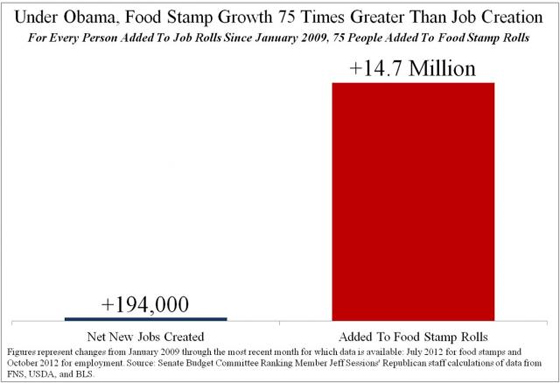
With the latest jobs report, it is now the case that “Under Obama, Food Stamp Growth Is 75 Times Greater Than Job Creation,” according to statistics compiled by the Republican side of the Senate Budget Committee. “For Every Person Added to Jobs Rolls Since January 2009, 75 People Added To Food Stamp Rolls.”
Here’s a chart detailing the growth:

In January 2009, there were 133.56 million Americans with jobs and 31.98 million on food stamps. Today, there are 133.76 million Americans with jobs and 46.68 million on food stamps.
Since January 2009, as the chart shows, a net of 194,000 new jobs have been created. During that same time, 14.7 million have been added to the food stamp rolls.
“Simply put, the President’s policies have not produced jobs. During his time in office, 14.7 million people were added to the food stamp rolls. Over that same time, only 194,000 jobs were created—thus 76 people went on food stamps for every one that found a job,” says Senator Jeff Sessions, ranking member of the Senate Budget Committee. “This is a product of low growth. Post-recession economic growth in 2010 was 2.4%, and dropped in 2011 to 1.8%. This year it has dropped again to 1.77%. Few, if any, net jobs will be created with growth of less than 2%.”
The Republicans on the Senate Budget Committee put the job growth into perspective:
In January 2009, there were 133.56 million Americans with jobs and 31.98 million on food stamps. Today, there are 133.76 million Americans with jobs and 46.68 million on food stamps. The employment rolls have thus grown by 0.15 percent and the food stamp rolls have grown by 46 percent, meaning that for every one American who found a job, 75 Americans signed up for food stamps. Meanwhile, during that time, our nation’s debt has risen $5.63 trillion. Total spending on food stamps is now more than $80 billion annually, a fourfold increase from 2001. Total spending on federal means-tested welfare—food stamps, public housing, social services, cash aid, etc.—is now approximately $1 trillion. That amount is enough, if converted to cash, to send every household beneath the federal poverty line an annual check for $60,000.
Welfare spending is projected to remain permanently elevated; for instance, at no point in the next 10 years will fewer than 1 in 9 Americans be on food stamps. In fact, the Administration has actively sought to boost food stamp spending and enrollment, including through a partnership with the Mexican government to advertise benefits to foreign nationals, as well as materials that teach outreach workers how to “overcome the word ‘No.’” USDA even goes so far as to argue that the program is “the most direct stimulus you can get.”
Overall, in the last four years, the United States’ gross federal debt has increased 53 percent, food stamp enrollment has increased 46 percent, and the number of employed persons has increased just 0.15 percent. This picture, however, is even more ominous than it looks. While only 194,000 net jobs have been created since 2009, the working age population has increased by approximately 5 million—almost 25 times that amount. In other words, a shrinking share of working age adults have or are even looking for a job. The real unemployment number (U-6), therefore, is 14.6 percent.
To put this month’s job creation in historical perspective, in October of 1984, 286,000 jobs were created—67 percent more—at a time when the U.S. working age population was 26 percent smaller than it is today.
Over time, these trends, if not reversed, spell economic disaster for the United States and its citizens. source- Weekly Standard
Under Obama 46 Million Americans Now On Food Stamps
Oct 17th
Record High Enrollment for Food Stamps: 46,681,833 Million
Food stamps enrollment has hit a new record high. 46,681,833 million are now enrolled in the social welfare program, according to the United States Department of Agriculture, the federal department that runs the program.
Here’s a chart from the minority side of the Senate Budget Committee, outlining the program’s enormous growth:
As the chart shows, when President Obama took office, enrollment in the food stamps program was 31.98 million. Now, not even four years later, it’s a whopping 46.48 million. (In 2002, as the chart states, “19.1 million Americans received food stamps.”)
In fact, the newly released data represents enrollment in July (the last month for which data is available). Assuming the program remained on its projected path, the number of those enrolled in food stamps is likely now larger by several hundreds of thousands.
“USDA has engaged in an aggressive outreach and promotional campaign to boost food stamp enrollment. Among these efforts are an ongoing partnership with the Mexican government to advertise food stamps to Mexican nationals, migrant workers, and non-citizen immigrants. Partly as a result of these efforts, the number of non-citizens on food stamps has quadrupled since 2001,” explains the Republican side of the Senate Budget Committee.
And the cost, the committee explains, is astronomical. “Total spending on food stamps is projected to reach nearly $800 billion over the next 10 years, with no fewer than 1 in 9 people on the program at any given time. Neither food stamp participation nor spending on the program are ever projected to return to pre-recession levels at any point in the next 10 years.” source – The Weekly Standard
Obama Using Mexico To Dramatically Increase Dependence On Food Stamps
Jul 19th
Understanding the Cloward-Piven Strategy
The Cloward–Piven strategy is a political strategy outlined in 1966 by American sociologists and political activists Richard Cloward (1926–2001) and Frances Fox Piven (b. 1932) that called for overloading the U.S. public welfare system in order to precipitate a crisis that would lead to a replacement of the welfare system with a national system of “a guaranteed annual income and thus an end to poverty”.
The authors pinned their hopes on creating disruption within the Democratic Party. “Conservative Republicans are always ready to declaim the evils of public welfare, and they would probably be the first to raise a hue and cry. But deeper and politically more telling conflicts would take place within the Democratic coalition,” they wrote. “Whites – both working class ethnic groups and many in the middle class – would be aroused against the ghetto poor, while liberal groups, which until recently have been comforted by the notion that the poor are few… would probably support the movement. Group conflict, spelling political crisis for the local party apparatus, would thus become acute as welfare rolls mounted and the strains on local budgets became more severe. source – Wiki
From The Daily Caller: The Mexican government has been working with the United States Department of Agriculture to increase participation in the Supplemental Nutrition Assistance Program (SNAP), or food stamps.
USDA has an agreement with Mexico to promote American food assistance programs, including food stamps, among Mexican Americans, Mexican nationals and migrant communities in America.
“USDA and the government of Mexico have entered into a partnership to help educate eligible Mexican nationals living in the United States about available nutrition assistance,” the USDA explains in a brief paragraph on their “Reaching Low-Income Hispanics With Nutrition Assistance” web page. “Mexico will help disseminate this information through its embassy and network of approximately 50 consular offices.”
The partnership — which was signed by former USDA Secretary Ann M. Veneman and Mexican Secretary of Foreign Affairs Luis Ernesto Derbez Bautista in 2004 — sees to it that the Mexican Embassy and Mexican consulates in America provide USDA nutrition assistance program information to Mexican Americans, Mexican nationals working in America and migrant communities in America. The information is specifically focused on eligibility criteria and access.
The goal, for USDA, is to get rid of what they see as enrollment obstacles and increase access among potentially eligible populations by working with arms of the Mexican government in America. Benefits are not guaranteed or provided under the program — the purpose is outreach and education.
Some of the materials the USDA encourages the Mexican government to use to educate and promote the benefit programs are available free online for order and download. A partial list of materials include English and Spanish brochures titled “Five Easy Steps To Snap Benefits,” “How To Get Food Help — A Consumer’s Guide to FNCS Programs,” “Ending Hunger Improving Nutrition Combating Obesity,” and posters with slogans like “Food Stamps Make America Stronger.”
When asked for details and to elaborate on the program, USDA stressed it was established in 2004 and not meant for illegal immigrants.
“The partnership with the Mexican embassy was established in 2004,” a USDA spokesman wrote The Daily Caller in an email. “USDA does not perform outreach to immigrants that are undocumented, and therefore not eligible for SNAP.”
Alabama Republican Sen. Jeff Sessions, who has been pushing for reform of SNAP, sent a letter to Secretary of Agriculture Tom Vilsack on Wednesday demanding more answers and documents pertaining to the partnership.
The agency has yet to supply documents and information requested by Sessions’ Senate Budget Committee staff, including the Memorandums of Understanding between USDA and the Mexican government regarding the food assistance partnership.
In an interview with TheDC, Sessions explained that the little-known partnership raises questions not just about where tax money is going, but about America’s immigration policy.
“It’s a very disturbing policy, gone on for some years, and it raises very serious questions about American immigration policy as well as fiscal policy,” Session said. “Let’s get back to the fundamentals. What happened with the ‘96 welfare reform was to say that if want to you come to America you come legally, you assert you’re not coming for welfare benefits but you’re coming to work or otherwise be independent. There is no logic behind an immigration policy that would encourage immigrants who can’t successfully operate within this society.” source - Dally Caller
Obama Gov’t Making Massive Push To Get More Americans On Food Stamps
Jun 28th
Food Stamp Nation
While spending on the food stamp program has increased 100 percent under President Barack Obama, the government continues to push more Americans to enroll in the welfare program.
The United States Department of Agriculture (USDA) has embraced entire promotional campaigns designed to encourage eligible Americans to participate in the Supplemental Nutrition Assistance Program (SNAP), or food stamps.
A pamphlet currently posted at the USDA website encourages local SNAP offices to throw parties as one way to get potentially eligible seniors to enroll in the program.
“Throw a Great Party. Host social events where people mix and mingle,” the agency advises. “Make it fun by having activities, games, food, and entertainment, and provide information about SNAP. Putting SNAP information in a game format like BINGO, crossword puzzles, or even a ‘true/false’ quiz is fun and helps get your message across in a memorable way.”
CNN Money further noted that the USDA began running paid radio ads in 2004, under President George W. Bush, who oversaw a 63 percent increase in average food stamp participation.
In the 1970s, one out of every 50 Americans was on food stamps. Today one our of every seven receive the benefit. After the recession, the ratio is expected to hover around one out of every nine, according to the Congressional Budget Office.
Despite the high rate of food stamp participation, the USDA has numerous blueprints posted on their website aimed at getting more people to enroll in SNAP. A 2009 State Outreach Plan Guidance explains why the agency believes states should adopt strategies to get more people on the rolls:
Outreach Can Help Increase Participation in SNAP Resulting in Multiple Benefits for Participants, States, and Communities: SNAP is the cornerstone of the nation’s nutrition safety net and an investment in our future. SNAP offers the opportunity for improved nutrition and progress toward economic self-sufficiency for participants who become stronger members of the community. However, too many low income people, especially seniors, working people, and legal immigrants, who are eligible for SNAP do not participate and thus forego assistance that could stretch their food dollars and help improve their nutrition.
According to the USDA, greater food stamp usage can be an economic plus for states and communities.
“Every $5 in new SNAP benefits generates $9.20 in an additional community spending,” the USDA contends in their outreach guidance. “If the national participation rate rose five percentage points, 1.9 million more low-income people would have an additional $1.3 billion in benefits per year to use to purchase healthy food and $2.5 billion total in new economic activity would be generated nationwide.”
During debate on the 2012 farm bill earlier this month, Senate Republicans pushed for amendments aimed at reducing the cost and participation in the food stamp program.
The Democratically controlled Senate voted down Republican efforts — denying amendments targeting the swelling rolls that were introduced by Kentucky Republican Sen. Rand Paul, and others from Alabama Republican Sen. Jeff Sessions — arguing they could reduce access to those in need. source – Daily Caller
Use of RFID Tracking Technology To Be Mandatory In US Food Stamp Program
May 31st
Food stamp welfare individuals must soon be chipped
“And he causeth all, both small and great, rich and poor, free and bond, to receive a mark in their right hand, or in their foreheads: And that no man might buy or sell, save he that had the mark, or the name of the beast, or the number of his name.” (Revelation 13:16-17)
In a little while, the above scene in Revelation 13 will become a global reality. People can no longer buy or sell without the mark of the beast. And sometimes that would mean no longer being able to eat!
The USDA is now considering biometric identification for all individuals who will want to benefit from their Food and Nutrition Services. The RFID chip may just soon be a must for everyone who does not want to starve!
The following is an excerpt of the executive summary of the FINAL REPORT of the Use of Biometric Identification Technology to Reduce Fraud in the Food Stamp Program:
Biometric identification technology provides automated methods to identify a person based on physical characteristics—such as fingerprints, hand shape, and characteristics of the eyes and face—as well as behavioral characteristics—including signatures and voice patterns.

Although used in law enforcement and defense for several years, it has recently been used in civilian applications and shows some promise to reduce the number of duplicate cases in the Food Stamp Program (FSP) and other assistance programs .
Already operational in some states
Biometric identification systems are currently operational at some level in Arizona, California (under county initiative, first by Los Angeles County), Connecticut, Illinois, Massachusetts, New Jersey, New York, and Texas. Finger imaging is the principal form of technology used in all eight States, though alternative technologies have simultaneously undergone trials in Massachusetts (facial recognition) and Illinois (retinal scanning). By the end of 2000, new systems are expected to be in place in California (statewide unified system), Delaware, and North Carolina. Other States are currently in the initial planning stages, including Florida, Maryland, Michigan, Mississippi, Pennsylvania, and South Carolina. However, there is little information available at this point regarding the specific course and trajectory these States will follow in terms of system types, implementation schedules, and the benefit programs in which they will implement the new requirement.
The States planned for implementation of their biometric identification systems in response to a wide variety of factors and considerations idiosyncratic to each State environment. Some States reported that their respective legislative mandates, which prescribed specific dates by which biometric systems were required to be in place, allowed insufficient time for development and planning. The States developed and followed implementation schedules in accordance with internal priorities and considerations. The States uniformly described their implementation processes as largely uneventful, though they encountered a variety of minor implementation issues, most of which were associated with the logistical difficulties of mobilizing and managing such a complex initiative.
Preparing staff for the implementation of the biometric systems, both philosophically and operationally, took different forms, priorities, and levels of effort in the States. At implementation, advance notification to clients and/or the general public about new biometric client identification procedures was considered important by all State representatives. The objective of providing advance notification was to inform and prepare clients for the additional application or recertification step (i.e., to explain the requirement and who is required to submit, and to address client concerns), as well as to accelerate enrollment of the existing caseload. All States prepared informational mailings to clients advising them of the new requirement. Some States reported developing additional outreach media including multilingual (English and Spanish) videos, posters, and brochures for viewing and distribution in the local office. Most of the States also identified various outlets in the community through which they informed the general public in advance about the implementation of biometric client identification procedures.
Program outcomes
The evaluations of finger imaging systems conducted by six States have produced the following findings.
- A small number of duplicate applications (approximately 1 duplicate for every 5,000 cases) have been detected by finger imaging systems. Finger-imaging systems appear to detect more fraud in statewide implementations than in regional pilot systems. Additional matches have been found by interstate comparisons of finger-image data.
- Institution of a finger-imaging requirement can produce a significant, short-term reduction in caseload, because some existing clients refuse to comply with the requirement. The number of refusals depends on the implementation procedures and appears to be lower when finger imaging is incorporated into the recertification process.
- The most carefully controlled estimate of non-compliance among existing clients suggests that introduction of a finger-imaging requirement reduces participation by approximately 1.3%. However, this estimate reflects both reduced fraud and deterrence of eligible individuals and households.
Source – USDA
Additional information from the USDA Nutrition Assistance Program
Obama Pays State $5 Million Bonus To Increase Food Stamp Usage
Sep 30th
Entitlement Nation
One of Obama’s heros is Saul Alinsky, Socialist writer who advocated ways to collapse an existing government that it might be rebuilt by its destroyers as a Socialist nation. In his book, “Rules For Radicals” Alinsky writes that the best way to collapse the system was by increasing the rolls of entitlement programs until bankruptcy was the inevitable outcome. This is one major reason why participation in the government food stamp program has risen 79% under Obama.
“In its quest to promote taxpayer-funded entitlement programs, the Obama Administration has actually rewarded one state with a $5 million bonus for its efficiency in adding food-stamp recipients to already bulging rolls.
It’s part of the administration’s campaign to eradicate “food insecure households” by improving access and increasing participation in the government’s Supplemental Nutrition Assistance Program (SNAP). Incidentally, the program was recently changed to SNAP to eliminate the stigma that comes with a name like food stamps. Just a few months ago the federal agency that administers the program, the U.S. Department of Agriculture (USDA), launched a multi-million-dollar initiative to recruit more food-stamp participants even though the number of recipients has skyrocketed in the last few years.
This week Oregon officials bragged that the USDA has given the state $5 million in “performance bonuses” for ensuring that people eligible for food benefits receive them and for its “swift processing of applications.” The money comes on the heels of a separate $1.5 million award from the feds for making “accurate payments of food stamp benefits to clients.” So welfare recipients are clients? .
It marks the fifth consecutive year that Oregon has been “recognized” by the federal government for “exceptional administration” of the entitlement program, according to the announcement posted on the state’s Department of Human Services web site. The state official who runs SNAP assures that her staff will “continue working very hard to exceed expectations” so that Oregonians can “put healthy foods on their table quickly.”
Could this be why the number of food-stamp beneficiaries in Oregon has increased dramatically in the last few years? Since 2008 the state has seen a 60% boost in the number of food-stamp recipients, which means that more than 780,000 people (one out of five Oregonians) get groceries compliments of Uncle Sam.
As if this weren’t bad enough, the feds are also giving the state a two-year grant to test an “innovative approach” to the food-stamp “client eligibility review process.” This will make it even easier for people to get food stamps because it grants state officials a waiver that allows them to grant the benefit without interviewing the candidate. source – Judicial Watch