China
US Under Obama Loses Top Producer Title To China
Feb 10th

China surpassed the U.S. to become the world’s biggest trading nation last year as measured by the sum of exports and imports of goods, official figures from both countries show.
U.S. exports and imports of goods last year totaled $3.82 trillion, the U.S.
Commerce Department said last week. China’s customs administration reported last month that the country’s trade in goods in 2012 amounted to $3.87 trillion. source – Bloomberg
Yangtze River Suddenly Turns Blood Red
Sep 8th
“And the second angel sounded, and as it were a great mountain burning with fire was cast into the sea: and the third part of the sea became blood;” Revelation 8:8
A stretch of China’s longest river has abruptly turned the color of tomato juice, and officials say they don’t know why. Residents of the southwestern city of Chongqing first noticed that the Yangtze River, called the “golden waterway,” had a spreading stain on its reputation yesterday (Sept. 6).

“When water turns red, the thing a lot of people think of first is red tide,” Stanley told Life’s Little Mysteries.
Though the bright-red water was concentrated around Chongqing, Southwest China’s largest industrial center, it was also reported at several other points along the river, according to ABC News.
Investigators have yet to determine a cause, but the Telegraph reports that environmental officials are considering industrial pollution and silt churned up by recent upstream floods as possible sources for the color.
One natural explanation for red water that can likely be ruled out is color-producing microorganisms, according to Emily Stanley, a professor of limnology (the study of inland waters) at the University of Wisconsin.
“When water turns red, the thing a lot of people think of first is red tide,” Stanley told Life’s Little Mysteries. “But the algae that causes red tide is a marine group and not a freshwater group, so it’s highly, highly unlikely that this is a red-tide-related phenomenon.”
Fresh water does occasionally turn blood-red for biological reasons (a lake that turned red during a drought in Texas last summer led to talk of the end times), but Stanley said this is most often due to incursions of color-producing bacteria that arrive when a body of water has less oxygen than normal. Because rivers move constantly, struggling and mixing with the air above them as they go, they rarely ever get the oxygen deficiencies necessary for a life-based red dye job.
After reviewing a few images of Chongqing’s shockingly red river, Stanley put her money on a man-made cause.
“It looks like a pollutant phenomenon,” she said. “Water bodies that have turned red very fast in the past have happened because people have dumped dyes into them.”
An industrial dye dump was in fact the explanation when an urban stretch of another Chinese river, the Jian, turned crimson last December. Investigators traced the color back to a chemical plant that they said had been illegally producing red dye for firework wrappers.
Still, Stanley says she can’t rule out the other possibility officials are now reportedly investigating: an upstream influx of silt. Her instinct, though, is that red clay would be more likely.
“China is well known for having areas with a lot of steep hill sides and a lot of land use practices that promote soil erosion and soil going into rivers,” she said. “You can get red-colored clays that wouldn’t be a whole lot different from having a big dose of dye go in there. But if that’s the cause I’d imagine there would have had to be a huge storm or a huge amount of clay go into the system.”
Taking another look at the Campbell’s-hued Yangtze, she said, “It looks really industrial somehow.” source – Live Science
EXPOSED! Satellite Photo Reveals China’s First Aircraft Carrier At Sea
Dec 14th
Hidden no longer
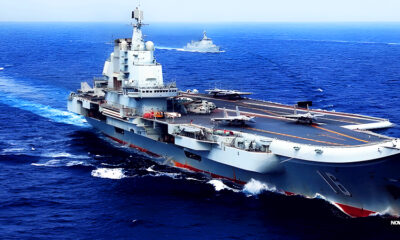
A commercial satellite operator says it has captured a rare image of China’s first aircraft carrier as it sailed through the Yellow Sea, after going through an exercise that’s the 21st-century equivalent of finding a needle in a haystack.

This satellite image provided by the the DigitalGlobe Analysis Center shows the Chinese aircraft carrier Shi Lang (Varyag) sailing in the Yellow Sea. The picture was acquired Dec. 8 by DigitalGlobe's QuickBird satellite.
DigitalGlobe said the aircraft carrier showed up on a cloud-filled picture snapped on Dec. 8 by its polar-orbiting QuickBird satellite from a height of 280 miles (450 kilometers). An analyst spotted the ship while checking the image on Tuesday, said Stephen Wood, the director of the company’s analysis center.
“There is something that is always indispensable about having people involved,” Wood told me. The ship was identified “using a combination of the satellite imagery plus open-source material on the Internet, and geography,” he said, but “at the end of the day, it still comes down to a person.”
Experts have been hoping for months to get a glimpse of the aircraft carrier at sea. The former Soviet Union started building the ship, originally known as the Varyag, but never finished it. After the Soviet breakup, the Varyag ended up in the hands of the Ukrainian government. The ship was auctioned off to the Chinese in 1998. Since then, the Varyag, which has reportedly been rechristened the Shi Lang, has been under refurbishment for sea service.
“This is a ship and a story that has had legs for many years,” Wood said.
DigitalGlobe said this picture was taken during the carrier’s second sea trial, approximately 62 miles (100 kilometers) south-southeast of the port of Dalian. Wood said the picture indicates that the ship is “moving at a decent rate of speed, which would be expected in the middle of the ocean.” The U.S. military could no doubt glean more information about the Shi Lang’s status, from QuickBird’s pictures as well as from classified, higher-resolution imagery. source – MSNBC
China President Hu Urges Navy To PREPARE FOR WAR
Dec 6th
Chinese President Hu Jintao Tuesday urged the navy to prepare for military combat amid growing regional tensions over maritime disputes and a US campaign to assert itself as a Pacific power.
The navy should “accelerate its transformation and modernisation in a sturdy way, and make extended preparations for military combat in order to make greater contributions to safeguard national security,” he said.
Addressing the powerful Central Military Commission, Hu said: “Our work must closely encircle the main theme of national defence and military building.”
His remarks, which were posted on a statement on a government website, come amid growing US and regional concerns over China’s naval ambitions, particularly in the South China Sea.
China claims all of the maritime area, as does Taiwan, while four Southeast Asian countries declare ownership of parts of it, with Vietnam and the Philippines accusing Chinese forces of increasing aggression there.
In a translation of Hu’s comments, the official Xinhua news agency quoted the president as saying China’s navy should “make extended preparations for warfare.”
But the Pentagon on Tuesday downplayed Hu’s speech, saying that Beijing had the right to develop its military, although it should do so transparently.
“They have a right to develop military capabilities and to plan, just as we do,” said Pentagon spokesman George Little, but he added “we have repeatedly called for transparency from the Chinese and that’s part of the relationship we’re continuing to build with the Chinese military.”
“Nobody’s looking for a scrap here,” insisted another spokesman Admiral John Kirby. “Certainly we wouldn’t begrudge any other nation the opportunity, the right to develop naval forces to be ready.
“Our naval forces are ready and they’ll stay ready.”
US undersecretary of defence Michelle Flournoy is due to meet in Beijing with her Chinese counterparts on Wednesday for military-to-military talks.
Chinese Premier Wen Jiabao last month warned against interference by “external forces” in regional territorial disputes including in the South China Sea, a strategic and resource-rich area where several nations have overlapping claims.
And China said late last month it would conduct naval exercises in the Pacific Ocean, after Obama, who has dubbed himself America’s first Pacific president, said the US would deploy up to 2,500 Marines to Australia.
China’s People’s Liberation Army, the largest military in the world, is primarily a land force, but its navy is playing an increasingly important role as Beijing grows more assertive about its territorial claims.
Earlier this year, the Pentagon warned that Beijing was increasingly focused on its naval power and had invested in high-tech weaponry that would extend its reach in the Pacific and beyond. source – Yahoo News
Is China Preparing For War Using Space Satellites?
Nov 15th
Google map mystery of giant lines spotted by satellite in Gobi desert
“And the sixth angel poured out his vial upon the great river Euphrates; and the water thereof was dried up, that the way of the kings of the east might be prepared.” Revelation 16:12
A Google Maps satellite has spotted a series of bizarre structures during a sweep of the Gobi desert in China. The internet is buzzing with theories about what their purpose is, with suggestions ranging from giant QR readers to practise targets for military satellites.

Unidentified: This bizarre structure was spotted by a Google Maps satellite on the borders of Gansu province and Xinjiang
To add to the intrigue, they are located on the borders of Gansu province and Xinjiang in northwestern China – an area that the superpower uses to build military, space and nuclear equipment.
In fact, some of the sites are less than 100 miles from Jiuquan, where China’s space programme headquarters and launch pads can be found.
Some internet users have been trying to overlay one of the strange structures on to various U.S. city maps, worried that there may be a sinister military purpose behind them. Others have pointed out that if China wanted to attack a U.S. city, it doesn’t need a practise map in the desert.
What’s also fuelling the mystery is that it’s just too difficult to tell what the structures are made of – whether they are painted on or dug into the landscape. However, upon zooming in, planes and burnt-out trucks can be seen on some of the photographs, which hints that they may indeed be targets of some kind.
This is the second time in a number of days that the search giant has published photographs of possibly secret facilities. Last week it published pictures of Iranian facilities which the UN says may be used to develop nuclear weapons.
Satellite images of Arak and Natanz show changes to the facilities in the areas when compared with images taken in October 2010.
The overhead pictures were released by Google following a report by the International Atomic Energy Agency (IAEA) which expressed ‘serious concerns regarding possible military dimensions to Iran’s nuclear programme’. source – Daily Mail UK
Is China Planning a Surprise Missile Attack On United States?
Sep 1st
A retired Chinese general recently revealed that his country might be planning a surprise missile attack on the United States. The public comment of Xu Guangyu came in response to WikiLeaks revelations that last year Washington had warned its allies beforehand of China’s test of a missile interceptor.
Secretary of State Hillary Clinton, in a classified cable sent last January 9th, instructed American embassies in Australia, Britain, Canada, and New Zealand to notify those countries of upcoming Chinese launches two days later. The cable included details of the launch sites for the interceptor and the target, the models of the missiles, the purpose of the test, and the test date.
Yesterday, Hong Kong’s South China Morning Post carried comments from Xu, now at the China Arms Control and Disarmament Association, to the effect that American satellites would have detected activity at the launch sites but that some of the information in the cables—specifically the types of missiles and the day of the test—must have come from a source on the ground. WikiLeaks’s release of this cable, revealing one or more American spies in China’s strategic missile corps, is perhaps the website’s most significant compromise of US security to date.
The Hong Kong paper noted that Xu said that “if China could no longer keep secret its missile launches, it would not be able to launch a surprise attack on the US.”
Is China really in the process of planning to destroy the American homeland with a preemptive barrage of nuclear-tipped missiles? Xu’s comment, of course, is not proof, but it does reveal that Chinese flag officers are thinking about doing so.
Unfortunately, Xu’s hostile sentiment fits within a worrisome trend. Especially since the beginning of last year, there has been a series of belligerent comments from China’s generals, admirals, and colonels, some talking about war with the US in the near future. Last February, for instance, Colonel Meng Xianging said the People’s Liberation Army would “qualitatively upgrade” its capabilities to force a showdown on US policy toward Taiwan within the decade “when we’re strong enough for a hand-to-hand fight with the US.”
Given the belicose statements coming from some of China’s military brass—along with China’s well-documented aggressive behavior in the South China Sea and other peripheral waters—it is difficult to imagine how Western observers can deny China’s intentions and the clashes that lie ahead. Thank you, General Xu. source – World Affairs Journal
China Building Electromagnetic Pulse Weapons For Use Against US Naval Carriers
Jul 22nd
Blasts thwart all electronics
China’s military is developing electromagnetic pulse weapons that Beijing plans to use against U.S. aircraft carriers in any future conflict over Taiwan, according to an intelligence report made public on Thursday.
Portions of a National Ground Intelligence Center study on the lethal effects of electromagnetic pulse (EMP) and high-powered microwave (HPM) weapons revealed that the arms are part of China’s so-called “assassin’s mace” arsenal – weapons that allow a technologically inferior China to defeat U.S. military forces.
EMP weapons mimic the gamma-ray pulse caused by a nuclear blast that knocks out all electronics, including computers and automobiles, over wide areas. The phenomenon was discovered in 1962 after an aboveground nuclear test in the Pacific disabled electronics in Hawaii.
The declassified intelligence report, obtained by the private National Security Archive, provides details on China’s EMP weapons and plans for their use. Annual Pentagon reports on China’s military in the past made only passing references to the arms.
“For use against Taiwan, China could detonate at a much lower altitude (30 to 40 kilometers) … to confine the EMP effects to Taiwan and its immediate vicinity and minimize damage to electronics on the mainland,” the report said.
The report, produced in 2005 and once labeled “secret,” stated that Chinese military writings have discussed building low-yield EMP warheads, but “it is not known whether [the Chinese] have actually done so.” source - Washington Times