United Nations
UN Chief Moon Hails Pope Francis As A ‘Global Spiritual Leader’
Apr 20th
“And I beheld another beast coming up out of the earth; and he had two horns like a lamb, and he spake as a dragon.” Revelation 13:11
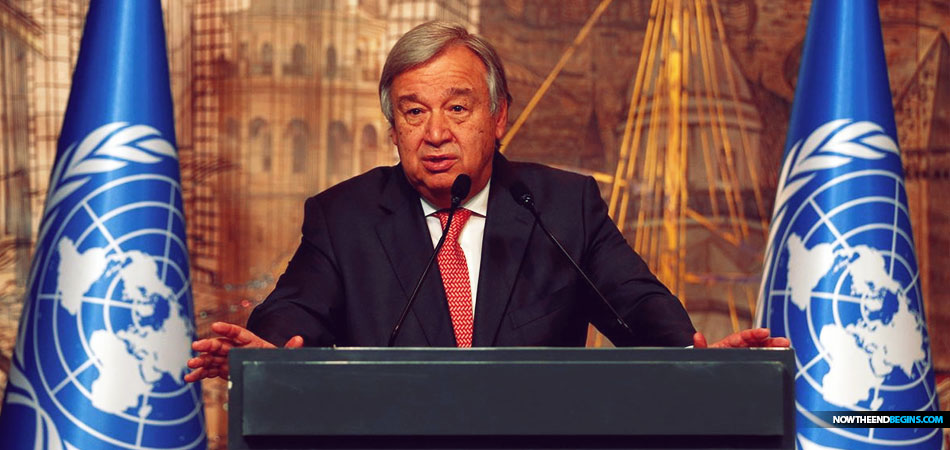
VATICAN CITY – UN Secretary General Ban Ki-moon on Tuesday hailed Pope Francis as “a spiritual leader of the world” and emphasized goals of social justice shared between the Vatican and the United Nations.
“It is very important to meet a spiritual leader of the world,” Ban said at the start of his meeting with the Argentine pope, who last month became the first non-European leader of the world’s Catholics in nearly 1,300 years.
“The Holy See and the UN share common goals and ideas,” said Ban—one of the first world leaders to be received at an audience by the new pontiff.
Francis has called for the Roman Catholic Church to be closer to ordinary people and help the needy, as well as to reach out to people of different religions and non-believers.
“We discussed the need to advance social justice and accelerate work to meet the Millenium Development Goals,” Ban said after the meeting.
The international community has undertaken to meet goals including eradicating extreme poverty and hunger and reducing child mortality by 2015. ”Pope Francis is a man of peace and purpose. He is a voice for the voiceless,” he said.
Ban said he also invited the pope to visit the United Nations “at his earliest convenience.”
The UN leader also commented on the pope’s choice to name himself after St Francis of Assisi, saying this was “a powerful message for the many goals shared by the United Nations.”
“It speaks loudly of his commitment to the poor, his acute sense of humility, his passion and compassion to improve the human condition,” he said. Ban gave the pope a large book with the Charter of the United Nations in six languages. The pope, who only spoke in Italian, gave Ban a mosaic of Rome. source – GMA News
Second Amendment Crumbling As Obama Gun-Control Victories Spread
Apr 5th
Obama is rapidly destroying the Second Amendment
The Second Amendment got attacked this week from three sides, leaving gun owners scrambling to find safe ground. President Obama has picked up victories with his allies in blue states and at the United Nations.

The United States Constitution is an endangered species as long as Obama and company continue to occupy the White House.
After Thursday, Connecticut should consider changing its state nickname from the “Constitution State” to the “Unconstitutional State,” as Gov. Dannel Malloy signed an extremely restrictive gun-control law. The bill passed the state House Thursday morning and the Senate on Wednesday.
Before the Newtown tragedy, the Brady Campaign determined that Connecticut was the fifth highest-rated state for restrictive gun-control laws. Adam Lanza ignored those laws — such as including stealing the guns, carrying them without a permit and violating the federal “gun free” school zone — in his evil mission to murder school children and teachers.
Connecticut lawmakers decided that its current “assault weapon” ban, which had a two-characteristic test, was not severe enough, so all semi-automatic rifles with one scary-looking feature are illegal. The bill cites 100 specific makes and models that are banned, such as the AR and AK.
There is a new eligibility certificate required before purchasing or receiving a long gun, which is defined as any firearm that is not a pistol or revolver. These certificates cost $35 and are issued by the Commissioner of Emergency Services and Public Protection, but there is no time limit on how long the application process can take.
Also, buying or even transferring a long gun — such as a father passing down his shotgun to his son — requires a background check and registration. The penalty for violating this provision could be a felony. Connecticut expanded the category of citizens who are permanently prohibited from having a rifle or shotgun to include those who have been convicted of misdemeanors including possession of as little as one-half ounce of marijuana or “unlawful restraint.”
Starting Oct. 1, a gun permit or a new “ammunition certificate” will be required to buy ammunition and magazines. Standard magazines that are considered “large capacity” — which is over 10 rounds — will be illegal. The penalty for a first-time offense of possession of this magazine, purchased before Jan 1., 2014, will be a $90 fine. The penalty will be a class D felon for subsequent offenses or for magazines obtained after that date,
Below the Mason-Dixon line, Maryland may have to change its state nickname from the “Free State” to the “Disarmed State” since only the law-abiding will be affected by its new gun-control law. After months of intense pressure from Gov. Martin O’Malley, the state House passed Wednesday a radical new gun-control law. The Senate is expected to pass it Thursday, and it will then be signed by Mr. O’Malley. source – WashTimes
Obama Supports UN Gun Treaty That Hobbles 2nd Amendment
Apr 2nd
The United Nations General Assembly on Tuesday signed off on a sweeping, first-of-its-kind treaty to regulate the international arms trade, brushing aside worries from U.S. gun rights advocates that the pact could lead to a national firearms registry and disrupt the American gun market.
The long-debated U.N. Arms Trade Treaty (ATT) requires countries to regulate and control the export of weaponry such as battle tanks, combat vehicles and aircraft and attack helicopters, as well as parts and ammunition for such weapons. It also provides that signatories will not violate arms embargoes, international treaties regarding illicit trafficking, or sell weaponry to countries for genocide, crimes against humanity or other war crimes.
With the Obama administration supporting the final treaty draft, the General Assembly vote was 154 to 3, with 23 abstentions. Iran, Syria and North Korea voted against it.
American gun rights activists, though, insist the treaty is riddled with loopholes and is unworkable in part because it includes “small arms and light weapons” in its list of weaponry subject to international regulations. They do not trust U.N. assertions that the pact is meant to regulate only cross-border trade and would have no impact on domestic U.S. laws and markets.
Critics of the treaty were heartened by the U.S. Senate’s resistance to ratifying the document, assuming President Obama sent it to the chamber for ratification. In its budget debate late last month, the Senate approved a non-binding amendment opposing the treaty offered by Sen. James M. Inhofe, Oklahoma Republican, with eight Democrats joining all 45 Republicans backing the amendment.
“The U.S. Senate is united in strong opposition to a treaty that puts us on level ground with dictatorships who abuse human rights and arm terrorists, but there is real concern that the Administration feels pressured to sign a treaty that violates our Constitutional rights,” Mr. Moran said. “Given the apparent support of the Obama Administration for the ATT, members of the U.S. Senate must continue to make clear that any treaty that violates our Second Amendment freedoms will be an absolute nonstarter for ratification.”
Mr. Inhofe likewise said Mr. Obama should take the Senate vote seriously.
source – Washington Times
Is Obama’s Dep’t Of Homeland Security Planning Open War In America?
Mar 11th
The Denver Post, on February 15th, ran an Associated Press article entitled Homeland Security aims to buy 1.6b rounds of ammo, so far to little notice. It confirmed that the Department of Homeland Security has issued an open purchase order for 1.6 billion rounds of ammunition. As reported elsewhere, some of this purchase order is for hollow-point rounds, forbidden by international law for use in war, along with a frightening amount specialized for snipers.
Also reported elsewhere, at the height of the Iraq War the Army was expending less than 6 million rounds a month. Therefore 1.6 billion rounds would be enough to sustain a hot war for 20+ years. In America.
Add to this perplexing outré purchase of ammo, DHS now is showing off its acquisition of heavily armored personnel carriers, repatriated from the Iraqi and Afghani theaters of operation. As observed by “paramilblogger” Ken Jorgustin last September:
[T]he Department of Homeland Security is apparently taking delivery (apparently through the Marine Corps Systems Command, Quantico VA, via the manufacturer – Navistar Defense LLC) of an undetermined number of the recently retrofitted 2,717 ‘Mine Resistant Protected’ MaxxPro MRAP vehicles for service on the streets of the United States.”
These MRAP’s ARE BEING SEEN ON U.S. STREETS all across America by verified observers with photos, videos, and descriptions.”
Regardless of the exact number of MRAP’s being delivered to DHS (and evidently some to POLICE via DHS, as has been observed), why would they need such over-the-top vehicles on U.S. streets to withstand IEDs, mine blasts, and 50 caliber hits to bullet-proof glass? In a war zone… yes, definitely. Let’s protect our men and women. On the streets of America… ?”
…
“They all have gun ports… Gun Ports? In the theater of war, yes. On the streets of America…?
Seriously, why would DHS need such a vehicle on our streets?”
Why indeed? It is utterly inconceivable that Department of Homeland Security Secretary Janet Napolitano is planning a coup d’etat against President Obama, and the Congress, to install herself as Supreme Ruler of the United States of America. There, however, are real signs that the Department bureaucrats are running amok.
About 20 years ago this columnist worked, for two years, in the U.S. Department of Energy’s general counsel’s office in its procurement and finance division. And is wise to the ways. The answer to “why would DHS need such a vehicle?” almost certainly is this: it’s a cool toy and these (reportedly) million dollar toys are being recycled, without much of a impact on the DHS budget. So… why not?
Remember the Sequester? The president is claiming its budget cuts will inconvenience travelers by squeezing essential services provided by the (opulently armed and stylishly uniformed) DHS. Quality ammunition is not cheap. (Of course, news reports that DHS is about to spend $50 million on new uniforms suggests a certain cavalier attitude toward government frugality.)
Spending money this way is beyond absurd well into perverse. According to the AP story a DHS spokesperson justifies this acquisition to “help the government get a low price for a big purchase.” Peggy Dixon, spokeswoman for the Federal Law Enforcement Training Center: “The training center and others like it run by the Homeland Security Department use as many as 15 million rounds every year, mostly on shooting ranges and in training exercises.”
At 15 million rounds (which, in itself, is pretty extraordinary and sounds more like fun target-shooting-at-taxpayer-expense than a sensible training exercise) … that’s a stockpile that would last DHS over a century. To claim that it’s to “get a low price” for a ridiculously wasteful amount is an argument that could only fool a career civil servant.
Meanwhile, Senator Diane Feinstein, with the support of President Obama, is attempting to ban 100 capacity magazine clips. Doing a little apples-to-oranges comparison, here, 1.6 billion rounds is … 16 million times more objectionable.
Mr. Obama has a long history of disdain toward gun ownership. According to Prof. John Lott, in Debacle, a book he co-authored with iconic conservative strategist Grover Norquist,
“When I was first introduced to Obama (when both worked at the University of Chicago Law School, where Lott was famous for his analysis of firearms possession), he said, ‘Oh, you’re the gun guy.’
I responded: ‘Yes, I guess so.’
’I don’t believe that people should own guns,’ Obama replied.
I then replied that it might be fun to have lunch and talk about that statement some time.
He simply grimaced and turned away. …
Unlike other liberal academics who usually enjoyed discussing opposing ideas, Obama showed disdain.”
Mr. Obama? Where’s the disdain now? Cancelling, or at minimum, drastically scaling back — by 90% or even 99%, the DHS order for ammo, and its receipt and deployment of armored personnel carriers, would be a “fourfer.”
- The federal government would set an example of restraint in the matter of weaponry.
- It would reduce the deficit without squeezing essential services.
- It would do both in a way that was palatable to liberals and conservatives, slightly depolarizing America.
- It would somewhat defuse, by the government making itself less armed-to-the-teeth, the anxiety of those who mistrust the benevolence of the federales.
If Obama doesn’t show any leadership on this matter it’s an opportunity for Rep. Darrell Issa, chairman of the House Oversight and Government Reform Committee, and Rep. Michael McCaul, chairman of the House Committee on Homeland Security, to summon Secretary Napolitano over for a little national conversation. Madame Secretary? Buying 1.6 billion rounds of ammo and deploying armored personnel carriers runs contrary, in every way, to what “homeland security” really means. Discuss. source – Forbes
UN Demands Israel Withdraw From Judea And Samaria
Jan 31st
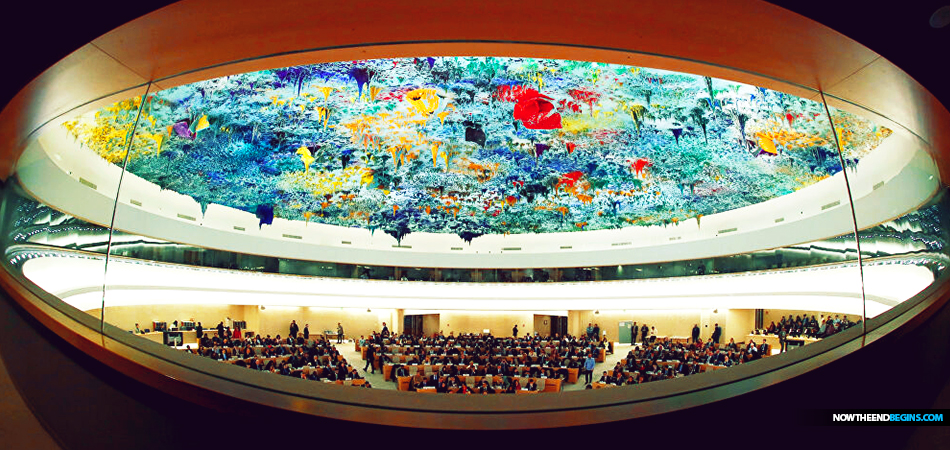
The United Nations says Israel must withdraw all of its citizens from the regions of Judea and Samaria. The recommendation came in a report issued Thursday by the U.N. Human Rights Council, which has a history of passing numerous biased resolutions condemning Israel for various alleged “crimes” each year.
“Israel must, in compliance with Article 49 of the Fourth Geneva Convention, cease all settlement activities without preconditions,” the report said in part. “It must immediately initiate a process of withdrawal of all settlers from the occupied Palestinian territories.”
Israel”s Foreign Ministry responded in a fiery statement immediately to the report, which claimed that Jewish settlement activity only “hampers peace efforts.”
In response, Foreign Ministry spokesman Yigal Palmor said, “The Human Rights Council has sadly distinguished itself by its systemically one-sided and biased approach towards Israel.
“This latest report is yet another reminder of that,” he added.
At least half a million Israelis live in Judea, Samaria and areas of Jerusalem restored to the capital during the 1967 Six Day War. source – Arutz Sheva
United Nations To Launch Predator Drone Surveillance
Jan 9th
The watchmen sound the alarm but the people won’t hear
The bible says that in the last days, the end times church would not be on fire for the Lord, but rich, increased with goods, and very self-satisfied. It would be the church of Laodicea, whose ears have grown cold and dead, and whose heart has waxed gross. This is the current state of the professing Christian church.
“I know thy works, that thou art neither cold nor hot: I would thou wert cold or hot. So then because thou art lukewarm, and neither cold nor hot, I will spue thee out of my mouth.” Revelation 3:15,16
If you would have done a story like this 20 years ago, every, single prophecy person in America would be rushing to write their next book on the One World Government. There would be a huge outcry and protests in the streets. But in 2013 you will hear none of that. Most Christians don’t know bible prophecy, and neither do they care to take the time to “study to show thyself approved unto God”.
We are asleep at the wheel as the world prepares to go dark.
From WashPost: UNITED NATIONS — The United Nations, looking to modernize its peacekeeping operations, is planning for the first time to deploy a fleet of its own surveillance drones in missions in Central and West Africa.
The U.N. Department of Peacekeeping has notified Congo, Rwanda and Uganda that it intends to deploy a unit of at least three unarmed surveillance drones in the eastern region of Congo.
The action is the first step in a broader bid to integrate unmanned aerial surveillance systems, which have become a standard feature of Western military operations, into the United Nations’ far-flung peacekeeping empire.
But the effort is encountering resistance from governments, particularly those from the developing world, that fear the drones will open up a new intelligence-gathering front dominated by Western powers and potentially supplant the legions of African and Asian peacekeepers who now act as the United Nations’ eyes and ears on the ground.
“Africa must not become a laboratory for intelligence devices from overseas,” said Olivier Nduhungirehe, a Rwandan diplomat at the United Nations. “We don’t know whether these drones are going to be used to gather intelligence from Kigali, Kampala, Bujumbura or the entire region.”
Developing countries fear Western control over intelligence gathered by the drones. Some of those concerns are rooted in the 1990s, when the United States and other major powers infiltrated the U.N. weapons inspection agency to surreptitiously collect intelligence on Iraqi President Saddam Hussein’s military.
The growing American use of drones in Pakistan, Yemen and elsewhere to identify and kill suspected terrorists has only heightened anxieties about their deployment as part of multilateral peacekeeping missions.
U.N. officials have sought to allay the suspicions, saying there is no intention to arm the drones or to spy on countries that have not consented to their use.
The U.N. drones would have a range of about 150 miles and can hover for up to 12 hours at a time. They would be equipped with infrared technology that can detect troops hidden beneath forest canopy or operating at night, allowing them to track movements of armed militias, assist patrols heading into hostile territory and document atrocities.
“These are really just flying cameras,” said one U.N. official who spoke on condition of anonymity because of the sensitivity of the topic. “Our best method of protection is early warning. We recently had a patrol ambushed in Darfur. If you had a drone ahead of the patrol, it could have seen the ambush party.”
“If you know armed groups are moving in attack or battle formation early enough, you can warn civilians,” the official added.
The United Nations, which manages a force of more than 100,000 blue helmets in 15 peacekeeping missions, views drones as a low-cost alternative to expensive helicopters for surveillance operations.
Along with the pending deployments in the Congo, the organization has ordered a feasibility study into their use in Ivory Coast. U.N. military planners say they see a need for drones in many other missions, including Darfur, Sudan and South Sudan, where the United Nations monitors tensions along the border of the two countries. But they acknowledged that they have little hope that Sudan would permit them.
The United Nations has previously turned to the United States and other governments to provide with over-flight imagery. Rolf Ekeus, the former Swedish chief of the U.N. Special Commission in Iraq, persuaded the United States to loan the United Nations U-2 spy planes to monitor Saddam Hussein’s weapons of mass destruction program in the 1990s.
More recently, Ireland, France and Belgium supplied unmanned aircraft to U.N.-backed, European-led missions in Chad, Lebanon and the Congo, and Belgium sent four drones to the Congo to help provide security for presidential and legislative elections. Two days before the 2006 election, one of the drones crashed, killing one woman and injuring two in Kinshasa, the capital.
Interest in drone technology has picked up among U.N. humanitarian and relief agencies. Last February, the U.N. Institute for Training and Research deployed the United Nations’ first drone in Port-au Prince, Haiti, to survey earthquake damage and help coordinate recovery efforts.
The use of drones in peacekeeping missions has proved more sensitive.
Pakistan’s U.N. ambassador, Masood Khan, recently told reporters that member states understand the importance of surveillance in ensuring the safety of peacekeepers. But he said there are differing views over the appropriateness of deploying drones.
Others say the dispute centers on questions about who would have access to the images and intelligence collected by the drones and whether the next step would be arming them.
To address such questions, the U.N. special committee on peacekeeping operations, which is made up of more than 140 countries, has asked the secretary general to assess the effect of drones and other modern technology on peace missions.
Herve Ladsous, the U.N. undersecretary general for peacekeeping, asked the Security Council in a closed door meeting Tuesday to support his plan for drones in Congo.
The United States, Britain, France and other Western members of the council backed the proposal, saying the United Nations needs to modernize its peacekeeping role. But China, Russia, Rwanda, Pakistan and Guatemala voiced concern, setting the stage for a contentious debate over the U.N. plan. Rwanda’s U.N. ambassador, Eugène-Richard Gasana, told the council that the U.N.’s introduction of drones carries the risk of transforming the peacekeeping mission into a belligerent force, according to a council diplomat.
But Richard Gowan, an expert on U.N. peacekeeping at New York University’s Center on International Cooperation, said much of the resistance is driven by fear that drones would replace the legions of U.N. peacekeepers.
“This really boils down to a concern from the troop contributors that they are going to be sidelined. A drone is a cheaper and more efficient alternative to an infantry patrol,” said Gowan. “I think, very frankly, that a number of the large African and Asian troops contributors are worried that if the United Nations gets involved in high-tech operations like this, that their personnel will be made redundant.” source – Washington Post