Posts tagged war
IDF Says 8,000 Rockets and Missiles Could Hit Israel if War Erupts
Jan 3rd
Based on these assessments and the growing arsenals of Hamas, Hezbollah, Syria and Iran, a war in 2017 would likely include the firing of 15,000 rockets and missiles into Israeli cities, causing greater devastation and more casualties. The IDF believes that most of the rockets will be short-range and another 5,500 will have a range over 70 km.
The revelation regarding the missile threat to the Israeli home-front comes as the IDF continues to negotiate with the government regarding the defense budget for 2012. The IDF had initially planned to implement a new multi-year plan for the years 2010-2017, but put those plans on hold after the government decided to cut the defense budget in wake of the past summer’s social protest.
According to the IDF, under the NIS 50 billion budget proposed by the government the IDF is still missing close to NIS 7 billion needed for training its forces, procuring new capabilities and adequately countering the growing threats in the region. Deputy Chief of Staff Maj.-Gen. Yair Naveh recently appeared before the government and proposed that the IDF receive NIS 5 billion and find within its budget the remaining NIS 2 billion. Naveh warned the government that if the money is not allocated, the IDF will not be able to procure new missile defense systems such as the Iron dome for short-range rockets, David’s Sling for medium-range rockets, and the Arrow 2 and Arrow 3 for long-range ballistic missiles.
The IDF assessed that it will require around a dozen Iron Dome missile defense batteries to protect Israel from the short-range missile threat along its borders. The gap in the budget, according to the IDF, stems from the government’s refusal in recent years to compensate it for the increase in the costs of living within Israel, such as the rising expenses of gas and food.
According to the Brodet Commission, which studied the defense budget five years ago, the IDF is supposed to receive compensation for these costs. The Brodet Commission’s recommendations were approved by the government at the time. One of the recommendations capped the amount the IDF would pay in property tax at NIS 320 million. The Treasury has refused to implement that recommendation and today the IDF is paying over NIS 700 million. source – JPost
China President Hu Urges Navy To PREPARE FOR WAR
Dec 6th
Chinese President Hu Jintao Tuesday urged the navy to prepare for military combat amid growing regional tensions over maritime disputes and a US campaign to assert itself as a Pacific power.
The navy should “accelerate its transformation and modernisation in a sturdy way, and make extended preparations for military combat in order to make greater contributions to safeguard national security,” he said.
Addressing the powerful Central Military Commission, Hu said: “Our work must closely encircle the main theme of national defence and military building.”
His remarks, which were posted on a statement on a government website, come amid growing US and regional concerns over China’s naval ambitions, particularly in the South China Sea.
China claims all of the maritime area, as does Taiwan, while four Southeast Asian countries declare ownership of parts of it, with Vietnam and the Philippines accusing Chinese forces of increasing aggression there.
In a translation of Hu’s comments, the official Xinhua news agency quoted the president as saying China’s navy should “make extended preparations for warfare.”
But the Pentagon on Tuesday downplayed Hu’s speech, saying that Beijing had the right to develop its military, although it should do so transparently.
“They have a right to develop military capabilities and to plan, just as we do,” said Pentagon spokesman George Little, but he added “we have repeatedly called for transparency from the Chinese and that’s part of the relationship we’re continuing to build with the Chinese military.”
“Nobody’s looking for a scrap here,” insisted another spokesman Admiral John Kirby. “Certainly we wouldn’t begrudge any other nation the opportunity, the right to develop naval forces to be ready.
“Our naval forces are ready and they’ll stay ready.”
US undersecretary of defence Michelle Flournoy is due to meet in Beijing with her Chinese counterparts on Wednesday for military-to-military talks.
Chinese Premier Wen Jiabao last month warned against interference by “external forces” in regional territorial disputes including in the South China Sea, a strategic and resource-rich area where several nations have overlapping claims.
And China said late last month it would conduct naval exercises in the Pacific Ocean, after Obama, who has dubbed himself America’s first Pacific president, said the US would deploy up to 2,500 Marines to Australia.
China’s People’s Liberation Army, the largest military in the world, is primarily a land force, but its navy is playing an increasingly important role as Beijing grows more assertive about its territorial claims.
Earlier this year, the Pentagon warned that Beijing was increasingly focused on its naval power and had invested in high-tech weaponry that would extend its reach in the Pacific and beyond. source – Yahoo News
Has the War with Iran Already Begun?
Dec 6th
Two incidents that occurred on Sunday—Iran’s claim of a shoot-down of a U.S. drone, and an explosion outside the British embassy in Bahrain—may have been unrelated. But they appear to add to growing evidence that an escalating covert war by the West is under way against Iran, and that Tehran is retaliating with greater intensity than ever.

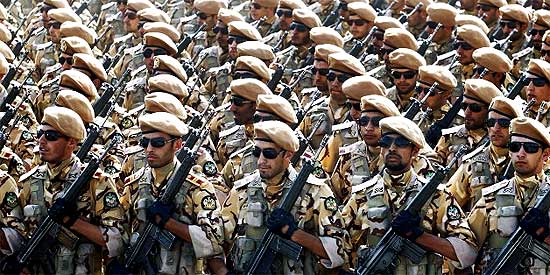
UPI/Maryam Rahmanian Iranian soldiers march during the annual military parade on September 22, 2011 in front of the mausoleum of the Iran's late leader Ayatollah Khomeini in Tehran,Iran. The parade marks the beginning of the 1980-1988 war between Iran and Iraq. UPI/Maryam Rahmanian
Asked whether the United States, in cooperation with Israel, was now engaged in a covert war against Iran’s nuclear program that may include the Stuxnet virus, the blowing-up of facilities and the assassination or kidnapping of scientists, one recently retired U.S. official privy to up-to-date intelligence would not deny it.
“It’s safe to say the Israelis are very active,” the official said, adding about U.S. efforts: “Everything that [GOP presidential candidate] Mitt Romney said we should be doing—tough sanctions, covert action and pressuring the international community — are all of the things we are actually doing.” Though the activities are classified, a senior Obama administration official also would not deny that such a program was under way. He indicated that the U.S. was not involved in every action, referring to recent alleged explosions at Isfahan and elsewhere. But, he added: “I wouldn’t assume that everything we do is coordinated.”
Former undersecretary of State Nicholas Burns, who oversaw America’s Iran engagement during the Bush administration, asked Sunday about reports that the U.S. program began under George W. Bush, said he could not comment on intelligence matters.
In September, the head of the Atomic Energy Organization of Iran, Fereydoun Abbasi-Davani, accused Great Britain, Israel and the U.S. of conducting attacks on him and other Iranian scientists.”Six years ago the intelligence service of the UK began collecting information and data regarding my past, my family, the number of children,” Abbasi-Davani told a news conference at the annual conference of the International Atomic Energy Agency (IAEA) in Vienna. Abbasi-Davani, who was said to have been wounded in 2010 car bomb explosion, said the attacks were carried out by Israel with the “support of the intelligence services of the United States and England.”
Last week, Iranian protesters stormed the British embassy in Tehran. Dominick Chilcott, Britain’s ambassador to Iran, later said the attack occurred “with the acquiescence and the support of the state.” Then, on Sunday, Bahrain’s interior ministry announced that an explosion occurred inside a minibus parked near the British Embassy. There were no immediate reports of serious damage or injuries.
U.S. officials alleged in October that agents acting for Iran’s Revolutionary Guard, which has increasingly exerted control over the Tehran regime, were involved in a plot to kill that Saudi ambassador to Washington in a restaurant. Iran denied the allegations. Then, on Sunday, in what have been another escalation, Iran’s news agency reported that Iranian armed forces shot down an unmanned U.S. spy plane that illegally crossed the country’s eastern border.
Responding to the Iranian report, NATO command in Afghanistan released a terse statement Sunday: “The UAV to which the Iranians are referring may be a US unarmed reconnaissance aircraft that had been flying a mission over western Afghanistan late last week. The operators of the UAV lost control of the aircraft and had been working to determine its status.” National Journal
Iran’s Revolutionary Guards Prepare for War!
Dec 6th
Strike on nuclear facility imminent
An order from Gen Mohammed Ali Jaafari, the commander of the guards, raised the operational readiness status of the country’s forces, initiating preparations for potential external strikes and covert attacks.
Western intelligence officials said the Islamic Republic had initiated plans to disperse long-range missiles, high explosives, artillery and guards units to key defensive positions.
The order was given in response to the mounting international pressure over Iran’s nuclear programme. Preparation for a confrontation has gathered pace following last month’s report by the International Atomic Energy Agency (IAEA) in Vienna that produced evidence that Iran was actively working to produce nuclear weapons.
The Iranian leadership fears the country is being subjected to a carefully co-ordinated attack by Western intelligence and security agencies to destroy key elements of its nuclear infrastructure.
Recent explosions have added to the growing sense of paranoia within Iran, with the regime fearing it will be the target of a surprise military strike by Israel or the US.
Its ballistic missile programme suffered a major setback on Nov 12 after an explosion at the regime’s main missile testing facility at Bidganeh, about 30 miles west of Tehran.
At least 17 people died, including Gen Hassan Tehrani Moghaddam, the head of Iran’s missile research programme.
The IAEA report said Iranian scientists had worked to develop a missile capable of carrying nuclear warheads. Security analysts described Iran’s missile advances as “a turning point” that had “profound strategic implications”.
Last week another mysterious explosion caused significant damage to Iran’s uranium conversion facility at Isfahan.
“It looks like the 21st century form of war,” said Patrick Clawson of the Washington Institute for Near East Policy, a Washington think tank, told the Los Angeles Times. “It does appear that there is a campaign of assassinations and cyber war, as well as the semi-acknowledged campaign of sabotage.”
Ayatollah Ali Khamenei, Iran’s spiritual leader, issued a directive to the heads of all the country’s military, intelligence and security organisations to take all necessary measures to protect the regime.
Gen Jaafari responded to this directive by ordering Revolutionary Guards units to redistribute Iran’s arsenal of long-range Shahab missiles to secret sites around the country where they would be safe from enemy attack and could be used to launch retaliatory attacks.
In addition, the Iranian air force has formed a number of “rapid reaction units”, which have been carrying out extensive exercises to practice a response to an enemy air attack.
At the weekend, Iran claimed it had succeeded in shooting down an advanced American RQ-170 drone in the east of the country. If true, this would represent a major coup for the ayatollahs, as this type of drone contains sensitive stealth technology that allows it to operate for hours without being detected.
A spokesman for Nato’s International Security Assistance Force in Afghanistan would only confirm that US operators had “lost control” of a drone, without specifying the model.
Intelligence officials believe the dangerous game of cat and mouse between Iran and the West was responsible for last week’s attack on the British Embassy in Tehran. William Hague, the Foreign Secretary, closed the embassy and expelled Iranian diplomats in response.
But with Iran showing no sign of backing down over its nuclear programme, there is growing concern that Israel will launch unilateral military action.
At the weekend, Benjamin Netanyahu, Israel’s prime minister, warned that he would take “the right decision at the right moment” if Iran continued with its uranium enrichment programme.
Israel’s uncompromising approach is viewed with alarm in Washington.
Leon Panetta, the US defence secretary, has warned that a unilateral strike by Israel risked “an escalation” that could “consume the Middle East in confrontation and conflict that we would regret”.
A senior Western intelligence official said: “There is deep concern within the senior leadership of the Iranian regime that they will be the target of a surprise military strike by either Israel or the US.
“For that reason they are taking all necessary precautions to ensure they can defend themselves properly if an attack happens.” source – Telegraph UK
Israel Refuses To Tell US Its Iran Intentions
Nov 12th
Israel has refused to reassure President Barack Obama that it would warn him in advance of any pre-emptive strike on Iran’s nuclear capabilities, raising fears that it may be planning a go-it-alone attack as early as next summer.
The US leader was rebuffed last month when he demanded private guarantees that no strike would go ahead without White House notification, suggesting Israel no longer plans to “seek Washington’s permission”, sources said. The disclosure, made by insiders briefed on a top-secret meeting between America’s most senior defence chief and Benjamin Netanyahu, Israel’s hawkish prime minister, comes amid concerns that Iran’s continuing progress towards nuclear weapons capability means the Jewish state has all but lost hope for a diplomatic solution.
On Tuesday, UN weapons inspectors released their most damning report to date into Iran’s nuclear activities, saying for the first time that the Islamic republic appeared to be building a nuclear weapon. It was with that grave possiblity in mind that Leon Panetta, the US defence secretary, flew into Israel last month on what was ostensibly a routine trip.
Officially, his brief was restricted to the Middle East peace process, but the most important part of his mission was a private meeting with Mr Netanyahu and the defence minister, Ehud Barak. Once all but a handful of trusted staff had left the room, Mr Panetta conveyed an urgent message from Barack Obama. The president, Mr Panetta said, wanted an unshakable guarantee that Israel would not carry out a unilateral military strike against Iran’s nuclear installations without first seeking Washington’s clearance.
The two Israelis were notably evasive in their response, according to sources both in Israel and the United States.
“They did not suggest that military action was being planned or was imminent, but neither did they give any assurances that Israel would first seek Washington’s permission, or even inform the White House in advance that a mission was underway,” one said.
Alarmed by Mr Netanyahu’s noncommittal response, Mr Obama reportedly ordered the US intelligence services to step up monitoring of Israel to glean clues of its intentions.
What those intentions might be remains distinctly murky. Over the past fortnight, Israel’s press has given every impression that the country is on a war footing, with numerous claims that Mr Netanyahu and Mr Barak are lobbying the cabinet to support the military option.
Two weeks ago Israel tested a long-range ballistic missile capable of reaching Iran, its first since 2008. Shortly before, the Israeli airforce took part in Nato exercises in Sardinia that involved air-to-air refuelling, a key component of an aerial strike on Iran. A separate exercise in and around Tel Aviv tested civilian readiness in the event of a missile strike against the city. In a sign of the febrility of the public mood, many beach-goers apparently mistook the air raid sirens for a genuine Iranian attack and fled in panic for their cars. There were similar jitters in Iran yesterday, when a huge but apparently accidental explosion at arms dump outside Tehran killed at least 27 soldiers and shook the city.
Speculation about an imminent Israeli military action has been a regular occurrence over the years, but rarely as fevered as now. Last week, a British official even suggested that an attack could come before Christmas.
Few in Israel believe that is likely and the difficulty of mounting an operation over winter, when cloud cover hampers aircraft targeting systems, means that if military action is being considered it will not come before the spring or summer of next year.
Many observers also believe that the bellicose rhetoric voiced by a number of senior Israeli figures in recent days is largely bluff, designed to goad the international community into imposing sanctions of such severity that Iran would be forced into economic ruin if it persisted with its nuclear ambitions. Israel says that if Iran’s central bank were sanctioned and a ban on Iranian oil exports enforced by an international naval blockade, military action would not be necessary.
Mr Barak has already publicly stated that he does not believe the West can overcome Russian and Chinese opposition to the sanctions Israel wants, leaving military action increasingly as the only alternative.
Mr Netanyahu may have another reason to bluff. In recent months, Meir Dagan, who retired as director of Mossad at the beginning of the year, has made a series of unprecedented speeches countenancing against Israeli military action – describing it as “the stupidest idea I’ve ever heard”.
His comments have infuriated the Israeli establishment – senior officials have said they would like to see him behind bars – because they fear it could convince Iran’s Mullahs that Israel’s sporadic talk of war is a fiction.
Hints by Mr Netanyahu that he is considering the military option may be designed to resurrect Iran’s paranoia of Israel, something seen in the Jewish state as a powerful deterrent, says Yossi Melman, a leading intelligence analyst and journalist.
“Meir Dagan made a laughing stock of military action,” Mr Melman said. “Netanyahu believes he damaged the deterrent and he wants to repair it.”
Yet the fact that Mr Dagan chose to speak out – extraordinary in itself for a just-retired Mossad chief – suggests that he believes Mr Netanyahu is intent on attacking Iran.
Tellingly, until last year, Israel’s four most powerful military and security chiefs, including Mr Dagan, were all strongly opposed to military action. All four have now been replaced by younger men who may be less able to stand up to Mr Netanyahu, not that Israeli prime ministers are necessarily bound to heed objections from their top military advisers anyway. In 1981, Menachem Begin did just that when he bombed Iraq’s nuclear reactor at Osirak.
If Israel is to attack Iran, many in the country believe time is running out. Last week’s report by the International Atomic Energy Agency (IAEA) highlighted Iran’s apparent determination to build a nuclear warhead, but did not indicate how long it might take.
Some in Israel, however, believe it is very close.
“It is my personal opinion that, if the Iranian regime decides to do so, it can produce a nuclear explosive device within a year, plus or minus a few months,” said Ephraim Asculai, a former IAEA official and leading Israeli expert on Iran’s nuclear programme.
Not everyone agrees. Some argue that a covert espionage operation has caused such delays that Iran still needs another three years to build a bomb. Sabotage efforts by Israeli, American and British intelligence have successfully slowed Iranian progress, most notably via the Stuxnet computer virus that caused the centrifuges at Iran’s Natanz uranium enrichment plant to explode. Mossad agents on motorbikes are also believed to have planted magnetic explosives on the cars of at least two key Iranian nuclear scientists as they weaved through Tehran’s traffic jams. Mohsen Fakhrizadeh, the scientist and Revolutionary Guards officer who is thought to be the ultimate mastermind of the nuclear programme, is now believed to be under round-the-clock protection as a result. But, whatever the time frame, some in Israel believe there is additional cause for urgency that could prompt military action sooner rather than later.
According to western intelligence assessments, Tehran is preparing to move the bulk of its nuclear production to a plant beneath a mountain near the holy city of Qom that would be far harder to hit from the air.
According to Ronen Bergman, senior military analyst for Israel’s Yediot Ahronot newspaper and the author of a forthcoming book on Mossad, that makes a strike necessary well before Iran actually perfects its programme.
“Today Israeli intelligence talks of what is known as the ‘framework of immunity’,” he said. “In other words, it is not the point at which Iran acquires a nuclear device, but the point at which the project has reached such an advanced stage that a strike any time after would be ineffective.”
An Israeli attack could probably manage at most a dozen targets, using more than 100 F-15 and F-16 aircraft.
Three German-designed Dolphin submarines equipped with conventional cruise missiles could also be ordered into the Persian Gulf to take part, although it is thought that Israel’s Jericho-3 ballistic missiles are to inaccurate to play a role.
But how effective the mission would be is another matter. At best, Israel can hope to delay Iran from building a bomb by two to four years, experts assess. Optimists hope that within such a period, Iran’s Islamist regime could collapse and give may to a more moderate government. But it could equally redouble its nuclear efforts, this time arguing that it now had every right to produce a weapon.
As Mr Panetta warned during a Pentagon briefing last Thursday, such a strike would also have a “serious impact” on the region. Iran could blockade the Straits of Hormuz, through which 25 per cent of the world’s oil exports are shipped, sending energy prices soaring. US military assets in the Gulf could come also come under attack from Iranian Scud missiles.
Iran would almost certainly fire its Shahab ballistic missiles at Israeli cities and press Hizbollah and Hamas, the militant Islamist groups it funds and equips, to unleash their huge rocket arsenals from their bases in Lebanon and Gaza.
Despite this, last week Mr Barak – making a rare venture in such sensitive territory – predicted that fewer than 500 fatalities would arise “if people stayed at home”.
Such are both the political and military risks involved that many Israelis say it is inconceivable that Mr Netanyahu would go to war without the United States alongside him.
“I think personally that if such action is taken, there will be come kind of consultation with the United States,” said Ilan Mizrahi, Mossad’s former deputy director and Israel’s national security adviser until 2007.
“If Iran breaks all the rules, then military action will be needed, but definitely not alone by a tiny country like Israel,” added Uzi Eilam, a retired general who held senior positions at the Israeli defence ministry.
But not everyone is so sure. Mr Obama’s willingness to take on Iran militarily is openly questioned in Israel. And while many Israelis do not believe Iran has any intention of actually firing a nuclear missile at them, the the key question is whether their prime minister is one of them.
In Mr Netanyahu’s eyes, Iran’s president, Mahmoud Ahmadinejad, is another “Hitler” whose aim is to complete what the Holocaust failed to do by wiping out the Jewish race.
“People outside Israel don’t understand how profound memories of the Holocaust are, and how they affect future policy making,” said Mr Bergman, the military analyst. “At the end of the day, this policy of ‘never again’ would dictate Israel’s behaviour when intelligence comes through that Iran has come close to a bomb.” source – Telegraph UK
UK and U.S. ‘draw up joint plan to attack Iran’
Nov 3rd
Evidence of nuclear programme raises tension in Middle East
Whitehall figures say Iran is ‘newly aggressive – and we are not sure why’
- Iran ‘has enough enriched uranium for four nuclear weapons’
- Israeli Prime Minister Benjamin Netanyahu pushing for invasion
- Tel Aviv test-fires rockets capable of carrying nuclear warheads into Iran
- Report reveals China continues to supply Tehran with missiles and other conventional weapons
- Obama says nuclear programme remains a threat and calls on Iran to reveal its intentions
The UK and U.S. are drawing up plans to attack Iran amid growing tensions in the Middle East, it was claimed last night. Barack Obama and David Cameron are preparing for war after reports that Iran now has enough enriched uranium for four nuclear weapons.
President Mahmoud Ahmadinejad’s hardline regime in Tehran has been linked to three assassination plots on foreign soil, according to senior officials in Whitehall.
Iran has come sharply back into focus following the end of the Libya conflict. And the unrest has been inflamed by sabre-rattling from top politicians in Israel.
President Obama said Iran’s nuclear programme continues to pose a threat and that he and French president Nicolas Sarkozy want the international community to maintain pressure on the country to admit its intentions.
The International Atomic Energy Agency (IAEA) is preparing to reveal intelligence on Iran’s alleged nuclear arms experiments. Iran has consistently denied that it is trying to build nuclear weapons and insists the programme is for peaceful purposes. The U.S., Britain and France want the IAEA to share its intelligence, but Russia and China are pressing for the report to be delayed or scrapped entirely.
Yesterday it was revealed that Tel Aviv had successfully test-fired a rocket capable of carrying a nuclear warhead which could strike Iran. Israeli Prime Minister Benjamin Netanyahu and Defence Minister Ehud Barak are reportedly agitating for a pre-emptive attack against the Islamic state.
The UK would be likely to agree to any U.S. decision to invade, even though the Ministry of Defence are stretched to breaking point by swingeing budget cuts and wars in Afghanistan and Libya.
An MoD spokesman said: ‘The British government believes that a dual track strategy of pressure and engagement is the best approach to address the threat from Iran’s nuclear programme and avoid regional conflict.
‘We want a negotiated solution – but all options should be kept on the table.’
A special unit at the MoD has been instructed to work out the UK’s strategy if the Army should invade Iran.
War planners will look at potential deployments of Royal Navy ships and submarines equipped with Tomahawk cruise missiles and RAF fighter jets armed with precision-guided Paveway IV and Brimstone bombs and missiles, surveillance planes and air-to-air refuelling. source – Daily Mail UK
Israeli Forces Brace for Violence When Palestinians March for Statehood
Sep 5th
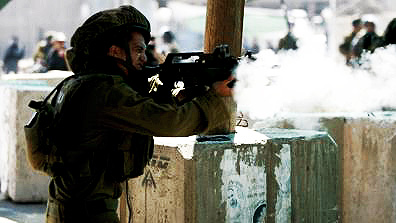
An Israeli soldier fires tear gas canisters at Palestinian protesters during a protest march at the Qalandia checkpoint between the West Bank city of Ramallah and Jerusalem.
ELAZAR, West Bank — Israeli forces are seeking to prevent bloodshed when Palestinians march in support of a statehood drive this month, but they are preparing for worst-case scenarios, even authorizing West Bank settlers to shoot at Palestinians who approach their communities.

Aug. 26, 2011: An Israeli soldier fires tear gas canisters at Palestinian protesters during a protest march at the Qalandia checkpoint between the West Bank city of Ramallah and Jerusalem.
Palestinians say the rallies will be peaceful — a view shared by Israel’s own security assessments — and will steer clear of any settlements. Yet, the combustible atmosphere and the long and deadly history of Israeli-Palestinian violence are raising the specter that events might spin out of control.
For the Palestinians, the mass marches are intended to boost their campaign to get the U.N. to recognize an independent state, a strategy they are trying because negotiations aimed at bringing about a state through a peace deal with Israel have been stalled for two years.
Settlers living on land the Palestinians want for their future state have long been targets for militant attacks; likewise, some settlers have attacked Palestinian civilians. The fear among settlers now is that even unarmed crowds — if large enough — could overrun their communities.
Ilan Paz, a retired Israeli general who served in the West Bank for a decade, said a scenario with hundreds of casualties was not unthinkable.
“You can’t know how this sort of protest will end,” Paz said. “All sorts of local incidents can lead to injuries, and this can cause a deterioration in the situation.”
Israel’s army is training soldiers used to battling gunmen in non-lethal riot control tactics and inviting settlers to watch the drills at a military camp in a rural part of central Israel.
The mass demonstrations are set for around the time of the Sept. 13-22 United Nations General Assembly session, where the Palestinians hope to be granted official endorsement as a state. Some doubt the rallies will take place at all, however, and several Palestinian activist groups say they will not take part, believing the effort would achieve little.
Preparations undertaken by police are expected to cost Israel about $20 million, according to a senior police officer. Purchases include 16 long-range tear gas launchers, 15 trained Belgian horses to bolster the police’s mounted forces, and a weeklong riot training course for a quarter of the nation’s 28,000 police officers, he said.
Police expect Israeli-controlled east Jerusalem, home to 250,000 Palestinians, to be a flash point, he added. He spoke on condition of anonymity because of the sensitive nature of the precautions.
Security forces are stockpiling tear gas, stun grenades, water cannons and other non-lethal weapons. At a military camp about an hour’s drive from Israel’s metropolitan center in Tel Aviv, troops are practicing civilian crowd control. source - Fox News