Posts tagged spring
US Secretary of Defense Panetta Believes Israel Will Attack Iran By Spring 2012
Feb 2nd
There, he said it
US secretary of defense is concerned Israel will launch an attack before Iran enters so-called “immunity zone” when military strike won’t bust Iran’s nuclear facilities, ‘Washington Post’ reports.

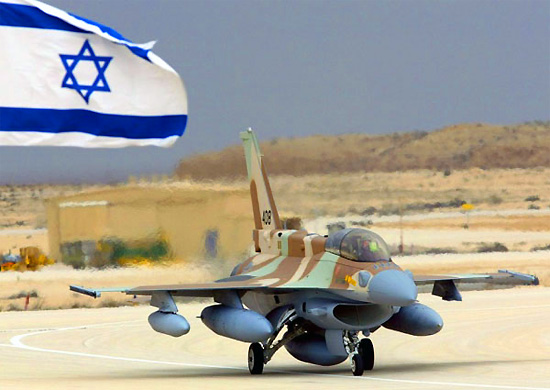
United States Secretary of Defense Leon Panetta believes that Israel will attack Iran in April, May or June, the Washington Post reported Thursday.
According to the report, written by the paper’s senior opinion writer David Ignatius, Panetta is concerned that Israel will launch an attack before Iran enters the so-called “immunity zone” when its nuclear facilities will be heavily fortified and a military strike will no longer succeed.
Ignatius does not quote Panetta in the article but he is currently traveling with the secretary of defense in Brussels.
According to the article, Israel might decide to strike before Iran completes the fortification since afterward only America will be capable of stopping Iran militarily.
“Israeli Prime Minister Benjamin Netanyahu doesn’t want to leave the fate of Israel dependent on American action,” Ignatius wrote. According to the report, Israel’s strike against Iran’s nuclear facilities could last five days which would be followed by a United Nations-brokered ceasefire. source – JPost
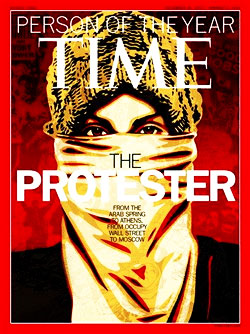
Time Magazine ‘Person of the Year’ Is The Arab Spring
Dec 14th
Praising the anarchists
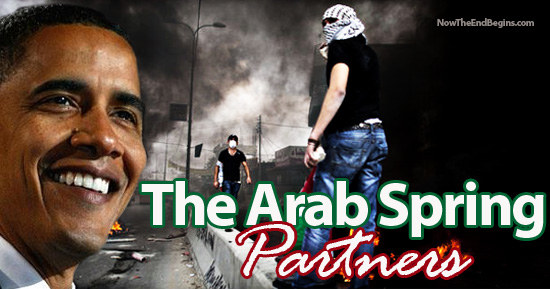
It started in Tunisia, and soon spread all through the Muslim world. Governments were toppled in in Tunisia, Libya, Egypt with others in Yemen and Syria getting ready to fall. As NTEB has reported all year, this is not a ‘youth movement for democracy”, but a coldly, calculated plot between Obama and the Muslim Brotherhood. (Click here to read our entire archive on Obama and the Muslim Brotherhood.)
Everywhere the riots have been, murders, rapes and anarchy followed in it’s path. So its only natural that Time Magazine would choose to glorify this evil phenomenon by making the Arab Spring it’s Person of the Year.
‘Kill all the Jews’
The big winner in the Arab Spring, of course, is the Islamist Muslim Brotherhood. They have two stated goals. The first being to turn the Middle East into a region dominated by Sharia Law, and the second being to ‘kill all the Jews’.
“Muslim Brotherhood holds venomous anti-Israel rally in Cairo mosque Friday; Islamic activists chant: Tel Aviv, judgment day has come. The Muslim Brotherhood rally in Cairo’s most prominent mosque Friday turned into a venomous anti-Israel protest, with attendants vowing to “one day kill all Jews.”
Some 5,000 people joined the rally, called to promote the “battle against Jerusalem’s Judaization.” The event coincided with the anniversary of the United Nation’s partition plan in 1947, which called for the establishment of a Jewish state.
Speakers at the event delivered impassioned, hateful speeches against Israel, slamming the “Zionist occupiers” and the “treacherous Jews.” Upon leaving the rally, attended were given small flags, with Egypt’s flag on one side and the Palestinian flag on the other, as well as maps of Jerusalem’s Old City detailing where “Zionists are aiming to change Jerusalem’s Muslim character.” source – YNET News
Brutal Islamic sexual assaults
(CBSNews) On Friday, Feb. 11, the day Egyptian President Hosni Mubarak stepped down, CBS chief foreign correspondent Lara Logan was covering the jubilation in Tahrir Square for a “60 Minutes” story when she and her team and their security were surrounded by a dangerous element amidst the celebration. It was a mob of more than 200 people whipped into frenzy.
In the crush of the mob, she was separated from her crew. She was surrounded and suffered a brutal and sustained sexual assault and beating before being saved by a group of women and an estimated 20 Egyptian soldiers.
She reconnected with the CBS team, returned to her hotel and returned to the United States on the first flight the next morning. She is currently in the hospital recovering.
There will be no further comment from CBS News and correspondent Logan and her family respectfully request privacy at this time.” source – CBS News
George Soros and the Occupy Wall Street Movement
Time Magazine did not stop there in praising the Islamists, they also included a group we affectionately refer to as the Flea Party – Occupy Wall Street movement. Like it’s Middle East counterpart, the Arab Spring, OWS is known for it’s high rate of STDs, suicides, rapes and murder.
By now we all know who they are, the Occupy Wall Street people. They have protested, they have rioted. They have had hundreds of cases of STD’s. They have raped, they have looted, they have set things on fire. They are unwashed, unshaven. They are anti-semtic and anti-America. And most of all they hate successful people with money. They are the opposite of the Tea Party Patriots. They are, for lack of a better name, the Flea Party. And they are, according to President Obama, the reason why he ran for office to become president in the first place.
From the Weekly Standard: President Obama hugs an increasingly unpopular, vulgar, and lawless movement. The Hill reports that after President Obama was heckled by protesters at an event in New Hampshire, he said:
“I appreciate you guys making your point; let me go ahead and make mine,” Obama said before continuing his speech. “I’ll listen to you, you listen to me, OK?”
A few minutes later, Obama acknowledged the Occupy protest movement again, saying: “You are the reason I ran for office.” Weekly Standard
Arab Spring Is Now Targeting Algeria
Dec 8th
(Reuters) – Algeria’s Islamists, in the political wilderness since their last attempt to win power dissolved into civil war, are now trying again, galvanized by the success of their brethren elsewhere in north Africa in the wake of the “Arab Spring”.

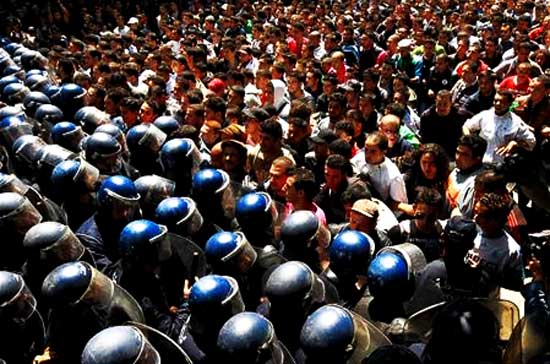
Riot policemen clash with university students from marching during a demonstration in which they demand political change in Algiers May 2, 2011. Credit: Reuters/Zohra Bensemra
Most Islamists in Algeria have been excluded from political life since the conflict, but in the past few months they have shown renewed signs of activity, much of it conducted from exile to dodge the attentions of the Algerian state.
They have set up a satellite television station based in Europe, sent delegations to Arab countries that saw revolutions this year, and made tentative forays into anti-government protests.
Their chances of success are slim: they are divided into rival ideological camps, hemmed in by the powerful Algerian security apparatus, and, most importantly, discredited in the eyes of many people by a conflict in which they took part and which killed an estimated 200,000 people.
But they see an opportunity in the upheavals of the “Arab Spring,” which have this year unseated entrenched secularist leaders. In neighboring Tunisia, a previously outlawed Islamist movement has come to power, while in Egypt Islamists have taken a strong early lead in multi-stage parliamentary elections.
“Tunisia was an example and launcher of this (Arab Spring) revolution,” said Abdullah Anas, a London-based member of the leadership council of the Islamic Salvation Front (FIS), which is banned in Algeria.
“It could be a very good example for Algeria.”
LEGACY OF VIOLENCE
Any Islamist revival in Algeria, an OPEC member and supplier of about a fifth of Europe’s imported gas, would have first to shed the burden of the country’s bloody history.
Twenty years ago, FIS was poised to win a legislative election, called after street protests forced the authorities to loosen their grip on power. FIS said it would impose an Islamic state.
The military-backed government stepped in to annul the election. The Islamists took up arms and Algeria slipped into a conflict of horrific violence. Civilians had their throats slit in the street; in the mornings, people woke up to find their towns littered with bodies.
A rump of Islamists, now operating under the banner of al Qaeda in the Islamic Maghreb, is still fighting. They periodically ambush security forces in the countryside, kidnap Westerners and stage suicide bombings.
But the violence has subsided considerably. A huge security crackdown has rounded up thousands of insurgents. Others have laid down their arms and been granted an amnesty, in exchange for an undertaking to stay out of politics.
This legacy is the biggest obstacle to any comeback by Algeria’s Islamists.
“Since then (the conflict), the Islamist was no longer seen as a hero who stands up against tyranny,” said Soheib Bencheikh, a theologian who used to be the chief cleric at the mosque in Marseilles, France, where there is a large Algerian community.
“On the contrary, he became, in the eyes of public opinion, accountable for the pain and suffering of the people,” Bencheikh told Reuters.
A fear of a return to violence helps explain why Algeria has this year remained relatively calm while neighboring countries have been convulsed by unrest.
TV STATION
But the Islamists still believe that Algeria is ripe for change, and are beginning to take practical steps.
Starting in November, a group of exiled Islamists with links to FIS set up a Europe-based television station, called Rachad TV. Carried by the Atlantic Bird 7 and Nilesat satellites , the station can be picked up in Algeria, where most homes have a dish.
It broadcasts political and social programs where opposition leaders and activists — most of them harshly critical of the government — are invited to comment on Algeria.
At the top of the station’s homepage on the Internet, there is a link to show viewers “how to free your country”, and a second link to help them “organize and participate in unrest.”
The exiles say they are also building contacts with other countries where “Arab Spring” revolts have propelled Islamists into a position of power.
Rachad says on its website that it sent a delegation to Libya in late September to meet officials in the new government, in which Islamists have a prominent role.
Abdullah Anas, the exiled Islamist in London, said there had also been contacts with Rachid Ghannouchi, the head of the moderate Islamist Ennahda party. Since an election in October his party leads Tunisia’s coalition government.
Tunisia’s experience had proved that it is possible to open up the political space in north Africa, said Anas.
“Everyone in Algeria must understand that Algeria has room for all … no matter what opinions you have,” he said, calling for a lifting of political curbs and the possibility of power-sharing between previously antagonistic groups.
SALAFISTS STIRRING
Inside Algeria, the most influential Islamist force are the Salafists, followers of an ultra-purist interpretation of Islam. Unlike the FIS, they are tolerated by the Algerian state because their creed forbids participation in politics.
When Algeria was shaken at the beginning of this year by protests sparked by a spike in food prices, the spiritual leader of the Algerian Salafists, Abdelmalek Ramdani, who lives in Saudi Arabia, issued a religious decree.
It said: “As long as the commander of the nation is a Muslim, you must obey and listen to him. Those who are against him are just seeking to replace him, and this is not licit.”
Nevertheless, there are stirrings of political activity by some Salafist preachers.
Sheikh Abdelfateh Zeraoui, a former FIS member and now a well-known Salafist preacher in the Algerian capital, issued a declaration in October saying the government had to enact urgent reforms.
“Political reforms allowing us to have free political activity are key to the stability of the country. Without reforms the country may explode,” the declaration stated.
The preacher has also tried to organize protest marches in the capital, but these have been blocked by the security forces. “We have been barred from politics,” he told Reuters.
The fact that Algerian Islamists are divided dilutes their ability to stage a comeback, said Mohamed Mouloudi, an editor and specialist on Islam.
“They are no longer speaking with one voice,” Mouloudi told Reuters.
“You have the Salafists, the Muslim brotherhood, and the Djaz’airists,(who give priority to Algerian religious traditions) among others,” he said. “You have those who are for a political action, and those who consider political action as illicit.”
SUCCESSION DEBATE
Even so, a debate is now under way in earnest within the Algerian ruling elite, for the first time since the conflict began 20 years ago, about giving Islamists a role in politics.
The focus for that debate — which, like much of Algerian politics, is conducted behind closed doors — is the question of who will succeed President Abdelaziz Bouteflika when his final term ends in 2014.
One camp within the elite is backing Abdelaziz Belkhadem, a former prime minister and secretary general of the ruling FLN party. He is a secularist but is trusted by the Islamists. Opposing him is a camp of hardline secularists who have backing from the powerful security forces.
Friction spilled out into the open when a group of Belkhadem opponents inside the FLN launched a campaign to have him removed from the party leadership.
“It will be wise to promote a man like Abdelaziz Belkhadem who has good ties with Islamists as well as with decision makers inside the regime,” said Mohamed Lagab, a secularist academic at Algiers university.
“Decision makers should take into account that North Africa will be ruled by Islamists ,” said Lagab. source – Reuters
President Abbas Declares ‘Palestinian Spring’
Sep 25th
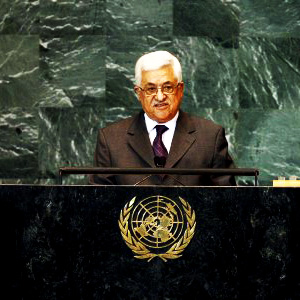
RAMALLAH, West Bank (AP) — Thousands of Palestinians cheering and waving flags gave President Mahmoud Abbas a hero’s welcome in the West Bank Sunday, as he told them triumphantly a “Palestinian Spring” had been born following his historic speech to the U.N. last week.
Abbas’ popularity has skyrocketed since he asked the U.N. on Friday to recognize Palestinian independence, defying appeals from Israel and the United States to return to peace talks. His request has pushed the region into uncharted waters, and left the international community scrambling over how to respond.
Thousands of people crowded Abbas’ West Bank headquarters in the city of Ramallah to get a glimpse of the 76-year-old president upon his return from New York. Abbas was uncharacteristically animated, shaking his hands and waving to the audience.
Abbas compared his campaign to the Arab Spring, the mass demonstrations sweeping the Arab world in hopes of freedom, saying that an independent Palestinian state is inevitable.
“We have told the world that there is the Arab Spring, but the Palestinian Spring is here,” he said. “A popular spring, a populist spring, a spring of peaceful struggle that will reach its goal.”
He warned that the Palestinians face a “long path” ahead. “There are those who would put out obstacles … but with your presence they will fall and we will reach our end.”
The Palestinians want an independent state in the West Bank, east Jerusalem and the Gaza Strip, territories captured by Israel in the 1967 Mideast war. source – Yahoo News
With Obama’s Help, Arab Spring Jihadists Plot to Take Over Libya
Sep 5th
U.S. steps up surveillance of suspects among rebels
Jihadists among the Libyan rebels revealed plans last week on the Internet to subvert the post-Moammar Gadhafi government and create an Islamist state, according to U.S. intelligence agencies.

Next to Iran, the #1 country funneling the most money and supplies to the Arab Spring rebels all across the Middle East has been Obama and the United States
U.S. officials said spy agencies are stepping up surveillance of Islamist-oriented elements among Libyan rebels. A government report circulated Tuesday said extremists were observed “strategizing” on Internet forums about how to set up an Islamist state in Libya after the regime of Col. Gadhafi is defeated.
“Several forum participants have suggested that, following a transitional stage, the battle should turn against secularist rebels and members of the [rebels’] Transitional National Council,” the unclassified report stated.
Some U.S. officials sought to play down the remarks by noting that such Internet postings are not always accurate measures of jihadist plans.
The report said the jihadists’ strength and influence on the ground “are uncertain at this time.”
However, the report said the jihadist plotting coincided with the high-profile emergence of Abu Abdallah al-Sadiq, a former leader of the al Qaeda-linked Libyan Islamic Fighting Group (LIFG) and now a leading rebel. He is currently known as Abdel Hakim al-Khulidi Belhaj and led rebels in overrunning Col. Gadhafi’s Tripoli compound.
A U.S. official familiar with intelligence reports on the region said there are concerns that some LIFG members remain committed to al Qaeda and others may be temporarily renouncing their ties to the terrorist group for “show.”
“Some members of LIFG in the past had connections with al Qaeda in Sudan, Afghanistan or Pakistan, and others dropped their relationship with al Qaeda entirely,” the official said.
“It seems – from their statements and support for establishing a democracy in Libya – that this faction of LIFG does not support al Qaeda. We’ll definitely be watching to see whether this is for real or just for show.”
A defense official familiar with jihadist strategy said Islamists likely will emerge in power from the turmoil expected after the demise of the Gadhafi regime and the West will be partly to blame.
“We’re helping pave the way for them” through NATO airstrikes and other support, he said.
About 1,000 jihadists are operating covertly in Libya, Noman Benotman, a former Libyan al Qaeda member, told The Washington Times in March.
According to a translation of the forum exchanges, Libyan Islamists view the fall of Tripoli to rebels as the initial phase of a battle to take over the country.
Jihadists were urged to prepare for the next stage in the battle: taking on secular rebels and the interim National Transitional Council, sometimes called the Transitional National Council, the secular political organization that is mainly pro-democratic. The jihadists want to set up an Islamist state ruled by Shariah law. source – Washington Times