Posts tagged Netanyahu
Gilad Schalit Returned Home, Netanyahu Warns Palestinian Terrorists
Oct 18th
Reunion is bittersweet as over 1,000 terrorists also go home
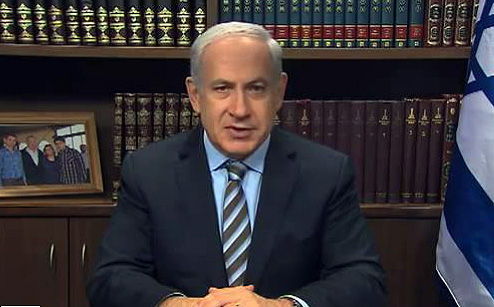
TEL NOF AIR BASE, Israel (AP) – Israel’s prime minister has warned the Palestinian militants freed in a prisoner swap that they will be punished if they return to violence.

In this image from Egypt TV Tuesday Oct 18 2011 Israeli soldier Gilad Schalit is seen at an undisclosed location in the Gaza- Egypt border area accompanied by Hamas guards as he is moved in to Egypt from captivity in Gaza beginning an elaborate prisoner swap deal in which hundreds of Palestinian inmates are to be freed in return for the captured tank crewman. (AP Photo/ Egypt TV)
Netanyahu issued the warning after greeting the lone Israeli soldier freed in the swap, in which Israel is releasing more than 1,000 prisoners. Some 300 of them had been serving life sentences for deadly attacks on Israelis.
Netanyahu said he understood the pain of Israeli families who have lost relatives in Palestinian violence.
He said, “We will continue to fight terror and every released terrorist who returns to terror will be held accountable.”
THIS IS A BREAKING NEWS UPDATE. Check back soon for further information. AP’s earlier story is below.
TEL NOF AIR BASE, Israel (AP) – Freed Israeli soldier Gilad Schalit has arrived at an air base in central Israel for an eagerly awaited reunion with his family.
Schalit landed at Tel Nof air base on board a military helicopter.
His parents, Noam and Aviva, have led an emotional campaign to win their son’s release for the past five years. They have led nationwide marches and set up a protest tent outside the official residence of the prime minister.
Earlier Tuesday, Hamas militants in Gaza freed Schalit in a swap for more than 1,000 Palestinian prisoners.
Ahead of the reunion, Schalit switched out of civilian clothes given to him by Hamas and into an Israeli military uniform. source – My Way
Netanyahu Set for Showdown With Palestine at the United Nations
Sep 15th
Let’s get ready to rumble!
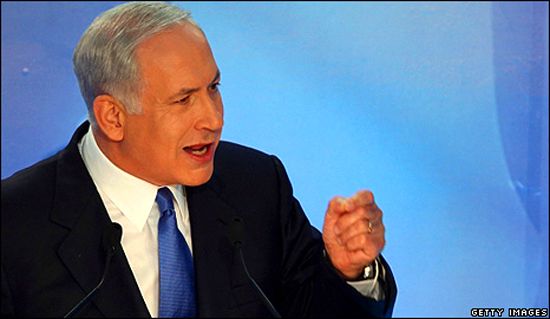
Benjamin Netanyahu, the Israeli prime minister, will address the UN General Assembly on Friday next week, setting the stage for a potentially dramatic diplomatic showdown with the Palestinians. He will speak on the same day that Mahmoud Abbas, the Palestinian leader, is due to deliver a landmark speech calling on the global body to support Palestinian statehood.
“The General Assembly is not a place where Israel usually receives a fair hearing,” Mr Netanyahu said on Thursday. “But I still decided to tell the truth before anyone who would like to hear it.”
The Israeli government, which opposes the Palestinian UN bid, had originally considered sending Shimon Peres, the Israeli president, to New York. Mr Peres is widely seen as a less divisive figure on the international stage than the prime minister. However, a failure by Mr Netanyahu to turn up at the UN next week could also have been interpreted as an unnecessary snub to the UN at a time when Israel is already facing growing diplomatic isolation.
The announcement suggests that the Israeli government now has little faith in the last-ditch effort by US and European negotiators to stop the Palestinian drive for statehood at the UN. According to several officials and diplomats, Mr Abbas on Wednesday rebuffed an alternative “package” that was drafted and presented by Tony Blair, the international community’s Middle East envoy.
The deal would have involved a statement by the Middle East Quartet (the US, UN, Russia and the European Union) calling for a return to direct negotiations between Israel and the Palestinians. The statement would have included a timeline for negotiations and clearer terms of reference than were offered in the past – for example on the likely borders of a future Palestinian state. The package, according to several people involved in the talks, also held out the promise of a UN resolution, though one that would have stopped short of endorsing Palestinian statehood at this point.
Mr Abbas, however, told Mr Blair that the deal on offer was not sufficient. Palestinian officials said it fell short of, among other things, the Palestinian demand for Israel to freeze construction in Jewish West Bank settlements. It was also unclear whether the Israeli government itself was ready to accept the Quartet statement – a key point for Palestinian negotiators.
“We believe these last-minute moves were not for the sake of restarting peace talks, but for the sake of preventing the Palestinians from going to the UN,” one Palestinian official based in Ramallah said.
Mr Abbas is still facing strong pressure from senior US officials to step back from the UN move. However, most officials and diplomats believe that there is now little chance of stopping a Palestinian bid for statehood, which could take place either at the UN Security Council or in the UN General Assembly. Mr Abbas himself is scheduled to give a television address on Friday night, amid speculation that he will use the broadcast to finally reveal the precise Palestinian proposal for statehood at the UN. source – FT
Israel’s Policy Of Military Restraint Is Working Against Them As Terror Attacks Rise
Aug 30th
As the September deadline approaches, terror attacks rise in Israel
In the 10 days after Palestinian raiders killed eight Israelis on the Eilat highway on Aug. 18, Israel has suffered five terrorist attacks, the latest in Tel Aviv Sunday night which targeted a big teenagers’ back-to- school party. Five of the eight people injured were police officers and the club’s security guard. Israeli failure to respond commensurately to the Eilat Highway attack, the first in the series, blew another big hole in Israel’s military deterrence.
The policy of military restraint pursued by Prime Minister Binyamin Netanyahu and Defense Minister Ehud Barak was shown by the Tel Aviv attack by a Palestinian jihadi yelling Allah Akhbar to have crossed a dangerous red line: Civilians are being left in harm’s way to serve diplomatic interests such as not further straining relations with the new rulers in Cairo. Israel received due warning ahead of the Eilat highway attack, for which15-20 gunmen from Gaza crossed into Israel from Egyptian Sinai. But no preventive action was taken. Eight Israelis paid with their lives for this restraint and another 33 were inured.
Since then, Israel has received a specific warning that another attack is building up fast: A Jihad Islami team has departed the Gaza Strip for Sinai where it has set up another multiple attack from the Egyptian border on southern Israel.
debkafile’s military sources say this warning is a red herring. The Iranian-sponsored coordinated strike is planned to be more elaborate than the first, consisting on a raid on a southern Israeli highway near the Egyptian border and another assaulting civilian locations abutting the Gaza Strip, already battered year after year by Palestinian missiles.
Palestinian Jihad Islami, which declared a missile ceasefire last Thursday, Aug. 25 – to fend off a damaging Israeli reprisal for the first Palestinian attack and the 150 missiles fired into Israel since then – saw Israel was sitting on its hands and was encouraged to go for more outrages.
debkafile’s military sources report that Israel sent notice of this threat to Cairo last week in the expectation of Egyptian action to thwart the attack before it reached the Israeli border. However, nothing was done and as the peril advanced, Jerusalem let the public know Monday, Aug. 29, that Egypt was in the picture in the hope of prodding its rulers into action.
But failing military action, sovereign Israel is shrinking back under a terrorist threat. Sunday night, dire security concerns closed two national highways, 12 and 10, to traffic, suspending the road links between northern Israel and the South – causing major disruptions in the entire affective region. Even contractors on a rush job to finish the defensive wall going up along the 200-kilometer Egyptian border were told to wait for adequate security measures.
Since last week, Jerusalem has been on high terror alert level. Various signs of preparation for several attacks in the capital were spotted by security forces at sensitive locations.
Since the onset of the latest Palestinian terrorist-cum-missile offensive, popular pressure on the government has increasingly demanded seriously punitive action for cutting the offensive short and providing a deterrent for the future. After the Eilat Highway attack, the prime minister publicly pledged due punishment for the perpetrators. Now, his spokesmen are explaining that Israel needs to act with restraint, “using its brain not its gut,” because of the approaching Palestinian application for UN recognition on Sept. 20 – which is anyway a lost battle for Israel because of the Palestinians’ automatic majority – and the incendiary climate engendered by the Arab revolts in the lands around Israel.
Such statements are worse than counter-productive; they are harmful.
Palestinian extremists treat them as open invitations to batter Israel without fear of IDF retaliation. The belief in Jerusalem that if Israel let terror goes unpunished – or even foiled – this will guarantee Israel a smooth, bloodless ride past Sept. 20 is no more than a foolish illusion. Faced with an unthreatening Israel, Palestinian terrorists have never felt safer to do their worst. The level of violence will rise rather than decline around that date.
A spineless Israeli government is thus leading the country day by day down a slippery slope to the next Palestinian uprising (Intifada).
It is no coincidence that these circumstances are strongly reminiscent of the situation which produced the suicide-powered Palestinian uprising of 2000, because it happened during Ehud Barak’s brief stint as prime minister. Then too, he instructed Israeli soldiers not to shoot straight at Palestinian positions but dip their guns and aim at the foreground. This of course did not put Yasser Arafat off and went right ahead to blow up buses, markets and cafes across Israel’s cities, a hellish experience lasting two years.
Barak did not last long as prime minister; popular frustration with his passivity was expressed in a vote for his ouster from power.
But he has not changed.
This Monday, shortly before a Palestinian from Nablus set about him among Israelis with a knife after running them down in a stolen cab, a “senior defensive official” stated in a briefing to foreign correspondents that Israel would not be able to halt Iran’s quest for atomic weapons by a single attack.
Declining to be identified, he said: “We’re not talking about Iraq or Syria where one strike would derail a program” – a reference to Israel’s 1981 air strikes that destroyed Iraq’s nuclear reactor and Syria’s plutonic plant in 2007.
He concluded that the US stood a better chance than Israel of forcing Iran to change its mind about a nuclear weapon. “With all respect to Israel – the greatest fear of the [Iranian] regime is the USA.”
The admission that the Iranians fear American military strength – but not Israel’s – is tantamount to a formal acknowledgement that Israel has lost its military deterrence.
Binyamin Netanyahu and his right-of-center Likud have much to answer for.
A pledge to eradicate Iran’s military nuclear program topped their election platform two and a half years ago. Since forming a broad coalition government in 2009, he has not lifted a finger to promote that objective or stem Iranian expansion across the Middle East and its boosts in arms and funding for Israel’s terrorist enemies.
Netanyahu seems to be satisfied with passing the buck to America, knowing perfectly well that President Barack Obama has no intention of picking it up. The Netanyahu-Barack duo have opted for the same passive approach to Palestinian terror – as though that too is someone else’s business. source – DEBKA
Will He NEVER Learn? Obama Attacks Israel As Judgment Continues To Fall On US
Aug 9th
US scolds Israel over new construction plans
WASHINGTON (AP) — The Obama administration says it is “deeply concerned” by Israeli approval of new housing construction in disputed east Jerusalem.
The State Department says such “unilateral actions work against efforts to resume direct negotiations” and the spirit of the peace process. In a statement, the department says it has raised its objections with the Israeli government.
Last week, an Israeli planning commission approved 930 new housing units in the Har Homa neighborhood in east Jerusalem. Actual building is at least two years off.
Alongside its rare rebuke of a close ally, the State Department said Israelis and Palestinians should settle their differences on Jerusalem through negotiation.
Israel captured east Jerusalem in the 1967 Mideast war and claims it as part of its capital. Palestinians hope to establish their future capital there. source – AP
Jerusalem, Too? Netanyahu Says EVERYTHING Is On Table For Arab Peace Talks
Jul 22nd
How far will he go?
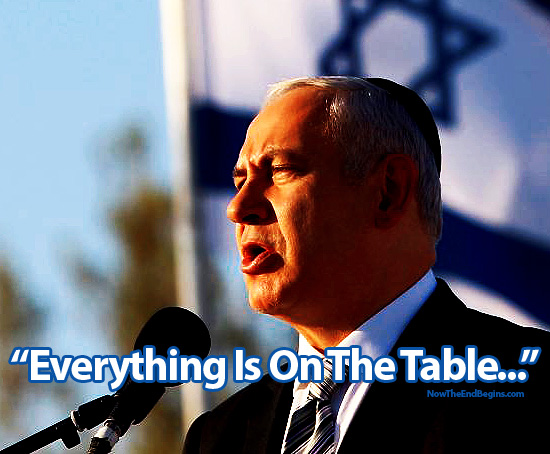
Israel PM Benjamin Netanyahu said something amazing yesterday as the September deadline in the UN for Palestinian recognition approaches. He said that “everything is on the table”. If he truly means that, then he is saying that Jerusalem, the pre-1967 borders, all of it is up for discussion. NTEB is of the opinion that this is political rhetoric and not something he is actually prepared to do., especially after he took Obama to task for saying Israel must return to it’s pre-1967 borders. But in our role as a watchman for Israel, we are letting you know everything that is said. But no matter if this is genuine or political posturing, it’s certainly something you need to know. September is shaping up to be huge in regards to bible prophecy.
JERUSALEM (AP) — With a September deadline looming, Israel’s prime minister turned to the Arabic media Thursday for the first time since taking office two years ago in an attempt to lure the Palestinians back to peace talks, saying “everything is on the table.”
Benjamin Netanyahu’s interview with the Al-Arabiya satellite channel reflects Israeli concerns over Palestinian plans to seek U.N. recognition of their independence this fall. But it also highlights Netanyahu’s new strategy of engaging directly with the Arab public.
Netanyahu has fielded questions from Arabs before on YouTube and even made a recorded plea to Arab viewers to submit questions. But the face-to-face Al-Arabiya interview is his first of its kind. Netanyahu’s office called the move “the beginning of a new era” and promised more such interviews in the near future.
The interview, which aired Thursday evening, comes as Israel is scrambling to counter the Palestinian U.N. initiative this fall. Israel fiercely opposes the move, saying a Palestinian state should be formed through negotiations and not by unilateral steps.
Peace negotiations have been stalled since 2008, and the Palestinians have refused to negotiate while Israel continues to build homes in Jewish settlements.
Although the vote will be largely symbolic, the Palestinians hope to isolate Israel and put pressure on it to make concessions.
In the interview, Netanyahu says he is willing to negotiate anywhere and with anyone who accepts Israel’s right to exist.
“Everything is on the table. But we need to get to the table,” Netanyahu said.
“I’m prepared to negotiate with President Abbas directly for peace between our two peoples right now. We can do it here in my home in Jerusalem, we can do it in Ramallah, we can do it anywhere,” he said.
Netanyahu said he realized he would have to make “difficult compromises for peace,” but he offered few new details about his plans.
The Palestinians seek all of the West Bank and east Jerusalem — areas captured by Israel in the 1967 Mideast war — as parts of a future independent state. Netanyahu has said he wants to keep parts of the West Bank, and he opposes any division of Jerusalem.
Netanyahu also addressed the regional unrest in Syria and Egypt.
“You know anything that I say will be used — not against me — but against the process of genuine reform that Syrian people would like to see. We don’t intervene in Syria but it does not mean we are not concerned. We’d like the peace and quiet on the Israeli-Syrian border to be maintained and I would like to ultimately, have that turned into a formal peace between Israel and Syria,” Netanyahu said. “I think the people, the young people of Syria deserve a better future.”
Netanyahu said he hopes the Arab Spring will result in democracies in the Arab world.
“If there’s genuine democracy in the Arab world, in the Arab countries, then there will be genuine peace. Because a genuine democracy reflects the desires of the people, and most people Arabs, Jews, anyone they don’t want their sons and daughters dying on battlefields.”
He said, “If it goes toward an Iranian-style dictatorship, as it did, unfortunately in Iran and in Lebanon, then it’s bad. It’s bad for the peoples there, but it’s also bad for peace.”
Ofir Gendelman, Netanyahu’s spokesman for the Arab media, said Saudi-owned Al-Arabiya was chosen as a conduit for Netanyahu’s outreach because it is a professional station that reaches 40 million Arabs. He refused to discuss why Al-Jazeera, the top-rated Arab media outlet, was not selected. Al-Jazeera’s coverage has been accused of stirring up anti-Israel sentiment on the Arab street.
Gendelman said Netanyahu’s office also communicates with the Arab world via Facebook, Twitter and YouTube.
“There are a lot of issues the prime minister wants to address,” he said. “The goal of the interview is twofold: to convey the message that he wants to resume negotiations and express via the interview how important Arab public opinion is to him.”
Israel’s most pressing concern at the moment is what happens in September. No one knows exactly how the vote will unfold.
The United States opposes the plan and, as one of the five permanent members of the Security Council, could veto a Palestinian membership request and derail the process.
If that happens, the Palestinians could go to the General Assembly and seek recognition there as a nonmember observer state, a largely symbolic nod. Still, widespread support in the General Assembly would signal that a majority of countries support Palestinian statehood in the pre-1967 lines.
The Palestinians insist that their U.N. bid does not rule out a return to negotiations.
Palestinian leaders have called on their people to take to the streets in nonviolent protests in September and Israeli officials are concerned that these could spiral out of control and set off a new round of fighting.
Israeli Cabinet Minister Moshe Yaalon dismissed these concerns Thursday, telling foreign reporters that he “can’t see any change on the ground after September.”
He called the unilateral option one of the “balloons inflated in the last two years by those who thought we might be threatened.”
Yaalon, a former military chief, also rejected the argument that the current status quo is untenable. ”The situation is not sustainable? It’s sustainable. It’s not going to be solved in the near future. We can live with it. We can survive with it,” he said. source – Google News/AP Wire
Gaza Flotilla Determined to Sail Despite Setbacks
Jul 2nd
A cruise ship for terrorism
An international aid flotilla is continuing with plans to sail to the Hamas-ruled Gaza Strip despite a series of setbacks. Pro-Palestinian activists organizing the aid flotilla say they still intend to challenge Israel’s blockade on Gaza, a day after an American boat was intercepted by the Greek coast guard and turned back to Athens. American Greta Berlin, who was on board the vessel, blames Israel and the United States for the setback.

The activist run boat "Audacity of Hope" is escorted by the Greek coast guard in port of Perama, near Athens, Greece, July 1, 2011.
“The Greek government is under a huge amount of pressure from the Israeli government and probably our own government as well,” said Berlin.
Israel and the U.S. have urged the flotilla not to violate the Gaza blockade, warning that the mission is dangerous and provocative. Last year ago, Israeli naval commandos intercepted a Gaza aid flotilla, and in the botched raid, nine pro-Palestinian activists were killed. The incident sparked international outrage and raised regional tensions. The United Nations and European Union have backed the Israeli and U.S. position, which calls for the flotilla to dock in Israeli or Egyptian ports and transfer their cargo to Gaza legally over land.
Prime Minister Benjamin Netanyahu said Israel has the full right to thwart any attempt to facilitate the smuggling of missiles, rockets and other weapons to what he described as the “Hamas terrorist enclave.”
But activists reject that, charging that the blockade is illegal and immoral. Speaking from Athens, Greta Berlin says the mission to Gaza will go ahead. ”Our intent is to sail; it’s always been our intent,” Berlin added. “And we don’t give up very easily. We will continue to sail until Gaza is free.”
Organizers hope to bring up to eight boats and two cargo ships laden with supplies to Gaza, along with about 300 people, including politicians, journalists, writers and religious figures. But two boats have been disabled, allegedly by Israeli sabotage, and now Greece says it will not allow the six ships docked in its ports to depart for Gaza. Because of the delays, dozens of activists have run out of time and returned home. source – VOA News
Obama’s RAGE Over Netanyahu Meeting
Jun 10th
An angry and embarrassed President Obama confronts White House Chief of Staff Bill Daley
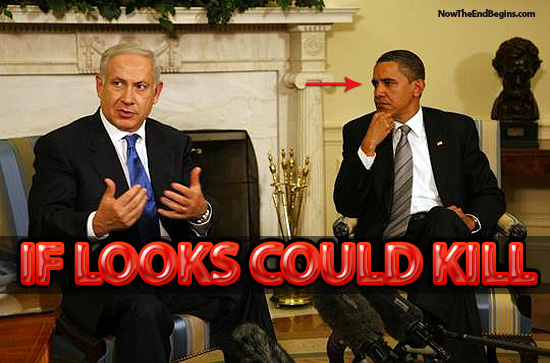
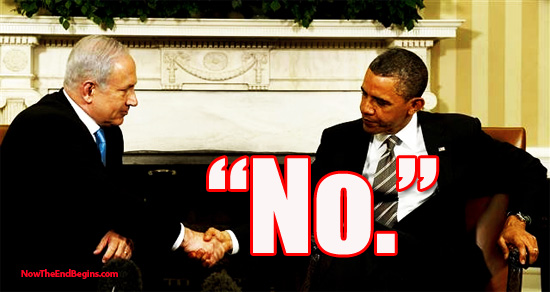
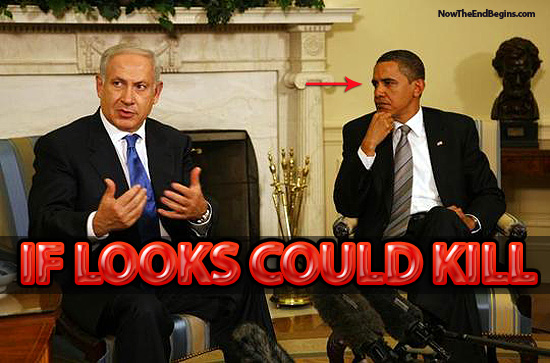
Shortly after the photo-op meeting and “working lunch” with Israeli Prime Minister Benjamin Netanyahu, the one that saw President Obama openly chastised by the Prime Minister for Obama’s earlier public comments regarding wanting to see Israel return to its 1967 borders, the president verbally “went off” on Richard Daley in the private study area that adjoins the Oval Office. President Obama’s verbal attack was clearly heard by numerous staff up and down the West Wing hallways.

The essence of the president’s rage and embarrassment can best be summed up with him yelling out very loudly, “What the **** was that!?” That phrase was apparently repeated a number of times in the span of about five minutes, a time period in which Obama’s voice became “louder and louder” and culminating in Obama exclaiming, “Never again! Do you understand me? Never again!” Any response by Bill Daley back to the president, if given, was not overheard. source – SocyBerty