Posts tagged Mubarak
GET OUT! Egypt’s President Morsi Flees Palace As Islamist Protests Reach Fever Pitch
Dec 4th
Posted by NTEB News Desk in Arab Spring
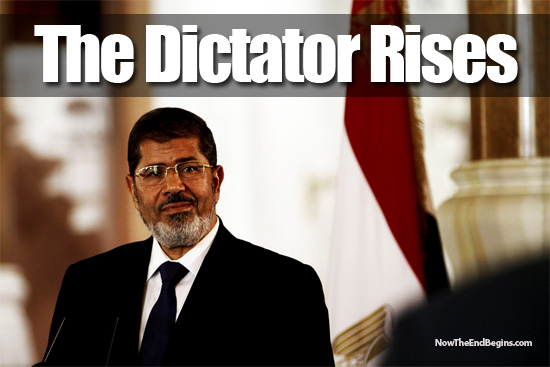
(Reuters) – Egyptian police battled thousands of protesters outside President Mohamed Mursi’s palace in Cairo on Tuesday, prompting the Islamist leader to leave the building, two presidential sources said.
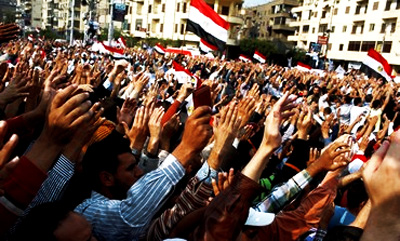
Police fired teargas at demonstrators angered by Mursi’s drive to hold a referendum on a new constitution on December 15. Some broke through police lines around his palace and protested next to the perimeter wall.
Several thousand people had gathered nearby in what they dubbed “last warning” protests against Mursi, who infuriated opponents with a November 22 decree that expanded his powers. “The people want the downfall of the regime,” the crowd chanted.
“The president left the palace,” a presidential source, who declined to be named, told Reuters. A security source at the presidency also said the president had left the building.
Mursi ignited a storm of unrest in his bid to prevent a judiciary still packed with appointees of ousted predecessor Hosni Mubarak from derailing a troubled political transition.
Riot police at the palace faced off against activists chanting “leave, leave” and holding Egyptian flags with “no to the constitution” written on them. Protesters had assembled near mosques in northern Cairo before marching towards the palace.
“Our marches are against tyranny and the void constitutional decree and we won’t retract our position until our demands are met,” said Hussein Abdel Ghany, a spokesman for an opposition coalition of liberal, leftist and other disparate factions.
Despite the latest protests, there has been only a limited response to opposition calls for a mass campaign of civil disobedience in the Arab world’s most populous country and cultural hub, where many people yearn for a return to stability.
A few hundred protesters gathered earlier near Mursi’s house in a suburb east of Cairo, chanting slogans against his decree and against the Muslim Brotherhood, from which the president emerged to win a free election in June. Police closed the road to stop them from coming any closer, a security official said.
Opposition groups have accused Mursi of making a dictatorial power grab to push through a constitution drafted by an assembly dominated by Islamists, with a referendum planned for December 15.
Egypt’s most widely read independent newspapers did not publish on Tuesday in protest at Mursi’s “dictatorship”. Banks closed early to let staff go home safely in case of trouble.
Abdelrahman Mansour in Cairo’s Tahrir Square, the cradle of the anti-Mubarak revolt, said: “The presidency believes the opposition is too weak and toothless. Today is the day we show them the opposition is a force to be reckoned with.”
After winning post-Mubarak elections and pushing the Egyptian military out of the political driving seat it held for decades, the Islamists sense their moment has come to shape the future of Egypt, a longtime U.S. ally whose 1979 peace treaty with Israel is a cornerstone of Washington’s Middle East policy.
The Muslim Brotherhood and its allies, who staged a huge pro-Mursi demonstration on Saturday, are confident that enough members of the judiciary will be available to oversee the mid-December referendum, despite calls by some judges for a boycott.
Cairo stocks closed up 3.5 percent on Tuesday as investors took heart at what they saw as prospects for a return to stability in a country whose divisions have only widened since a mass uprising toppled Mubarak on February 11, 2011.
Mohamed Radwan, at Pharos Securities brokerage, said the Supreme Judicial Council’s agreement to supervise the referendum had generated confidence that the vote would happen “despite all the noise and demonstrations that might take place until then”.
“NO WAY PERFECT”
Prime Minister Hisham Kandil, a technocrat with Islamist sympathies, said in an interview with CNN: “We certainly hope that things will quiet down after the referendum is completed.”
He said the constitution was “in no way a perfect text” that everyone had agreed to, but that a “majority consensus” favored moving forward with the referendum in 11 days’ time.
The Muslim Brotherhood, now tasting power via the ballot box for the first time in eight decades of struggle, wants to safeguard its gains and appears ready to override street protests by what it regards as an unrepresentative minority.
It is also determined to stop the courts, which have already dissolved the Islamist-led elected lower house of parliament, from further obstructing their blueprint for change.
Mohamed ElBaradei, coordinator of an opposition National Salvation Front, has said Mursi must rescind his decree, drop plans for the referendum and agree on a new, more representative constituent assembly to draft a democratic constitution.
In an opinion piece published in the Financial Times, he accused Mursi and the Brotherhood of believing that “with a few strokes of a pen, they can slide (Egypt) back into a coma”.
ElBaradei, a Nobel Peace Prize laureate who once headed the U.N. nuclear watchdog, wrote: “If they continue to try, they risk an eruption into violence and chaos that will destroy the fabric of Egyptian society.”
Despite charges that they are anti-Islamist and politically motivated, judges say they are following legal codes in their rulings. Experts say some political changes rushed through in the past two years have been on shaky legal ground.
A Western diplomat said the Islamists were counting on a popular desire for restored normality and economic stability.
“All the messages from the Muslim Brotherhood are that a vote for the constitution is one for stability and a vote against is one for uncertainty,” he said, adding that the cost of the strategy was a “breakdown in consensus politics”. source – Reuters
Hail Pharaoh! Protests Rock Egypt After Morsi Seizes Sweeping New Powers
Nov 23rd
Posted by NTEB News Desk in Al-Qaeda
Egypt slowly starts to realize they traded one dictator for another
FLASHBACK: NTEB showed you the true nature of the Arab Spring and Obama’s connection to it as far back as May 20,2011
Demonstrators storm Muslim Brotherhood HQ in Alexandria, pelt Port Said office with stones, and call for Egyptian president’s ouster in Cairo after he is called “pharaoh,” the new Mubarak for seizure of new powers.

Egyptians protest in the streets of Alexandria after realizing they were duped into trading one dictator, Murbarak, for a much worse one in Morsi. PHOTO: REUTERS
Protesters stormed the headquarters of the Muslim Brotherhood’s party in Alexandria on Friday, throwing chairs and books into the street and setting them alight, after the Egyptian president granted himself sweeping new powers.
Supporters of Egyptian President Mohamed Morsi and opponents also threw stones at each other near a mosque in the city, Egypt’s second largest, a witness said.
Two cars had glass smashed as the clashes moved away from the area.
In Port Said, another port on the Mediterranean, hundreds of protesters gathered outside the Brotherhood’s Freedom and Justice party headquarters and pelted it with rocks. Some tried to storm it but did not enter, another witness said.
In Cairo, thousands demonstrated against the decree issued on Wednesday night.
Morsi called “pharaoh” for seizing new powers
Morsi’s decree exempting all his decisions from legal challenge until a new parliament was elected caused fury amongst his opponents on Friday who accused him of being the new Hosni Mubarak and hijacking the revolution.
Morsi’s aides said the decree was to speed up a protracted transition that has been hindered by legal obstacles but Morsi’s rivals were quick to condemn him as a new autocratic pharaoh who wanted to impose his Islamist vision on Egypt.
“Morsi a ‘temporary’ dictator,” was the headline in the independent daily Al-Masry Al-Youm and hundreds of protesters in Tahrir Square, the heart of the 2011 anti-Mubarak uprising, demanded Morsi quit, accusing him of launching a “coup”.
Buoyed by accolades from around the world for mediating a truce between Hamas and Israel, Morsi on Thursday ordered that an Islamist-dominated assembly writing the new constitution could not be dissolved by legal challenges.
Morsi, an Islamist whose roots are in the Muslim Brotherhood party, also gave himself sweeping powers that allowed him to sack the unpopular general prosecutor and opened the door for a retrial for Mubarak and his aides.
The president’s decree aimed to end the logjam and push Egypt, the Arab world’s most populous nation, more quickly on its democratic path, the presidential spokesman said.
“President Morsi said we must go out of the bottleneck without breaking the bottle,” Yasser Ali told Reuters.
The president said any decrees he issued while no parliament sat could not be challenged, moves that consolidated his powers but look set to polarize Egypt further, threatening more turbulence in a nation at the heart of the Arab Spring.
“The people want to bring down the regime,” shouted protesters in Tahrir, echoing one of the chants that was used in the uprising that forced Mubarak to step down.
UN concerned Morsi hurting human rights
The decree is bound to worry Western allies, particularly the United States, a generous benefactor to Egypt’s army, which effusively praised Egypt for its part in bringing Israelis and Palestinians to a ceasefire on Wednesday.
The West may become concerned about measures that, for example, undermine judicial independence. But one Western diplomat said it was too early to judge and his nation would watch how the decree was exercised in the coming days.
“We are very concerned about the possible huge ramifications of this declaration on human rights and the rule of law in Egypt,” Rupert Colville, spokesman for the UN Human Rights Commissioner Navi Pillay, said at the United Nations in Geneva.
“The decree is basically a coup on state institutions and the rule of law that is likely to undermine the revolution and the transition to democracy,” Mervat Ahmed, an independent activist in Tahrir protesting against the decree, said. “I worry Morsi will be another dictator like the one before him.”
Leading liberal politician Mohamed ElBaradei, who joined other politicians on Thursday night to demand the decree was withdrawn, wrote on his Twitter account that Morsi had “usurped all state powers and appointed himself Egypt’s new pharaoh”. source – JPost
Egypt’s Morsi Seizes Unprecedented Power Moves Country Towards Dictatorship
Nov 23rd
Posted by NTEB News Desk in Al-Qaeda
The sham ‘revolution’ shows it’s true face now
FLASHBACK: NTEB showed you the true nature of the Arab Spring and Obama’s connection to it as far back as May 20,2011
From Yahoo News: CAIRO (AP) — Egypt’s Islamist president unilaterally decreed greater authorities for himself Thursday and effectively neutralized a judicial system that had emerged as a key opponent by declaring that the courts are barred from challenging his decisions.
Riding high on U.S. and international praise for mediating a Gaza cease-fire, Mohammed Morsi put himself above oversight and gave protection to the Islamist-led assembly writing a new constitution from a looming threat of dissolution by court order.
But the move is likely to fuel growing public anger that he and his Muslim Brotherhood are seizing too much power.
In what was interpreted by rights activists as a de facto declaration of emergency law, one of Morsi’s decrees gave him the power to take “due measures and steps” to deal with any “threat” to the revolution, national unity and safety or anything that obstructs the work of state institutions.
Morsi framed his decisions as necessary to protect the revolution that toppled Hosni Mubarak nearly two years ago and to cement the nation’s transition to democratic rule. Many activists, including opponents of the Brotherhood, criticize the judiciary as packed with judges and prosecutors sympathetic to Mubarak. Brotherhood supporters accuse the courts of trying to block their agenda.
“He had to act to save the country and protect the course of the revolution,” said one of Morsi’s aides, Pakinam al-Sharqawi, speaking on Al-Jazeera. “It is a major stage in the process of completing the January 25th revolution,” she said, alluding to the starting day of last year’s uprising against Mubarak.
In a nod to revolutionary sentiment, Morsi also ordered the retrial of Mubarak and top aides on charges of killing protesters during the uprising. He also created a new “protection of the revolution” judicial body to swiftly carry out the prosecutions. But he did not order retrials for lower-level police acquitted of such killings, another widespread popular demand that would disillusion the security forces if carried out.
Liberal politicians immediately criticized the decrees as dictatorial and destined to divide a nation already reeling from months of turmoil following Mubarak’s ouster. Some said they exceeded the powers once enjoyed by Mubarak.
“Morsi today usurped all state powers & appointed himself Egypt’s new pharaoh,” pro-reform leader Mohamed El Baradei wrote on Twitter. “A major blow to the revolution that could have dire consequences.”
El Baradei later addressed a news conference flanked by other prominent politicians from outside the Brotherhood, including two presidential candidates who ran against Morsi, Amr Moussa and Hamdeen Sabahi.
They pledged to cooperate to force Morsi to rescind his assumption of greater powers. “We will work together as Egyptians until we achieve the goals of our revolution,” said ElBaradei, a former director of the U.N.’s nuclear agency and Nobel peace laureate.
They called for mass protests Friday to demand the dissolution of the declarations. The audience interrupted the press conference, chanting “Down with the Guide’s rule,” referring to the Supreme Guide of Morsi’s Muslim Brotherhood group, Mohammed Badie.
The prospect of large rival protests involving Morsi’s opponents and supporters in Cairo on Friday raises the likelihood of clashes. Thousands from the rival camps were already out on the streets of Cairo late Thursday in an increasingly charged atmosphere.
A crowd of Brotherhood supporters massed outside the Supreme Court building and offices of the prosecutor general — whom Morsi removed in Thursday’s edict. They chanted slogans for “the cleansing of the judiciary,” shouting, “The people support the president’s decisions.” Leading Brotherhood member Mohammed el-Beltagi, attending the rally, singled out several critics of Morsi from among the ranks of the judiciary for criticism.
Meanwhile, blocks away near Tahrir Square, hundreds of demonstrators held a fourth straight day of protests against Morsi and the Brotherhood. “Brotherhood is banned from entry,” declared a large banner at the protest.
Wael Ghonim, an icon of the anti-Mubarak uprising, rejected Morsi’s decisions, arguing the president could have protected the revolution without concentrating so much power in his hands.
“The revolution was not staged in search for a benign dictator, there is a difference between revolutionary decisions and dictatorial decisions. God is the only one whose decisions are not questioned.”
The Egyptian leader decreed that all decisions he has made since taking office in June and until a new constitution is adopted and a new parliament is elected cannot be appealed in court or by any other authority. Parliamentary elections are not likely before next spring.
The decree also barred the courts from dissolving the controversy-plagued assembly writing the new constitution. Several courts have been looking into lawsuits demanding the panel be disbanded.
The Brotherhood and Morsi allies who dominate the assembly have pushed to give the draft an Islamist slant that opponents fear would marginalize women and minority Christians, infringe on personal liberties and even give Muslim clerics a say in lawmaking. Liberal and Christian members withdrew from the assembly during the past week to protest what they say is the hijacking of the process by Morsi’s allies.
Morsi on Thursday extended by two months, until February, the deadline for the assembly to produce a draft, apparently to give members more time to iron out their differences.
He also barred any court from dissolving the Islamist-led upper house of parliament, a largely toothless body that has also faced court cases.
The president made most of the changes Thursday in a declaration amending an interim constitution that has been in effect since shortly after Mubarak’s fall and has over time become a ramshackle patchwork. The military, which took power after Mubarak, set the precedent for the executive unilaterally issuing constitutional changes, which it did several times during its 16-month rule.
The moves come as Morsi basks in lavish praise from President Barack Obama and Secretary of State Hillary Rodham Clinton for mediating an end to eight days of fighting between Israel and Gaza’s Hamas rulers. Clinton was in Cairo on Wednesday, when she held extensive talks with Morsi.
Morsi not only holds executive power, he also has legislative authority after a previous court ruling just before he took office on June 30 dissolved the powerful lower house of parliament, which was led by the Brotherhood. With two branches of power in his hands, Morsi effectively took away many prerogatives of the third, the judiciary.
The provision for a retrial of Mubarak appeared to be a gesture to public opinion. The decree called for “new investigations and trials” against those who held “political or executive” positions in the old regime and who are accused of killing protesters.
Mubarak was convicted in June to life in prison for failing to stop the killing of protesters during last year’s uprising against his rule, but many Egyptians were angered that he wasn’t convicted of actually ordering the crackdown and that his security chief, Habib el-Adly, was not sentenced to death. Several top police commanders were acquitted, and Mubarak and his sons were found not guilty of corruption charges.
But the decree would not mean retrials for the dozens of lower-level police officers who have been acquitted or received suspended sentences in trials for killing protesters — verdicts that have outraged many Egyptians. That exclusion will guarantee Morsi the loyalty of the powerful but hated police force.
Morsi on Thursday also fired the country’s top prosecutor, Abdel-Maguid Mahmoud. A Mubarak-era appointee, Mahmoud has faced widespread accusations that his office did a shoddy job collecting evidence against Mubarak, el-Adly and the police in trials.
Morsi first fired Mahmoud in October but had to rescind his decision when he found that the powers of his office do not empower him to do so. So on Thursday, he decreed that the prosecutor general could serve in office only for four years, with immediate effect on Mahmoud, who had held the post since 2006. Morsi replaced Mahmoud with Talaat Abdullah, a career judge, and swiftly swore him in.
Thursday’s decisions were read on state television by Morsi’s spokesman, Yasser Ali. In a throwback to the days of the authoritarian Mubarak and his predecessors Anwar Sadat and Gamal Abdel-Nasser, the television followed up with a slew of nationalist songs. source – Yahoo News
Pro-Mubarak Forces Cause Massive Riot In Egypt Leaving 74 Dead and 1,000 Injured
Feb 2nd
Posted by NTEB News Desk in Arab Spring
Chaos in Cairo
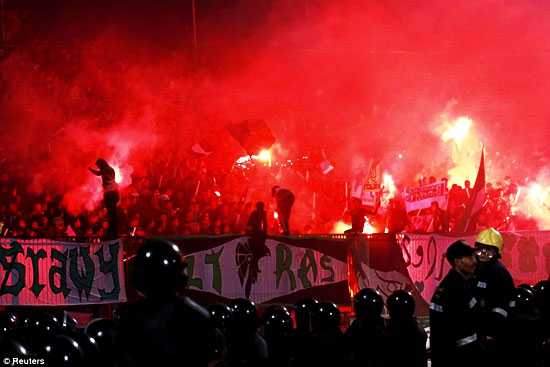
As injured football fans arrive at train station after ‘covert attack by Egyptian security forces’ left 74 dead and 1,000 wounded in stadium riot, this was the chaotic scene at Cairo’s main train station last night as hundreds of football fans returned from a stadium riot which left 74 dead and more than 1,000 injured.

Rivalry: A bitter long-standing hatred between the two sets of fans, was initially blamed for the worst football riot in Egyptian history, but was it Pro-Mubarak forces?
Anxious Egyptians gathered to see whether friends and family had made it back safely after violence flared in the Mediterranean city of Port Said when local team Al-Masry beat Cairo’s Al-Ahly, the country’s most successful club, 3-1.
Security forces loyal to ousted Egyptian president Hosni Mubarak have been blamed for sparking the football riot. The final whistle prompted more than 13,000 home fans, armed with knives, iron bars and machetes, to storm the pitch and attack rival Al-Ahly players and their 1,200 supporters.

Packed onboard: Hundreds of Al-Ahly fans were greeted by friends and family on their return into Cairo station after the riot last night
Anger quickly spread across the country – and thousands of protesters turned up at the Ramses terminal to chant ‘Down with military rule’.
Al-Ahly goalkeeper Sharif Ikrami, who was injured in the clashes and said the entire team had now quit football, said dead bodies were carried past him in the changing room.
He said: ‘There were people dying in front of us. It’s over.
‘We’ve all made a decision that we won’t play soccer any more. We can’t think about it.’
Pure hooliganism, and a bitter long-standing rivalry of clashes between the two sets of fans, was initially blamed for the worst football riot in Egyptian history.
But speculation is now mounting that the riot was orchestrated by pro-Mubarak forces in revenge against Al Ahly’s ultra fans.
The ultras had used their experience confronting police at matches to play a significant role in defending Cairo’s Tahrir Square – the heart of the uprising – against Mubarak’s heavy-handed security forces.
Albadry Farghali, a member of parliament for Port Said, screamed in a telephone call to live television: ‘The security forces did this or allowed it to happen.
‘The men of Mubarak are still ruling. The head of the regime has fallen but all his men are still in their positions.’ Former Al-Ahly player Hani Seddik told the BBC: ‘I don’t think this is about football. These trouble-makers were not football fans. source – Daily Mail UK
Egypt Radio Warns- ‘Camp David Accord is Over’
Feb 15th
Posted by NTEB News Desk in Headline News
Egyptian-Israeli relations on brink of possible collapse

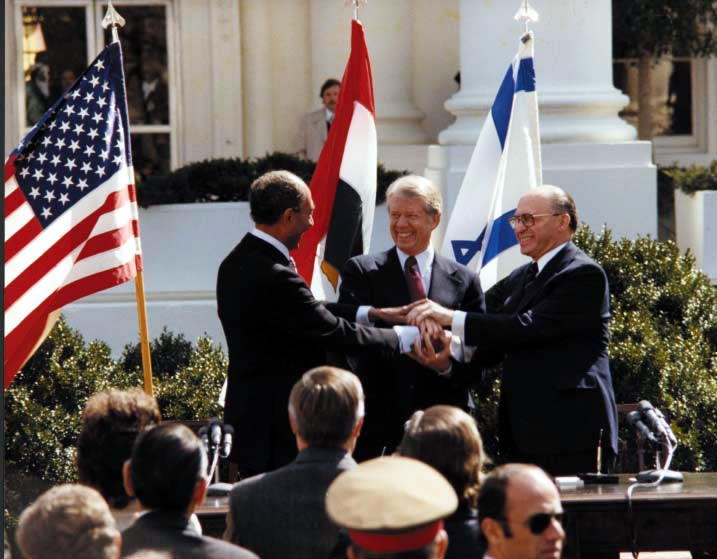
The Camp David Accords, signed by Egyptian President Anwar El Sadat and Israeli Prime Minister Menachem Begin in September of 1978, set the framework for the 1979 Egypt-Israel Peace Treaty.
Benjamin Netanyahu welcomed the Egyptian military’s pledge to honor the 1979 Peace Treaty with Israel, but not everyone believes that the agreements should be upheld. If the leader of Egypt’s secular Tomorrow Party gets his way, the treaty will be scrapped, echoing similar calls by the Muslim Brotherhood.
“A leader of Egypt’s secular opposition declared Sunday that the country’s 30-year peace treaty with Israel was “over”, despite assurances by the new military rulers that it would honor the accord in the wake of President Hosni Mubarak’s resignation.
“The Camp David accord is over,” Dr. Ayman Nour, leader of the Tomorrow Party who is planning to seek candidacy in the Egyptian presidential elections, told Egyptian radio.” source: Haaretz
Ayman Nour was arrested and imprisoned for nearly three years under Mubarak’s rule, and was suddenly released in 2009. The Council on Foreign relations paints Mr. Nour’s release from prison as a sort of good will gesture to President Obama, though it was mainly Europe that was calling for him to be set free. Nour is viewed as being closely aligned with Britain.
From the Council on Foreign Relations website: “On February 18, 2009, Egypt’s government released Ayman Nour, the most prominent of Egypt’s jailed pro-democracy dissidents, after for than three years in prison in what was widely regarded as an effort to improve relations with the new administration of President Barack Obama. Nour told the AP that he had no warning about his release, nor could he explain the timing. “Why they did this is unknown,” the AP quoted him as saying.”
Ayman Nour took a central role is the protests that led to Mubarak’s fall, and he is moving ahead with a candidacy for President of Egypt in upcoming elections. The Tomorrow party was established as a liberal democratic party, with a focus on human rights issues and political reform. The threat to Peace Accords comes as somewhat of a surprise to Israel, especially coming from the leader of a non-Islamic party. Dr. Nour conceded that the peace agreement with Israel has been beneficial over the last 30 years, but that it is no longer relevant as Egypt moves ahead into a new era. In his view, the treaty is not just, and it does not suit Egypt’s best interests.
“Egypt’s rights in the Camp David agreement are very modest,” Nour said. “Egypt will act with total equity towards all sides that want a just peace in the region.”
“In practice, the Camp David agreement [of 1979, in which then-President Anwar Sadat made peace with Israel – ed.] has ended,” Dr. Nour told an interviewer on Sunday, “because it is an old agreement, and we must improve its conditions in a way that will correspond to Egypt’s interests.” source: Israel National News
Report: Mubarak Falls Into Coma After Final Speech
Feb 14th
Posted by NTEB News Desk in Headline News
Outlived his usefulness?
Give the New World Order (George Soros, et al) credit for one thing – when they decide you are no longer useful and serving their purposes, you are done. Quickly. Less than one week after a military coup orchestrated by the Muslim Brotherhood deposed his 30 year rule in Egypt, Hosni Mubarak mysteriously winds up in a coma. Well, at least they didn’t cut his brake lines.

Egypt’s deposed president, Hosni Mubarak, went into a full coma on Saturday night at his residence in the Red Sea resort of Sharm al-Sheikh, an Egyptian newspaper reported on Monday, quoting well-informed sources. Mubarak and his family moved to Sharm al-Sheikh on Thursday night following his final speech, in which he handed over executive authority to former Vice-President Omar Suleiman, Egypt’s al-Masry al-Youm reported.
The same sources said that Mubarak was currently receiving medical treatment but that no decision had yet been made on whether to transfer the 82-year-old former head-of-state to a hospital. Rumors had circulated earlier that Mubarak had fainted twice while recording his final speech, which was broadcast on state television on Thursday evening. Prime Minister Ahmed Shafiq confirmed Sunday that Mubarak was in Sharm el-Sheikh and has not leave the country.” source – Al Arabiya
Editor’s note: We have no verification on this story at the time of this writing, but seeing as it’s popping up on many ME websites, we thought we would run it anyway. We will keep you posted as it develops….
Egypt: The Cart Before The Camel
Feb 11th
Posted by NTEB News Desk in Headline News
As an American I get chills watching the shouts for freedom in the streets of Cairo. I smile when seeing people who have been denied full freedom finally feel a sense of what Americans hold so dear. Within the shouts of Allah-hu-Akbar and Egyptian flags waving in the air, America will find out if we will retain an ally in the Middle East or if we just suffered a major loss.
I have heard many freedom loving Americans argue the point that as an American we should support Mubarak’s exit because he was in fact a dictator. True. I don’t disagree. Mubarak had to go. However, the fast paced ousting supported by Barack Obama wasn’t worth the risk of a major loss for America and our ally Israel. Some of my fellow Christian Conservatives have argued that we should be elated that the people of Egypt were heard. I agree but does that go for every situation when it leaves a country as important as Egypt wide open for radical Islam to infiltrate? Now we have a vacancy in the Middle East and no one knows who is going to fill it!
As networks gleefully reported Mubarak’s leave, a CNN reporter said “Unless something goes very wrong would you end up with something like the Islamic Republic (of Iran).” That’s the point. That’s a pretty big ‘’unless’’ and a major risk when one is speaking of a nation like Egypt. What if something does go really wrong? Furthermore the reporter asked “So who is running the country now?” Gee! That’s nice to hear! Yes Mubarak is gone but now there is this huge hole of leadership in a very important country in the Middle East. It’s sort of like ding dong the witch is dead…now what? It’s not too smart to leave a nation without a leader in place. Yes the military is supposedly going to head it up for now but what happens if that doesn’t turn out so well? This is why a plan should have been in place prior to Mubarak leaving just like Israel wanted. Unfortunately they put they cart before the camel.
I don’t mean to be a Debbie Downer but too many are looking at this situation as absolutely wonderful with no mention as to what happens if this takes a major turn south. I understand the cheering and energy is infectious but when the dust settles and an entire nation is left in the hands of a General, that’s when reality is going to hit. September is a long ways away and we know that the situation can change in the blink of an eye in the Middle East.
We have heard the word “historic” over and over again from the mouth of Barack Obama. It’s like his TelePrompTer is stuck. Great Barack, it’s ‘’historic’’ but there is good historic and there is bad historic. This sure can become historic if it creates a domino effect for other Middle Eastern nations to put up a vacancy sign in their palace windows. All I can say is keep your gas tanks full and food on hand because if this turns south you want to make sure your domino doesn’t fall too.