Posts tagged japan
Game Over: Japan To Exercise ‘Chernobyl Option’
Mar 31st
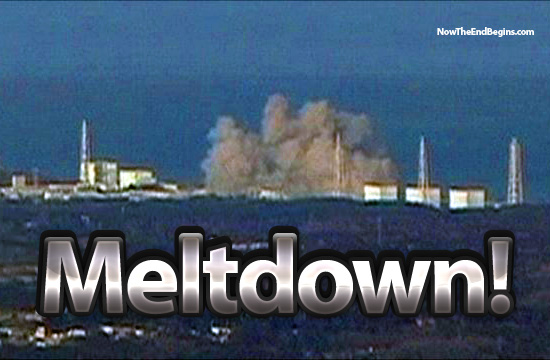
Japan nuke plant unsalvageable, will bury reactors like Chernobyl
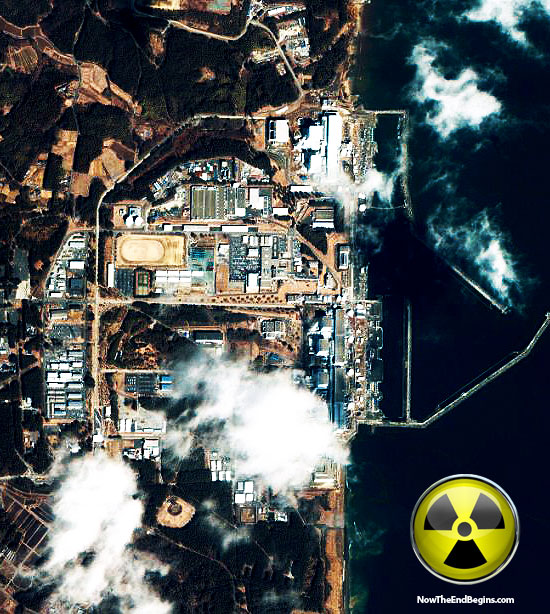
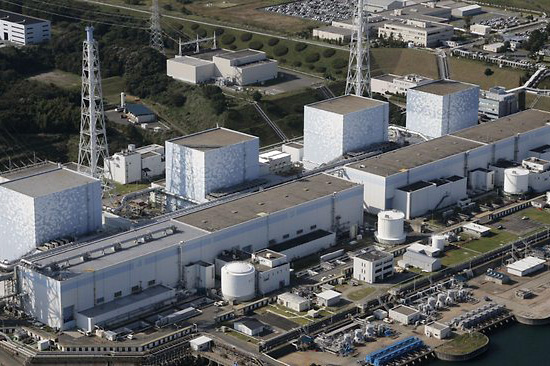
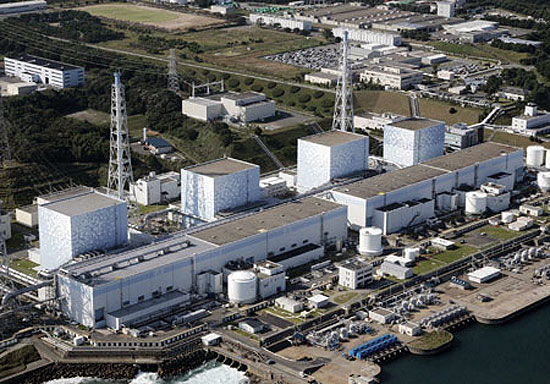
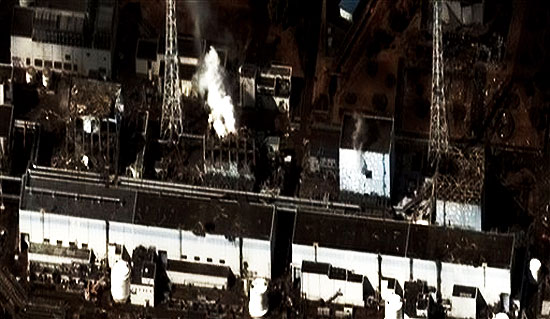
TOKYO — Some of the world’s largest cement pumps were en route to Japan’s stricken nuclear plant on Thursday, initially to help douse areas with water but eventually for cement work — including the possibility of entombing the site as was done in Chernobyl.
Operated via remote control, one of the truck-mounted pumps was already at the Fukushima Dai-ichi site and being used to spray water. Four more will be flown in from Germany and the United States, according to the German-manufacturer Putzmeister.
The biggest of the five has an arm that extends well over 200 feet. ”Initially, they will probably pump water,” Putzmeister stated. “Later they will be used for any necessary concreting work.”
A construction company in Augusta, Ga., was among those redirecting the pumps to Japan. Its owner said he believes building a concrete sarcophagus will follow.
“Our understanding is they are preparing to go to next phase and it will require a lot of concrete,” Jerry Ashmore told the Augusta Chronicle. He did not expect the pump to return. “It will be too hot to come back,” Ashmore said.”
The government said damage is expected to cost $310 billion, making it the most costly natural disaster on record.
Putzmeister concrete pumps were among those used to seal in the Chernobyl reactor after it exploded in Ukraine in 1986, and sightings of the first truck at the Dai-ichi complex last week led to media speculation that Japan was planning to do the same in Fukushima.” source – MSNBC
Japan On ‘Max Alert’ As PLUTONIUM Found In Soil
Mar 29th
Maximum alert over plutonium found in soil
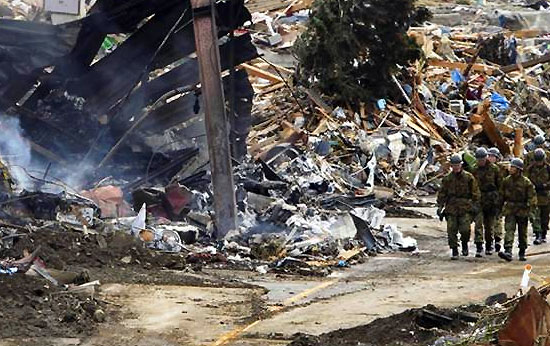
Japan said on Tuesday it is on “maximum alert” over a crippled nuclear plant where highly radioactive water has halted repair work and plutonium has been found in the soil. The earthquake and tsunami that ravaged Japan’s northeast coast and left about 28,000 dead or missing also knocked out reactor cooling systems at the Fukushima plant, which has leaked radiation into the air and sea.
Prime Minister Naoto Kan conceded the situation at the coastal atomic power station remained “unpredictable” and pledged his government would “tackle the problem while in a state of maximum alert”. In a stop-gap measure to contain the crisis at the plant, crews have poured thousands of tons of water onto reactors where fuel rods are thought to have partially melted, and topped up pools for spent fuel rods.
But the run-off of the operation has accumulated in the basements of turbine rooms connected to three reactors and filled up tunnels, making it too risky for workers to go near to repair cooling systems needed to stabilise the plant. One tunnel alone holds 6,000 cubic metres (212,000 cubic feet) of contaminated water, more than two Olympic swimming pools. Still, the only choice for now is to keep pumping water, said government spokesman Yukio Edano.
“Continuing the cooling is unavoidable… We need to prioritise injecting water,” Edano told reporters. If the rods are fully exposed to the air, they would rapidly heat up, melt down and spew out far greater plumes of radiation at the site, located about 250 kilometres (155 miles) northeast of Tokyo, nuclear experts fear.” source – Breitbart
Glowing! Radiation At Japan Nuke Plant 10 MILLION Times Normal
Mar 26th
Out of control
TOKYO — Radioactivity in water at one earthquake-crippled Japanese nuclear reactor soared to 10 million times its usual level Sunday, prompting the plant operator to evacuate workers, local media reported. The report about Fukushima Dai-ichi reactor No. 2 came as Tokyo Electric Power Co. workers were grappling with how to remove and store highly radioactive water pooling there and in two other troubled units.
The nuclear power plant in northeastern Japan has been leaking radiation making its way into food and water. The discovery of puddles with radiation levels 10,000 times the norm sparked a temporary evacuation of the plant on Thursday. Two workers who stepped into the water were hospitalized with possible burns. The development set back feverish efforts to start up a crucial cooling system knocked out in a massive March 11 earthquake and tsunami, but has helped experts get closer to determining the source of the dangerous leak.” source – MSNBC
JAPAN RADIATION 10,000 TIMES NORMAL IN NUCLEAR POOL
Mar 25th
Dangerous breach suspected at Japan nuke site
TOKYO — A suspected breach in the core of a reactor at the stricken Fukushima nuclear plant could mean more serious radioactive contamination, Japanese officials revealed Friday, as the prime minister called the country’s ongoing fight to stabilize the plant “very grave and serious.”

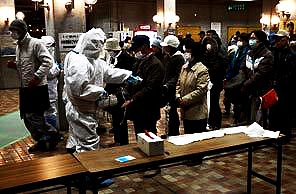
Workers from the Fukushima Dai-ichi nuclear complex are shielded with tarps before receiving decontamination treatment at a hospital on Friday. (photo AP)
A somber Prime Minister Naoto Kan sounded a pessimistic note at a briefing hours after nuclear safety officials announced what could be a major setback in the urgent mission to stop the plant from leaking radiation, two weeks after a devastating earthquake and tsunami disabled it.
“The situation today at the Fukushima Dai-ichi power plant is still very grave and serious. We must remain vigilant,” Kan said. “We are not in a position where we can be optimistic. We must treat every development with the utmost care.”
The uncertain situation halted work at the nuclear complex, where dozens of workers had been trying feverishly to stop the overheated plant from leaking dangerous radiation. The plant has leaked some low levels of radiation, but a breach could mean a much larger release of contaminants. source – MSNBC
Update: Japan Nuke Crisis Is Not Over
Mar 21st
Workers flee after smoke billows from two units; radiation taints vegetables, water
FUKUSHIMA, Japan — Gray smoke rose from two reactor units Monday, temporarily stalling critical work to reconnect power lines and restore cooling systems to stabilize Japan’s radiation-leaking nuclear complex.
Workers are racing to bring the nuclear plant under control, but the process is proceeding in fits and starts, stalled by incidents like the smoke and by the need to work methodically to make sure wiring, pumps and other machinery can be safely switched on.
“Our crisis is still going on. Our crisis is with the nuclear plants. We are doing everything we can to bring this to an end,” Gov. Yuhei Sato of Fukushima prefecture, where the plant is located, told the more than 1,000 people moved away from the plant into a gymnasium. “Don’t give up. We know you are suffering.”
“Please get us out of here,” yelled Harunobu Suzuki, a 63-year-old truck driver.” source – MSNBC
America In Freefall
Mar 16th
Lots of news, all of it bad
How is America doing today? Let’s take a quick peek around the news cycle and see, shall we?
Dow drops 240 points
The stock market closed today down -242.12 points today, in a spectacular drop against the Yen.
Feds deploy more radiation monitors in western US
SAN FRANCISCO – More radiation monitors are being deployed in the western United States and Pacific territories, as officials seek to mollify public concern over exposure from damaged nuclear plants in Japan, federal environmental regulators said. The U.S. Environmental Protection Agency already monitors radiation throughout the area as part of its RadNet system, which measures levels in air, drinking water, milk and rain.
The additional monitors are being deployed in response to the ongoing nuclear crisis in Japan, where emergency workers are attempting to cool overheated reactors damaged by last week’s magnitude-9.0 earthquake and tsunami. Officials with the U.S. Nuclear Regulatory Commission said they do not expect harmful radiation levels to reach the U.S. from Japan.
“The agency decided out of an abundance of caution to send these deployable monitors in order to get some monitors on the ground closer to Japan,” said Jonathan Edwards, director of EPA’s radiation protection division. California already has 12 monitoring stations scattered throughout the state that test the air for radiation levels. EPA also has 40 so-called “deployable” monitors that can be moved around in cases of emergency.EPA told The Associated Press it is adding two more stations in Hawaii and two in Guam. In Alaska, officials are setting up three new monitors in Dutch Harbor, Nome and Juneau.” source – Yahoo News
U.S. Debt Jumped $72 Billion Same Day U.S. House Voted to Cut Spending $6 Billion
(CNSNews.com) – The national debt jumped by $72 billion on Tuesday even as the Republican-led U.S. House of Representatives passed a continuing resolution to fund the government for just three weeks that will cut $6 billion from government spending. If Congress were to cut $6 billion every three weeks for the next 36 weeks, it would manage to save between now and late November as much money as the Treasury added to the nation’s net debt during just the business hours of Tuesday, March 15.
At the close of business on Monday, according to the Treasury Department’s Bureau of the Public Debt, the total national debt stood at $14.166 trillion ($14,166,030,787,779.80). At the close of business Tuesday, the debt stood at $14.237 trillion ($14,237,952,276,898.69), an increase of $71.9 billion ($71,921,489,118.89). Since the beginning of fiscal year 2011–which began on Oct. 1, 2010–the national debt has climbed from $13.5616 trillion ($13,561,623,030,891.79) to $14.2379 trillion ($14,237,952,276,898.69) an increase of $676.3 billion ($676,329,246,006.90).” source – CNS News
US: Nothing To Stop Japan Nuke Meltdown
Mar 16th
Is a total meltdown inevitable
The chief of the U.S. Nuclear Regulatory Commission said Wednesday that all the water is gone from one of the spent fuel pools at Japan’s most troubled nuclear plant, but Japanese officials denied it.
If NRC Chairman Gregory Jaczko is correct, this would mean there’s nothing to stop the fuel rods from getting hotter and ultimately melting down. The outer shell of the rods could also ignite with enough force to propel the radioactive fuel inside over a wide area. Jaczko did not say Wednesday how the information was obtained, but the NRC and U.S. Department of Energy both have experts on site at the Fukushima Dai-ichi complex of six reactors. He said the spent fuel pool of the complex’s Unit 4 reactor has lost water.
Jaczko said officials believe radiation levels are extremely high, and that could affect workers’ ability to stop temperatures from escalating.
Japan’s nuclear safety agency and Tokyo Electric Power Co., which operates the complex, deny water is gone from the pool. Utility spokesman Hajime Motojuku said the “condition is stable” at Unit 4.” source – NPR