Posts tagged Israel
Iran Threatens To Attack Israel Over Syria Bombing
Jan 31st
In wake of reported IAF attack on a military research center in Syria, Syrian ambassador to Lebanon says Damascus has option to respond as Iran threatens “serious consequences” for Tel Aviv; Hezbollah, Russia condemn strike.
BEIRUT – Syria’s ambassador to Lebanon said on Thursday that Damascus had the option of a “surprise decision” to respond to what it said was an Israeli air strike on a research center on the outskirts of the Syrian capital on Wednesday.
Syria could take “a surprise decision to respond to the aggression of the Israeli warplanes,” Ali Abdul Karim Ali was quoted as telling a Hezbollah-run news website.
In the wake of reported Israeli air strike on a Syrian weapons center, Iran also issued a threat to Israel on Thursday.
The Iranian regime’s English language mouthpiece, Press TV, quoted a deputy foreign minister as saying that the “strike on Syria will have serious consequences for Tel Aviv.” The official did not elaborate. source – JPost
Israeli Forces Strike Syria-Lebanon Border
Jan 30th
“Target was truckload of weapons, going from Syria to Lebanon,” says diplomat, adding that cache likely not chemical weapons.
Israeli forces attacked a convoy on the Syrian-Lebanese border on Wednesday, sources told Reuters, after Israelis warned their Lebanese enemy Hezbollah against using chaos in Syria to acquire anti-aircraft missiles or chemical weapons. source – JPost
Israeli Nightmare Unfolds As Both Egypt And Syria Fall Apart
Jan 30th
Israeli Air Force Commander Maj. Gen. Amir Eshel warned Tuesday, Jan. 29, that Syria is falling apart and no one knows what the next day may bring: “War may not break out tomorrow,” he said, “but we stand ready for any eventuality.”
If war is not expected tomorrow, why have Israel’s armed forces, including the air force, been on their highest level of preparedness since Friday, Jan. 25? The Syrian crisis may not technically fit the description of a state of war. However, the violent turbulence in that country may at any time spill over the border into hostilities in some shape or form.

Gen. El-Sissi reacted to the chaos and lawlessness engulfing Egypt. The government headed by President Mohamed Morsi and the Muslim Brotherhood is no longer a functioning administration. They have been reduced to the single task of fighting to hang onto power.
The “no comment” stance on the Syrian civil war, long held by Prime Minister Binyamin Netanyahu and Defense Minister Ehud Barak is untenable and pointless, especially after the latter cut short an overseas family trip to be flown home in a hurry Saturday.
No one believes the official explanation that the three Iron Dome anti-missile batteries stationed over the weekend in northern Israel – in the sight of many thousands of local dwellers – are there for a preplanned routine test – least of all after a senior Israeli officer told AFP that large Hizballah forces are parked at Bashar Assad’s chemical weapons stores poised ready to seize them.
If this happens, said the officer, “A decision to attack Syria or Lebanon will need to be implemented immediately.”
This is beginning to sound as though the politicians and the generals are not on speaking terms.
Gen. Eshel’s comment came hard upon the grave warning issued earlier Tuesday by Egypt’s army chief Abdel-Fattah el-Sissi, who is also the defense minister. “The political strife is pushing the state to the brink of collapse,” he said on the sixth day of turbulent protests across the country at the cost of more than 60 lives.
Gen. El-Sissi reacted to the chaos and lawlessness engulfing Egypt. The government headed by President Mohamed Morsi and the Muslim Brotherhood is no longer a functioning administration. They have been reduced to the single task of fighting to hang onto power.
None of the forces of law and order – the army, internal security, police – are willing to clash head-on with the opposition protesters rampaging on the streets of the main cities including Cairo. Some towns have descended into chaos and some outlying areas in this country of 90 million are no longer receiving regular food and water supplies.
The Egyptian defense minister’s warning may be taken two ways:
1. As a last warning to the Muslim Brotherhood and the opposition on the streets that this is the eleventh hour and if they don’t step back from their confrontation, the military will be forced to seize power to save the country.
2. Alternatively, that the army will not interfere and will stand aside for now, while warning that a civil war in Egypt would be more extensive and calamitous than the vicious conflict bringing Syria to ruin in the last two years. As the two countries teeter on the brink of catastrophe, Gen. Eshel’s dry forecast of doom correctly noted that no one knows what tomorrow will bring.
However, Israel is coming face to face with its worst fear: being hemmed in by a blazing ring of hopeless conflicts just across its borders: Syria and Lebanon in the north; Egypt in the west and south; and Jordan under threat. source – DEBKA
Prime Minister Binyamin Netanyahu Wins Historic Reelection
Jan 23rd
Prime Minister Binyamin Netanyahu wins historic reelection
Prime Minister Binyamin Netanyahu, who will head a large but weaker Likud party in the new Knesset, gave a victory speech at his party’s headquarters on Tuesday night.
“You have once again proved that Israel is a vibrant, dynamic, exemplary democracy, and I am proud to be your Prime Minister, and I thank you for giving me the opportunity for a third time to lead the State of Israel,” Netanyahu told the Israeli public. “This is a great honor but also a great responsibility.”
Netanyahu said that he plans to form a government that will be based on several key principles
These principles, he said, are maintaining a powerful stance in the face of security challenges, preventing Iran from acquiring nuclear weapons, fiscal responsibility in the wake of the global financial crisis, political responsibility in striving for true peace,working towards equal sharing of the burden, reducing the cost of living and reducing the cost of housing in Israel.
“I see many partners in our mission and, by joining hands in a wide coalition we can succeed,” Netanyahu said, adding, “I believe that the results of the election are an opportunity to make the changes that the people of Israel are longing for.”
Exit polls released after the polls closed indicated that the joint Likud Beytenu list will achieve 31 seats, significantly lower than the 42 that the Likud and Yisrael Beytenu had in the outgoing Knesset.
Yesh Atid (Future) headed by Yair Lapid surpassed all its achievements in previous surveys and has earned 18-19 seats, putting it in second place. The Labor party was in third with 17, and the Bayit Yehudi and Shas were neck and neck for fourth.
Netanyahu released a statement shortly after the polls were published, indicating he would immediately begin working to form as wide a coalition as possible.
“I want to thank the millions of Israeli citizens who exercised their democratic right today,” said Netanyahu in the statement that was posted to his Facebook page.
“The results of the exit polls make it clear that Israeli citizens stated that they want me to continue to serve as Prime Minister of Israel, and that should I form as broad a government as possible.”
“The emerging results are a great opportunity for many changes for all Israeli citizens. The election is behind us and there are many complex challenges ahead. Tonight I will begin the efforts to build the widest coalition possible,” said Netanyahu.
In another statement posted several minutes later, Netanyahu indicated that he had already spoken to Lapid and told him that “we have an opportunity to do great things for Israel.” source – Israel National News
Israel’s PM Benjamin Netanyahu In Historic Reelection Bid
Jan 22nd
The future of Israel is sure
“After many days thou shalt be visited: in the latter years thou shalt come into the land [that is] brought back from the sword, and is gathered out of many people, against the mountains of
Israel, which have been always waste: but it is brought forth out of the nations, and they shall dwell safely all of them.” Ezekiel 38:8
More than 2 million Israelis have exercised their right to vote as of 2 pm as polling stations struggle to keep up with the flow of voters. This indicates a particularly high voter turnout compared with the previous four campaigns. Polls will close at 10 pm. Polls at small communities will close at 8 pm.

Should he win re-election, Prime Minister Benjamin Netanyahu will become Israel’s longest-serving leader since David Ben-Gurion, the founder of the modern-day state of Israel.
A total of 5,656,705 eligible voters will be able to cast their ballots in 10,132 ballot boxes across Israel. President Shimon Peres voted at the Charles E. Smith High School for the Arts in Jerusalem. “Today the state is asking citizens to vote for a free, beautiful, democratic country,” he said after casting his ballot.
He wished success to all the candidates and called on the public to exercise their right to vote.
Asked whether he had any doubts about whom to vote for he replied, “Everyone should have some doubts about who to vote for but not about the act of voting. All citizens must be proud of their country.” Confronted with claims that he intervened in the election campaign, Peres said: “Of course I intervene. I voted. Isn’t that intervening?”
Prime Minister Benjamin Netanyahu was the first of the candidates to vote, shortly after the polls opened at 7 am. Accompanied by his wife Sara and his two sons Yair and Avner, Netanyahu cast his ballot at the Paula Ben Gurion school in Jerusalem.
“We want Israel to succeed, we vote Likud-Yisrael-Beitenu … The bigger it is, the more Israel will succeed,” Netanyahu said after casting his ballot.
“This is the first time the whole family votes together. I keep saying that the Likud-Yisrael Beiteinu represents the whole people and in this case the whole family. Anyone who wants Israel to succeed should vote for one large party.”
His son Yair remarked, “We call on all young people to vote Likud-Beiteinu, even if it’s not the fashionable choice.” His father then added, “and the national religious public too.”
Directly after casting their ballots, Netanyahu and his two sons headed to the Wailing Wall, where the prime minister placed a note that read: “With God’s help, for the future of Israel.”
Netanyahu said: “I go to the Wailing Wall to touch our people’s foundation, and I pray for the future of Israel and our nation.” source – YNet News
‘State Of Palestine’ Now The Official Name Of Israel’s Neighbor
Jan 7th
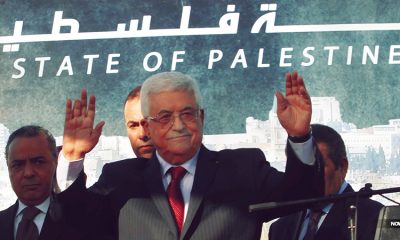
State of Palestine using new logo
“Yea, and what have ye to do with me, O Tyre, and Zidon, and all the coasts of Palestine? will ye render me a recompence? and if ye recompense me, swiftly and speedily will I return your recompence upon your own head” Joel 3:4
RAMALLAH, West Bank (AP) — With U.N. recognition of a Palestinian state in his pocket, President Mahmoud Abbas wants official documents to carry a new emblem: “State of Palestine.”
But scrapping the old “Palestinian Authority” logo is as far as Abbas is willing to go in provoking Israel. He is not rushing to change passports and ID cards Palestinians need to pass through Israeli crossings.

The very modesty of Abbas’ move to change official stationery underscores his limited options so long as Israel remains in charge of territories the world says should one day make up that state.
“At the end of the day, the Palestinian Authority won’t cause trouble for its people,” Nour Odeh, a spokeswoman for Abbas’ self-rule government, said of the need for caution.
Abbas won overwhelming U.N. General Assembly recognition for a state of Palestine in the West Bank, Gaza and east Jerusalem in late November, a rare diplomatic victory over a sidelined Israel. The U.N. nod was important to the Palestinians because it affirmed the borders of their future state in lands Israel captured in 1967.
Recognition, however, has not transformed the day-to-day lives of Palestinians, and some argue that it made things worse. In apparent retaliation for the U.N. bid, Israel in December withheld its monthly $100 million transfer of tax rebates it collects on behalf of the Palestinian Authority, further deepening the Abbas government’s financial crisis.
Since the U.N. recognition, Abbas has maneuvered between avoiding confrontation with Israel and finding small ways to change the situation on the ground.
Last week, his government press office urged journalists to refer to a state of Palestine, instead of the Palestinian Authority, the autonomy government set up two decades ago as part of interim peace deals with Israel.
Palestinian diplomatic missions around the world have been told to use the new names, including those in countries that did not vote “yes” at the General Assembly, said Omar Awadallah, a Palestinian Foreign Ministry official.
Israeli government spokesman Mark Regev dismissed the name change as pointless but declined comment on whether Israel would retaliate in any way. “Instead of looking for gimmicks, Palestinians should negotiate with Israel to bring about the end of the conflict,” he said. “That will lead to a situation of two states for two peoples.”
Israel objected to Abbas’ U.N. bid, accusing him of trying to bypass negotiations with Israel on the terms of statehood. Such talks have been frozen for more than four years because Abbas and Israeli Prime Minister Benjamin Netanyahu disagree on their parameters. Netanyahu says he is willing to cede land to a Palestinian state but will not withdraw to the 1967 lines or give up any part of east Jerusalem, the Palestinians’ desired capital.
Abbas has said negotiations remain his preferred choice, and that U.N. recognition was meant to improve his leverage with a far more powerful Israel once talks resume. Since the U.N. vote, Abbas has shied away from measures that could close the door to talks by upsetting Israel or the U.S., which also objected to his U.N. bid.
Abbas has not taken practical steps toward seeking membership for Palestine in U.N. agencies, something made possible by the November vote, and his security forces continue to coordinate with Israeli troops in tracking Islamic militants in the West Bank.
In Washington, State Department spokeswoman Victoria Nuland expressed U.S. opposition to using the term “State of Palestine.”
“You can’t create a state by rhetoric and with labels and names,” she told reporters. “You can only create a state, in this context, through bilateral negotiations.” Nuland called Abbas’ decision “provocative, without changing the condition for the Palestinian people.”
She said the U.S. peace envoy for the Mideast, David Hale, was headed to the region and would meet the Palestinian leader on Tuesday.
Some countries, such as Brazil, Costa Rica, Nicaragua and Honduras, have adopted the new name. Others, like Norway, Sweden and Spain, stick to the Palestinian Authority term even though they supported U.N. recognition.
Analysts said Abbas holds out hope that President Barack Obama will get more involved in the Israeli-Palestinian conflict in his second term and — freed from the restraints of seeking re-election — take a tougher stance toward Israel.
“He still hopes to resume peace talks in line with U.S. efforts,” Palestinian analyst Hani al-Masri said of Abbas.
“Therefore, he is making these slight changes because people expect him to make changes after the U.N. recognition.” Still, the gap between the symbolic U.N. nod and the reality on the ground remains wide.
The Palestinian Authority administers some 38 percent of the West Bank, but Israel maintains overall control over the territory. Abbas has no say in east Jerusalem, annexed by Israel in 1967, or in Gaza, seized by his political rival, the Islamic militant group Hamas, in 2007.
The documents and stationery with the new emblem will be ready within two months, said Hassan Alawi, a deputy interior minister in the Palestinian Authority.
Israeli officials declined comment Monday on whether Israel would refuse to deal with documents bearing the “State of Palestine” logo. However, Alawi said his office was informed by Israeli officials after Abbas’ decree that “they will not deal with any new form of passport or ID.”
Saeb Erekat, a senior Abbas aide, said the new emblem will be used in correspondence with countries that have recognized a state of Palestine. He suggested that there would be no change in passports or other documents Palestinians need for movement through Israeli crossings.
“As far as the Israelis are concerned, we are not going to overload the wagon of our people by putting state of Palestine on passports,” he said. “They (Israelis) will not allow them to travel.”
Palestinians must pass through Israeli-run crossings to leave the West Bank and also carry an ID card at all times or risk arrest if stopped at an Israeli military checkpoint inside the territory.
The name change has even less meaning for Palestinians in Hamas-ruled Gaza. Israel withdrew from the coastal strip in 2005 but continues to control access by air, sea and land, with the exception of one Gaza border crossing with Egypt. ”For me, it’s just ink on paper,” said Sharif Hamda, a 44-year-old pharmacist in Gaza City. “I wished they would save the money they will spend on this and use it for helping needy families.” source – Yahoo News
Jordanian Minister Accuses Israel Of Planning To Erect The Third Temple
Jan 5th
The prophet Daniel said that the Third Temple would be the Antichrist’s
“And he shall confirm the covenant with many for one week: and in the midst of the week he shall cause the sacrifice and the oblation to cease, and for the overspreading of abominations he shall make it desolate, even until the consummation, and that determined shall be poured upon the desolate.” Daniel 9:27
RELATED STORY: Understanding The Prophecy Of Daniel’s 70 Weeks
Jordanian minister accused Israel on Wednesday of planning to partition the Al-Aqsa Mosque compound in Jerusalem and the Temple Mount plaza surrounding it in order to erect the third Temple.

Only one thing stands between the Jews and the coming Third Temple. And its not the Dome of the Rock.
Islamic Endowments Minister Abdul Salam Abadi told a visiting clerical delegation from Australia that he received instructions from the “Hashemite leadership” to safeguard the Arab and Islamic identity of Jerusalem, Jordanian media reported.
Abadi said Israel was planning to divide the mosque from its courtyards with a 144-dunam structure.
Jordan, which extended its sovereignty to East Jerusalem and the West Bank in 1950, continues to administer the Islamic holy sites on the Temple Mount. Abadi told the Australian delegation that his ministry employs 600 civil servants in Jerusalem and oversees 40 Jerusalem schools.
According to the independent Jordanian daily Al-Ghad, Abadi stressed the need to support the residents of Jerusalem “in their steadfastness in the face of the repeated Israeli attacks on the holy Al-Aqsa Mosque and the Islamic holy sites in Jerusalem.”
He did not expand on what he meant.
Jordan and Israel signed a peace agreement in 1994.
Jews are banned from praying on the Temple Mount by the Jordanian department of endowments, known as the Waqf, which administers the plaza surrounding the Al-Aqsa Mosque and the Dome of the Rock.