Posts tagged Hamas
Reports In That Israel And Hamas Agree To Egyptian-Brokered Truce Deal
Nov 20th
UPDATE 12:21 PM EST…Minutes after a Hamas official told Reuters that Palestinians and Israeli had agreed to an Egyptian-brokered cease-fire, a spokesman Israel’s Prime Minister Benjamin Netanyahu said that no agreement had been reached yet. Mark Regev, the Israeli spokesman, told CNN that the negotiations are still going on.
An Israeli source told Hala Gorani of CNN that Israel is insisting on 24 hours of “calm” before agreeing to a deal. source – NY Times
Original Story ————————
We at NTEB are inclined to disbelieve the veracity of this story, but it is breaking news and we are reporting on it. Do not be surprised if rumors of a ceasefire turn out to be just that…
From Yahoo News: GAZA (Reuters) – Israel and militants from the Gaza Strip have agreed to an Egyptian-brokered ceasefire that will come into force at midnight local (2200 GMT), Hamas official Ayman Taha said, speaking to Reuters from Cairo.

Do you REALLY think that the missiles will magically cease to be fired from Gaza to Israel? If you believe that you are a….well, you know what you are.
“An agreement for calm has been reached. It will be declared at 9.00 p.m. and go into effect at midnight,” Taha said. source – Yahoo News
Hamas DARES Israel To Send In Ground Troops
Nov 20th
GAZA CITY — The top leader of Hamas dared Israel on Monday to launch a ground invasion of Gaza and dismissed diplomatic efforts to broker a cease-fire in the six-day-old conflict, as the Israeli military conducted a new wave of deadly airstrikes on the besieged Palestinian enclave, including a second hit on a 15-story building that houses media outlets. A volley of rockets fired from Gaza into southern Israel included one that hit a vacant school.
Speaking at a news conference in Cairo, where the diplomatic efforts were under way, the Hamas leader,Khaled Meshal, suggested that the Israeli infantry mobilization on the border with Gaza was a bluff on the part of Prime Minister Benjamin Netanyahu of Israel.
“If you wanted to launch it, you would have done it,” Mr. Meshal told reporters. He accused Israel of using the invasion threat as an attempt to “dictate its own terms and force us into silence.”
Rejecting Israel’s contention that Hamas had precipitated the conflict, Mr. Meshal said the burden was on the Israelis. “The demand of the people of Gaza is meeting their legimitate demands — for Israel to be restrained from its aggression, assassinations and invasions, and for the siege over Gaza to be ended,” he said.
Mr. Netanyahu met with top ministers Monday evening and Israeli media said they discussed the next steps in the Gaza conflict, including the possibility of a truce. Israeli officials declined to comment on those reports.
The Hamas Health Ministry said Monday evening that a total of 107 people had been killed since Wednesday morning, when Israeli airstrikes began, following months of Palestinian rocket fire into Israel. A spokeswoman for the Israeli military said she believed that a majority of these were militants, though it is difficult to know because Hamas’s own fighting brigade and the other factional groups are secretive.
The Hamas ministry said that the dead included at least 26 children, 10 women and 12 men over 50, who were presumably not involved in combat. Of the remainder, at least 36 are known militants. Hamas officials said more than 860 have been wounded, 260 of them children, 140 of them women and 55 men over 50.
Three people have been killed so far in Israel, all civilians, in a rocket strike that hit an apartment house in the southern Israeli town of Kiryat Malachi on Thursday morning. The Israelis have said that at least 79 Israelis have been wounded and that Gaza rockets have reached as far north as Tel Aviv.
The latest Gaza casualties — 22 people reported killed since midnight local time — included Palestinians killed in strikes by warplanes, a drone attack on two men on a motorcycle, and a father and two toddler sons in their bombed northern Gaza home, witnesses and medical sources said. Another Israeli drone attack killed the driver of a taxi hired by journalists and displaying “Press” signs, although it was not clear which journalists had hired it, Palestinian officials said.
On Sunday, Israeli forces attacked two buildings housing local broadcasters and production companies used by foreign outlets. Israeli officials denied targeting journalists, but on Monday Israeli forces again blasted the Al Sharouk block, a multiuse building where many local broadcasters, as well as Sky News of Britain and the channel Al Arabiya, had offices.
That attack, which struck a computer shop on the third floor, sparked a blaze that sent plumes of dark smoke creeping up the sides of the building. Video footage showed clouds of smoke billowing.
An Israeli bomb pummeled a home deep into the ground here on Sunday, killing 11 people, including nine in three generations of a single family, in the deadliest single strike since the latest conflict began. Members of the family were buried Monday in a rite that turned into a gesture of defiance and became a rally supporting Gaza’s militant Hamas rulers.
A militant leader said Tel Aviv, in the Israeli heartland, would be hit “over and over” and warned Israelis that their leaders were misleading them and would “take them to hell.” source – NY Times
Israel Must Retake The Gaza Strip Or Live With Endless Rocket Rain
Nov 19th
2 choices no options
Op-Ed article written by Daniel Greenfield
Seven years ago the Israeli government decided to forcibly evict the 8000 Jewish residents of Gaza and withdraw all bases and forces from the area. The experts, some with the government and some with the media, assured everyone that it would be for the best and that withdrawal would actually improve the security situation in the country.
It was put about that resources and lives were being wasted protecting Israelis living in Gaza, while those Israelis insisted that their presence in Gaza was protecting Tel Aviv and Jerusalem. The experts laughed at them. Now the experts are keeping an ear open for air raid sirens because as it turned out, those farmers and teachers, those men and women growing lettuce in greenhouses and building homes on hilltops, from which rockets are being launched, were the ones protecting Tel Aviv.
“They are now being asked to relinquish these accomplishments for the greater good,” the government press release said of their houses and farms, of their synagogues and greenhouses. And the greater good was served. The greenhouses were turned into Hamas training camps and the synagogues were burnt to the ground. Rockets fly into the air from the ruins of broken houses.
No longer will your sons have to die in Gaza, the experts said. A month later rockets were falling on Sderot. A year later Gilad Shalit had been kidnapped and Israeli soldiers were back again, dying in a Gaza that was now run by Hamas.
Among the bundle of promises from the Sharon government, was that the Gaza withdrawal was part of an oral agreement with the United States limiting further withdrawals and concessions. That agreement lasted for another few years until Obama took office and no one in his administration could ever remember such an agreement or accept its validity.
“The moment of truth has arrived,” Netanyahu said, on resigning from the Sharon government. “At the moment of truth, a man – especially a leader – must ask himself: ‘What are you doing, what do you stand for, what are you fighting for?’”
These moments of truth come fast and furious in Israel, but hardly anyone waits around for an answer. Not even Netanyahu, who knows better.
Hamas’ objectives have always been straightforward. Its commanders and suicide bombers, its militia members, bomb experts, smugglers, launchers and embezzlers know what they are fighting for.
“Our struggle against the Jews is extremely wide-ranging and grave,” the Hamas charter says. “Israel, by virtue of its being Jewish and of having a Jewish population, defies Islam and the Muslims.” It has the simplicity that you would expect from the Muslim Brotherhood, a fascist organization that drew equal inspiration from the Koran and Nazism.
What however is Israel fighting for? Since Oslo, the slogan of Israeli moderate conservatives has been “Peace with Security” even though it was quite clear that you could pursue peace and have neither peace nor security, or you could pursue security and have peace. Their slogan was muddled and their policies even more so.
Israel may have superior firepower, but like most Western countries, its policymakers are too muddled to be able to apply that firepower in a useful way. The limited scale warfare that has been adopted by America, including drone assassinations and extensive security measures, came out of Israel’s futile efforts to find a more humanitarian style of warfare that would limit civilian and military casualties. But all that these measures really did was make life with terror more manageable.
Withdrawals and a variety of defensive measures such as Iron Dome made it seem like Israel could maintain the status quo. Peace with Security meant no peace and no security, but enough of the illusion of both that it would seem as if the slogan had been fulfilled. Suicide bombings dropped and the terrorists were forced to resort to rocket attacks and drive-by shootings with much lower casualty rates. Rates so low that those who didn’t live in Sderot or Samaria could ignore them.
Instead of ending the threat, Israeli conservatives had found a way to live with the pain of terrorism while turning their focus to economic reforms. The left, with its emphasis on finding a permanent solution through appeasement and withdrawals, was discredited and collapsed. But the problem had not gone away.
While Israel slept, the makeup of the region changed. Hamas had formerly been strongly backed by Syria and Iran, with some support from more distant Islamist Gulf states such as Saudi Arabia and Qatar. Egypt and Jordan were both wary of Hamas because their governments were concerned about being overthrown by the Muslim Brotherhood.
The Arab Spring put Islamists into power in Egypt. Suddenly the Muslim Brotherhood was running things on both sides of the Rafah Crossing. Hamas switched its allegiance from the shaky Shiite axis of Iran, Syria and Iraq over to the rising Sunni Islamist axis of Saudi Arabia, Qatar, Turkey and Egypt. The Islamist terrorist group was no longer an isolated arm of Iranian foreign policy, it could count on the backing of Turkey, Qatar and Egypt.
Not long after Qatar’s leader paid a visit to Hamas, this latest war began. Like so many conflicts with terrorist groups, it isn’t about any specific domestic objective. The objectives are regional and now international. Egypt’s Muslim Brotherhood regime is looking shaky and the Gaza lifeline has come at a perfect time, allowing Morsi to turn the attention of Egyptians away from the shaky economy and some dubious proposals, including early store closings, over to familiar territory denouncing Israel.
Under Iran or Egypt, Hamas is not fighting for Palestinian nationalism, which was already a fiction manufactured by Soviet propagandists looking up to prop up a Greater Syria, but to support the aims of Iranian and Egyptian domestic policy. And suddenly those aims were uncomfortably close.
Terrorist militias serve an ideology, but function as a business. Al Qaeda, Hamas, Fatah or any other of the many groups blanketing the region, need money and weapons to be viable. They need state sponsors and the states that sponsor them want something in return. Terrorist groups find sponsors the way that Renaissance artists found patrons, they show off their skills and wait for someone to come calling with money and guns. And then they perform for their patrons.
Israel’s terrorist problem is unsolvable through any form of peace negotiations because there will always be sponsors. A terrorist group may sign a peace agreement, but then it quickly gets on the phone to its sponsors to assure them that it will go on committing acts of terror. Its militias are spun off into “separatist” or “splinter” groups that go on doing what they did before. And the group then asks its new friend American and Israeli friends for guns and money to fight these extremists. That way the terrorist groups get twice the money for terrorism and a farce of counter-terrorism.
Even if a terrorist leader is sincere, his movement is nothing but an umbrella group for terrorist militias. If the umbrella group stops funneling money from state sponsors to local militias, the militias go into business for themselves. And there is such a demand by sponsors for more and more “extreme” militias, that even the existing terrorist groups find themselves having to compete with newer and more violently Islamist militias.
Peace is useless and hopeless under these conditions. Fatah claimed that it could not control Hamas. Hamas claims it cannot control the men shooting rockets out of Gaza. The people shooting rockets out of Gaza will claim that they cannot control their fingers on the trigger. It’s plausible deniability all the way down when it’s convenient, but the real control is in the hands of regional regimes who feed coins into the slot and get out terrorism.
So what then is Israel fighting for? Peace with security. Which means slapping down Hamas hard enough that it will have to wait another 3-4 years before trying the same thing again, this time with bigger and better rockets. That was the policy six years ago and it’s the policy today.
Israel will bomb Hamas targets, kill some of its senior leaders and destroy some of its weapons stockpiles. Its soldiers will enter Gaza, arrest some more senior leaders, walk into traps that will kill some of its best and brightest, and then withdraw again while Hamas celebrates its victory in the Battle of XX or YY where five or six Israeli soldiers were killed, along with ten or fifteen Hamas terrorists. And then the Battle of XX will become the Massacre of XX and lead to a documentary that will be doing an extended tour of American and Canadian campuses during the next Israeli Apartheid Week.
This is the status quo and it cannot be maintained indefinitely. The air raid sirens going off in Tel Aviv and Jerusalem warn that the war is heading into unsustainable territory. As Iran goes nuclear, Hizbullah is trying to become another Iran and Hamas is trying to become another Hizbullah. It is not a nuisance that can be ignored. Israel has no answer to the growing threat except to try and contain it through the same old methods that have now put Jerusalem and Tel Aviv into the line of fire.
Since 1992, Israel has been retreating and those retreats have replaced secure borders with borders of terror. Rather than reversing those withdrawals, the right has been satisfied with trying to stabilize them. But that has only created safe spaces for terror while setting the stage for the next round of retreats by the left which will create even broader territories of terror. These territories are staging areas for the next invasion, which will come not from Hamas, but a Muslim Brotherhood Egypt and an Islamist Turkey, once Israel has been sufficiently softened up.
The only way to end the threat of Hamas in Gaza is by retaking Gaza, but no such policy is on the table. Like America, Israel responds to terrorism not with the aim of achieving decisive victories, but with a policy of intimidating the terrorists into scaling down their attacks. This is a political policy of political generals and leads to terror becoming a permanent institution.
Israel has tried negotiating its way out of the terrorist trap. It has not tried fighting its way out. Israel has tried to escape the occupation, but in a region where you are either the occupier or the occupied, it may have no choice.
Any moment of truth must begin and end with a realistic assessment of the realities that you face. Israel faces a proxy war by its neighbors and like most proxy wars, it is the opening round to a true war ending in true occupation and genocide.
Its neighbors know what they are fighting for. They are fighting Israel for the same reason that Shiites fight Sunnis and that Sunnis persecute Christians. They are fighting Israel because “by virtue of its being Jewish and of having a Jewish population” it is different and must be crushed for the national and religious aims of any proper Islamist country.
But what is Israel fighting for? Like so many modern countries it is fighting so as not to fight. It is fighting for peace. It is fighting to escape from fighting. And so like many modern countries it cannot bring itself to fight hard enough to break the cycle. Instead it fights just hard enough to defer the fight by another few years and the cycle continues.
Israel can retake Gaza once. Or it can retake Gaza every few years. It can have soldiers patrol Gaza or it can have rockets falling on Tel Aviv and Jerusalem. The options are as unfortunate as they are clear. The only hope for peace lies in driving out the terrorist militias who have turned Gaza and the West Bank into their own Somalia and Afghanistan and reclaiming the territory. Because after this fight is through, the next generation of rockets will go on being built and smuggled. And they will not fall in empty fields.
There can be farms and greenhouses on the hilltops of Gaza. Or there can be rockets. source – Israeli National News
Helping Hamas Obama Demands Israel DELAY Gaza Ground Operation
Nov 19th
Terrorist sympathizer Barack Hussein Obama
Obama knows how to play the game. He SAYS he “supports Israel’s right to defend itself”, so that his quote gets printed and archived. He is then on record as saying he “supports Israel”. Then, right after he says those words that he so obviously doesn’t mean, he goes and does what is really his heart – stopping Israel from defeating the Hamas terrorists.
From DEBKA: Prime Minister Binyamin Netanyahu, Defense Minister Ehud Barak and Foreign Minister Avigdor Lieberman conferred urgently Sunday night, Nov. 18 – Day 5 of the Gaza offensive – on how to respond to US President Barack Obama’s insistent demand that they delay a major IDF ground operation in the Gaza Strip.
DEBKAfile’s sources disclose that when Obama spoke to Egyptian President Mohamed Morsi Friday, Nov. 16 – after receiving an update from Netanyahu – he gave him a 48-hour window for talking Hamas around to a ceasefire.
Not only has the Egyptian president failed in this task, his bid made matters worse:
Hamas understood the US president was leaning hard on Israel to refrain from sending troops into the Gaza Strip and took advantage of the respite to redouble its missile barrage on a dozen Israeli locations in the last three days, including Tel Aviv and Jerusalem.
Following his talks with Morsi and Netanyahu, Obama referred in Bangkok Sunday to “the next 24, 36, 48 hours as crucial; Israel responded to his request to send two senior envoys to Cairo – a high-ranking military officer and an intelligence official - take part in the ceasefire negotiations.
However, Hamas turned down all the truce proposals on the table, leaving Israel with three options:
1. To delay the ground action until Wednesday although it was poised to go forward Sunday night - even though the US president may be expected to stand by his objections then too;
2. To go ahead and launch the ground stage of the military offensive over those objections; or
3. To conduct a series of ground sorties inside the Gaza Strip to test the ground there without delay. source – DEBKA
Hamas Says ‘NO’ To Ceasefire, IDF Launches Fresh Assaults In Gaza
Nov 18th
No ceasefire as battle to stop Gaza missile strikes continues
Israeli air and naval forces launched heavy assaults in Gaza before dawn Sunday, Nov. 18 – Day 5 of the IDF’s Gaza operation – after daylong bargaining Saturday among Washington, Jerusalem, Cairo and Gaza, failed to produce an Israel-Hamas truce accord.

OC Southern Command, Maj. Gen. Tal Rousso defined those objectives to reporters Saturday night as “eliminating the war arsenals of Hamas and terrorist organizations and restoring peace and normality to the population of southern Israel.”
When Egyptian and Turkish middlemen suggested a ceasefire was close, Israel accused them of pushing Hamas’s terms which were fashioned to present the Palestinian radicals as the victor in the contest. The trio leading the Israeli war, Prime Minister Binyamin Netanyahu, Defense Minister Ehud Barak and Foreign Minister Avigdor Lieberman, countered by intensifying the IDF’s Gaza offensive – though not as yet sending ground troops in.
A Western source said it would take some days to determine if a ceasefire was feasible. Egyptian intelligence meanwhile smuggled Hamas Prime Minister Islmail Haniyeh out of Gaza and over to El Arish in northern Sinai in the convoy of visiting Tunisian Foreign Minister Rafiq Abdessalem when he departed Gaza Saturday, DEBKAfile reports.
Friday night, Israel bombers struck government headquarters in Gaza City.
Egyptian President Mohamed Morsi decided that Haniyeh must be continuously available at the end of a phone to lead the Hamas side in the ceasefire negotiations. This was not possible so long as the Hamas prime minister remained in Gaza. All of Hamas leaders have gone to ground for fear of targeted assassination by Israel. They have switched off their phones and electronic communications to avoid giving away their locations to Israeli surveillance. Haniyeh was even afraid to communicate with Cairo through the Egyptian military mission in Gaza.
In these circumstances, Morsi and Erdogan’s were prevented from get their ceasefire mediation bid off the ground. Moving Haniyeh to El Arish put a Hamas negotiator in place to lead the give-and-take for a truce. Our sources have not discovered if he is still there or has moved back to Gaza.
The Turkish prime minister brought a secret passenger in the plane bringing him to Cairo Saturday. He is Saleh Aruri, formerly of the Hamas military wing. Aruri had spent 15 years in an Israeli prison for terrorism and murder until he was released on Oct. 18, 2011 in the prisoner exchange for the Israeli soldier Gilead Shalit on condition he went into exile.
Turkey granted him asylum and its intelligence agency MIT gave him free rein to set up an operational command in Istanbul for Hamas terrorist networks on the West Bank. On arrival in Cairo, the Turkish prime minister put Aruri in charge of the contacts with Haniyeh.
At a news conference in Cairo Saturday night, the Egyptian president and Turkish prime minister reported “some indications that there could be a ceasefire soon” although “there were still no guarantees.”
The guarantees issue has become a pivotal bargaining point.
Israel, backed by the United States, insists that a ceasefire be signed between the US, Egypt, Turkey and Israel, and exclude Hamas, which would be bound by a separate agreement with Cairo.
Netanyahu, Barak and Lieberman are asking the United States to act as guarantor for a ceasefire. Erdogan has countered by inviting Russian President Vladimir Putin to join US President Barack Obama as victor.
Hamas has rejected all of Israel’s terms.
During the night, Israel denied reports circulating in Cairo that an Israeli negotiator was heading for the Egyptian capital to get down to the specifics of an emerging truce deal. The three Israeli war leaders decided not to fall into the trap laid by Morsi and Erdogan. Instead, they told the IDF to press ahead with the operation until its objectives were attained – hence the launching of a fresh air and sea assault before daybreak Sunday.
OC Southern Command, Maj. Gen. Tal Rousso defined those objectives to reporters Saturday night as “eliminating the war arsenals of Hamas and terrorist organizations and restoring peace and normality to the population of southern Israel.”
The ground operation is meanwhile delayed, in accordance with Netanyahu’s promise to President Obama in their conversation early Saturday, that a full-scale ground invasion would not go forward so long as there was a chance of a ceasefire – unless there was escalation from Hamas or a strike that caused significant casualties.
A western source in Cairo familiar with the truce negotiations reported that Obama has not yet decided whether he wants to be directly involved in any ceasefire deal, which in any case has not reached the concluding stage. “The cake dough is still being kneaded and not yet ready to for the oven,” he said. source – DEBKA
Iron Dome Stops Rocket Over Tel Aviv In Mid-flight
Nov 18th
Iron Dome gets the job done
GAZA/JERUSALEM (Reuters) – Israeli aircraft bombed Hamas government buildings in Gaza, and the “Iron Dome” defense system shot down a Tel Aviv-bound rocket on Saturday as Israel geared up for a possible ground invasion.
Hamas, the Palestinian Islamist group that runs the Gaza Strip, said Israeli missiles wrecked the office building of Prime Minister Ismail Haniyeh – where he had met on Friday with the Egyptian prime minister – and struck a police headquarters.
Along the Tel Aviv beachfront, volleyball games came to an abrupt halt and people crouched as sirens sounded. Two interceptor rockets streaked into the sky. A flash and an explosion followed as Iron Dome, deployed only hours earlier near the city, destroyed the incoming projectile in mid-air.

Associated Press/Ahikam Seri – An Israeli Iron Dome missile is launched near the city of Be’er Sheva, southern Israel, to intercept a rocket fired from Gaza Saturday, Nov. 17, 2012. Israel bombarded the Hamas-ruled Gaza Strip with nearly 200 airstrikes early Saturday, the military said, widening a blistering assault on Gaza rocket operations to include the prime minister’s headquarters, a police compound and a vast network of smuggling tunnels. (AP Photo/Ahikam Seri) Yahoo News
With Israeli tanks and artillery positioned along the Gaza border and no end in sight to hostilities now in their fourth day, Tunisia’s foreign minister traveled to the enclave in a show of Arab solidarity. source – Yahoo News
AM YISRAEL CHAI! Israel Defends Jerusalem With Fresh Wave Of Air Strikes Over Gaza
Nov 17th
Over 200 air strikes hit back at terrorists
“”Pray for the peace of Jerusalem: they shall prosper that love thee.” Psalms 122:6
GAZA CITY, Gaza Strip (AP) — Israel bombarded the Hamas-ruled Gaza Strip with nearly 200 airstrikes early Saturday, the military said, widening a blistering assault on Gaza rocket operations to include the prime minister’s headquarters, a police compound and a vast network of smuggling tunnels.

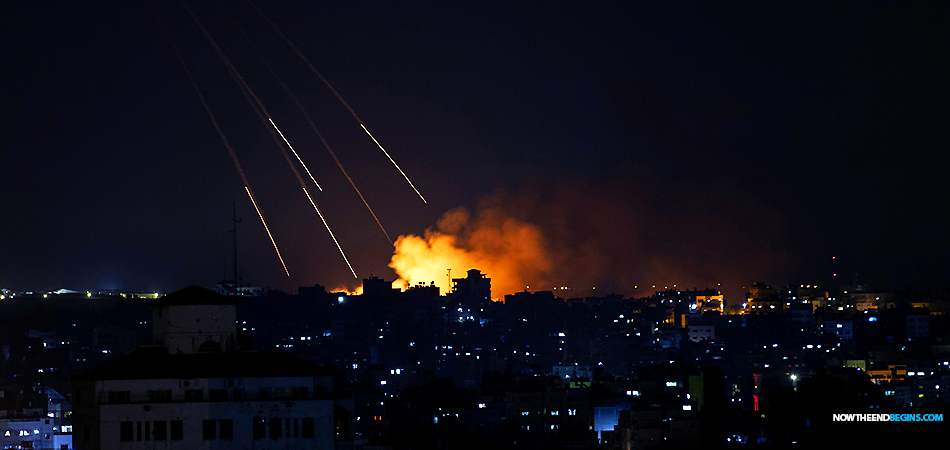
Associated Press/Ariel Schalit – Explosion and smoke rise following an Israeli strike in Gaza, seen from the Israel Gaza Border, southern Israel, Saturday, Nov. 17, 2012. Israel bombarded the Hamas-ruled Gaza Strip with more than 180 airstrikes early Saturday, the military said, widening a blistering assault on militant operations to include the prime minister’s headquarters, a police compound and a vast network of smuggling tunnels. The new attacks followed an unprecedented rocket strike aimed at the contested holy city of Jerusalem that raised the stakes in Israel’s violent confrontation with Palestinian militants. (AP Photo/Ariel Schalit)
The new attacks, which Gaza officials say left 10 dead, followed an unprecedented rocket strike aimed at the contested holy city of Jerusalem that raised the stakes in Israel’s violent confrontation with Palestinian militants and extended the battlefield.
Israeli aircraft also kept pounding their original targets, the militants’ weapons storage facilities and underground rocket launching sites. They also went after rocket squads more aggressively. The military has called up thousands of reservists and massed troops, tanks and other armored vehicles along the border with Gaza, signaling a ground invasion could be imminent.
Militants, undaunted by the heavy damage the Israeli attacks have inflicted, have unleashed some 500 rockets against the Jewish state, including new, longer-range weapons turned for the first time this week against Jerusalem and the Tel Aviv heartland. Following those attacks, the military deployed an Iron Dome rocket defense battery in central Israel on Saturday. The system, devised precisely to deflect the Gaza rocket threat, was deployed two months earlier than planned, the Defense Ministry said.
Ten people, including eight militants, were killed and dozens were wounded in the various attacks early Saturday, Gaza health official Ashraf al-Kidra said. In all, 40 Palestinians including 13 civilians and three Israeli civilians have been killed since the Israeli operation began.
The violence has widened the instability gripping the Mideast. At the same time, revolts against entrenched regional regimes have opened up new possibilities for Hamas. Islamists across the Mideast have been strengthened, bringing newfound recognition to Hamas, shunned by the international community because of its refusal to recognize Israel and renounce violence.
A high-level Tunisian delegation, led by Foreign Minister Rafik Abdessalem, drove that point home with a visit to Gaza on Saturday. The foreign minister’s first stop was the still-smoldering ruins of the three-story office building of Gaza’s prime minister, Ismail Haniyeh of Hamas.
“Israel has to understand that there is an international law and it has to respect the international law to stop the aggression against the Palestinian people,” Abdessalem told The Associated Press during a tour of Gaza’s main hospital, Shifa, later Saturday. He said his country was doing whatever it can to promote a cease-fire, but did not elaborate.
It was the first official Tunisian visit since Hamas’s violent 2007 takeover of the territory. Egypt’s prime minister visited Friday and a Moroccan delegation is due on Sunday, following a landmark visit by Qatar’s leader last month that implied political recognition.
Israel had been incrementally expanding its operation beyond military targets but before dawn on Saturday it ramped that up dramatically, hitting Hamas symbols of power. Israeli defense officials, speaking on condition of anonymity to discuss confidential decisions, said military chief Lt. Gen. Benny Gantz personally ordered the scope of the airstrikes to be increased.
Haniyeh’s three-story office building was flattened by an airstrike that blew out windows in neighboring homes. He was not inside the building at the time. The building’s security chief said Hamas scored points despite Israel’s military superiority.
“Hamas responded to the Zionist aggression and hit them in the depth of their land,” he said, referring to rockets aimed Friday at Jerusalem and Tel Aviv.
Another airstrike brought down the three-story home of a Hamas commander in the Jebaliya refugee camp near Gaza City, critically wounding him and injuring other residents of the building, medics said.
Missiles smashed into two small security facilities and the massive Hamas police headquarters in Gaza City, setting off a huge blaze that engulfed nearby houses and civilian cars parked outside, the Interior Ministry reported. No one was inside the buildings.
The Interior Ministry said a government compound was also hit while devout Muslims streamed to the area for early morning prayers, although it did not report any casualties from that attack.
Air attacks knocked out five electricity transformers, cutting off power to more than 400,000 people in southern Gaza, according to the Gaza electricity distribution company. People switched on backup generators for limited electrical supplies.
In southern Gaza, aircraft went after underground tunnels militants use to smuggle in weapons and other contraband from Egypt, residents reported. A huge explosion in the area sent buildings shuddering in the Egyptian city of El-Arish, 45 kilometers (30 miles) away, an Associated Press correspondent there reported.
The Israeli military said more than 800 targets have been struck since the operation began
The widened scope of targets brings the scale of fighting closer to that of the war the two groups waged four years ago. Hamas was badly bruised during that conflict, but has since restocked its arsenal with more and better weapons, and has been under pressure from smaller, more militant groups to prove its commitment to fighting Israel.
The attack aimed at Jerusalem on Friday and two strikes on metropolitan Tel Aviv showcased the militants’ new capabilities, including a locally made rocket that appears to have taken Israeli defense officials by surprise. Both areas had remained outside the gunmen’s reach before.
Just a few years ago, Palestinian rockets were limited to crude devices manufactured in Gaza. But in recent years, Israeli officials say, Hamas and other armed groups have smuggled in sophisticated, longer-range rockets from Iran and Libya.
Israeli leaders have threatened to widen the operation even further if the rocket fire doesn’t halt. Foreign Minister Avigdor Lieberman said options included the possible assassination of Haniyeh, the prime minister.
Israeli Prime Minister Benjamin Netanyahu met in emergency session with Cabinet ministers Friday and they approved mobilizing up to 75,000 reservists, more than doubling the number authorized earlier this week. That would be the largest call-up in a decade. At a parking lot in central Israel, uniformed reservists waited to board buses. One prayed, covered in a Jewish prayer shawl.
Lt. Col. Avital Leibovich, a military spokeswoman, said 16,000 reservists were called to duty on Friday and others could soon follow. She said no decision had been made on a ground offensive but all options are on the table.
President Barack Obama spoke separately to Israeli and Egyptian leaders Friday as the violence in Gaza intensified. In a conversation with Israeli Prime Minister Benjamin Netanyahu, he reiterated U.S. support for Israel’s right to self-defense. To Egyptian President Mohammed Morsi, he praised Egypt’s efforts to ease regional tensions. source – Yahoo News