Posts tagged debka
Israeli Forces On High Alert As Syrian Gunfire Hits Israeli Military Vehicle On Golan
Nov 6th
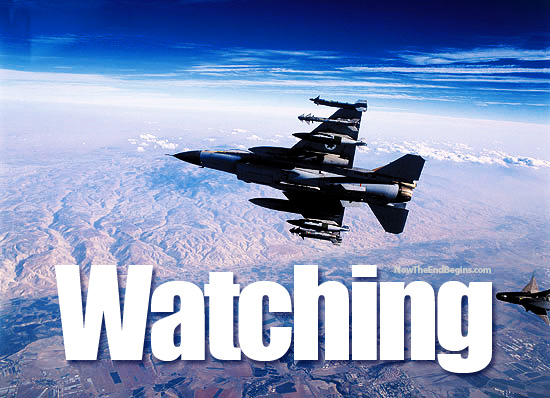
Israeli air force on high alert
Tension shot up on the Israeli-Syrian Golan border Monday night, Nov. 5, after Syrian small-arms fire from 1 kilometer over the Golan border hit the jeep of the Golani Brigade’s Patrol Battalion commander on a routine border patrol. There were no injuries. The jeep was badly damaged. DEBKAfile’s military sources: The incident occurred after a gunfight between Syrian troops and rebels over the Golan town of Quneitra ended in the town falling to the rebels.
Israeli air force planes are patrolling the Golan and Galilee skies of northern Israel after the Syrians were observed preparing aircraft and helicopters to fly to the aid of their defeated ground forces in Quneitra.
After the Syrian army’s 90th Brigade was forced to retreat, Damascus is reported by Western sources about to send reinforcements over to the Golan to recover Quneitra. IDF contingents on the Golan and the Israeli-Lebanese border are high alert in case the Syrian combat spills over the border.
DEBKAfile reported Sunday: Israeli warplanes flew over the divided Golan Sunday, Nov. 4, in a show of strength and as a deterrent against the Syrian civil war seeping across the border,DEBKAfile’s military and Western intelligence sources report. In Paris, President Francois Hollande vowed Sunday that “France would oppose with all its strength any bid to destabilize Lebanon. Lebanon must be protected.”
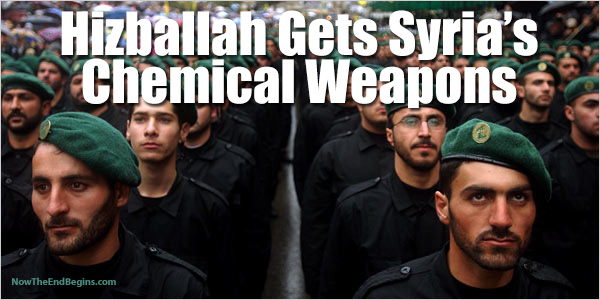
He spoke regardless of the 5,000 Lebanese Shiite Hizballah fighters who have poured into Syria from their Beqaa Valley stronghold of al-Harmel to fight Bashar Assad’s war. Our sources reveal that these Lebanese fighters have now advanced 50-60 kilometers deep into southwestern Syria, up to the outskirts of the embattled town of Homs.
On the Golan, further to the east, Israel’s chief of staff Lt. Gen. Benny Gantz visited the IDF contingent stationed there to reinforce the message broadcast by the IAF. Hizballah is now openly flaunting the presence of its regular troops in Syria. They are armed with heavy artillery and Chinese WS-1 multiple-launch rocket systems made in Iran. These “Katyushas,” shoot 302mm rockets at targets up to 100 kilometers away and can operate in the rugged mountain terrain of Lebanon, Syria and Israel and in harsh weather conditions, including snow.
Hizballah fighters are reported by our sources to have already used this weapon with deadly effect in a battle with Syrian rebels over the town of Quseir opposite the Lebanese Beqaa Valley. It ended in Hizbalah’s capture of the town.
Coordination is tight: Hizballah forces on the ground get in touch with Iranian command headquarters in Beirut and Damascus to call up Syrian helicopters for air cover. The Hizballah commander in Syria is Ibrahim Aqil, a veteran of the Hizballah militia and one of the most trusted by Hassan Nasrallah and Tehran.
Aqil took part in the 1983 assault on US Marines Beirut headquarters in which 241 American troops were killed, the highest death toll in a single event after World War II. In the year 2000, Aqil, then commander of the southern Lebanese front against Israel, orchestrated the kidnap from Israeli territory and murder of three Israeli soldiers, Benny Avraham, Adi Avitan and Omar Sawad.
Hizballah’s expeditionary force in Syria has been assigned three missions:
1. To seal off the routes used by the rebels to smuggle fighters and arms from Lebanon into Syria, most of which run through the Beqaa Valley. This mission is near completion.
2. To defend the clusters of Syrian Alawite and Shiite villages in the area of Hizballah control.
3. To provide a strategic reserve force for the Syrian units defending the main hubs of Syrian highways running west to east from the Mediterranean coast to the Syrian-Iraqi border and crisscrossed from north to south by the route running from the Turkish border up to Damascus. Control of these hubs makes it possible for the Syrian army to move military forces between the different warfronts at high speed. source – DEBKA
Firepower! Five Air Forces Set To Attack Libya
Mar 17th
On the wings of eagles
Shortly before the UN Security Council met Thursday, March 17, to discuss a no-fly zone resolution for Libya, Moscow promised Washington and other Western capitals not to apply a veto, debkafile’s sources report exclusively.
The US, British, French, UAE and Qatar air forces were on standby to attack Libyan army targets as soon as the resolution is passed. If attacked, Libya threatens retaliation against civilian and military targets in Europe and the Middle East, according to a statement from the Defense Ministry in Tripoli..
In Tunis, US Secretary of State Hillary Clinton explained that a UN no-fly zone over Libya “would require the bombing of targets to take out the threat posed by Muammar Qaddafi’s regime.”
She spoke after Cairo rejected Washington’s request for the use of Egyptian air bases to enforce the no fly zone against Libya and from which to launch US air attacks on Qaddafi’s army. This too is disclosed by debkafile’s exclusive sources.
Earlier Thursday, March 17, debkafile reported: Shortly before she left Egypt for Tunis Wednesday, March 16, US Secretary of State Hillary Clinton urgently asked the head of Egypt’s military junta Field Marshal Mohammed Tantawi for permission to use Egyptian air bases for American military jets to enforce a no-fly zone over Libya. This is reported exclusively by debkafile’s military and Washington sources.
Clinton told Tantawi she hoped for UN Security Council approval of the no-fly zone at its special session Thursday March 17. But this might not be enough to stop Muammar Qaddafi’s advance and the US might have to resort to military action against his army. She did not elaborate on this. In Tunis, she said later that a UN no-fly zone over Libya would require the bombing of targets to take out the threat posed by Muammar Qaddafi’s regime.” source – DEBKA
Hezbollah Team Breaks 22 Members Out of Egyptian Jail
Feb 4th
Criminals on the loose and back in Gaza
A joint Hizballah-Hamas unit used the havoc in Egypt to storm the Wadi Natrun prison north of Cairo Sunday, Jan. 30, and break out 22 members of the Hizballah’s spy-cum-terror network, tried and convicted in Egypt for plotting terrorist attacks in Cairo, the Suez Canal and Suez cities and on Israeli vacationers in Sinai in 2007-2008. This is reported by debkafile’s counter-terror sources.

With all the distraction created by the riots, Hezbollah used the opportunity to free 22 of their members from an Egyptian jail.
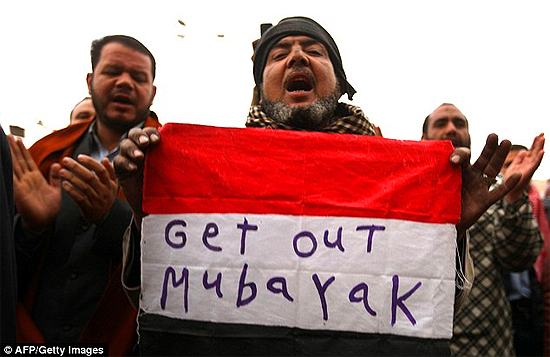
The second object of the break-in was to release Muslim Brotherhood inmates to boost the anti-Mubarak street protests now in their second week across Egypt. In April 2009, Hezbollah’s leader Hassan Nasrallah admitted he had sent Sami Shehab to Egypt to establish the network. It soon became one of the most dangerous terrorist cells ever to be exposed in the region in recent years. Among its members were also combatants of the radical Palestinian Hamas.
Thursday, Feb. 3, Mahmoud Qmati, Hizballah member of the Lebanese parliament, was glad to announce that all 22 members of the network, including its leader Sami Shehab, had been freed from jail and returned home safely. He provided no information on how this happened. DEBKAfile rounds out the picture.
The unit assigned by Nasrallah for the jail-break consisted of 25 trained Hizballah and Hamas gunmen. When the riots erupted in Egypt, they started making their way from Gaza to Egypt via smuggling tunnels. On the way, they picked up weapons and explosives in El Arish, northern Sinai, under cover of an onslaught armed Palestinians and Bedouin had launched against Egyptian security forces – partly for this purpose.
The break-out team was met at the Suez Canal by Muslim Brotherhood activists who ferried them across to Ismailia on the western bank by Egyptian smuggling boats. From there, they were driven to the Wadi Natrun prison, one of the largest in Egypt, to be briefed outside by former MB inmates on the guard and security arrangements in the jail and the locations of the cells holding the Hizballah, Hamas and Brotherhood convicts.
After days of surveillance, the team struck. Explosives and missile-launched grenades flattened the outer gates killing at least 30 Egyptian prison guards who tried to fight them off. Small explosive devices were used to smash internal gates and clear the way to the cells. To expedite the escape of a large number of prisoners, they also blew big holes in the prison’s outer walls. Outside, they were collected by a large convoy of trucks and buses brought in by the Muslim Brotherhood which distributed its freed members around the disturbance hubs in Cairo.
A smaller convoy of minivans carrying the 22 Hizballah and Hamas convicts and their liberators made its way by various routes past Egyptian security forces, who were fully engaged with the protest riots, to Sinai and onto the Gaza Strip. As soon as the escape was discovered, Egyptian forces in Sinai and Israeli forces on the Egyptian border deployed in an effort to stop them entering Gaza, but were too late.
This audacious Hizballah-Hamas attack on the Egyptian prison was the first major quasi-military operation they had ever carried out deep inside Egypt. source – DEBKA